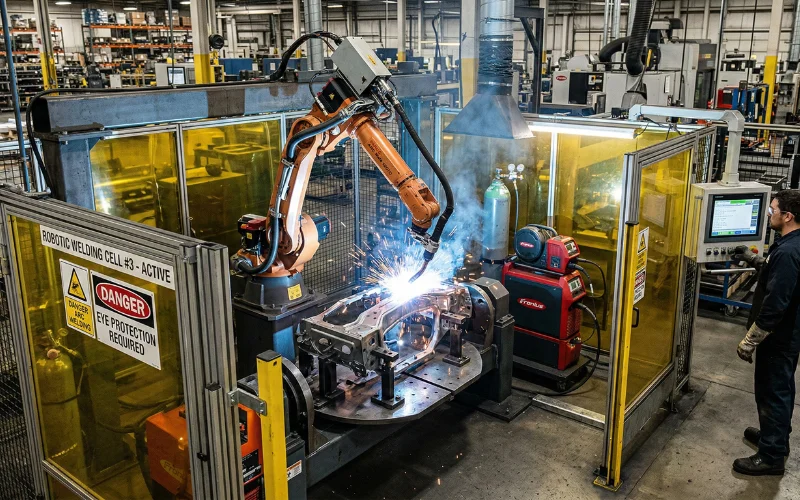
A robotic welding cell is only as precise as its weakest mechanical link. Modern welding robots hold repeatability tolerances of ±0.05 to ±0.1 mm — tight enough to land a weld bead with surgical consistency across an entire production shift. But in most automotive and industrial fabrication environments, that robot precision doesn’t make it to the weld joint. Something between the robot and the workpiece absorbs it. More often than fixture designers expect, that something is the rod end.
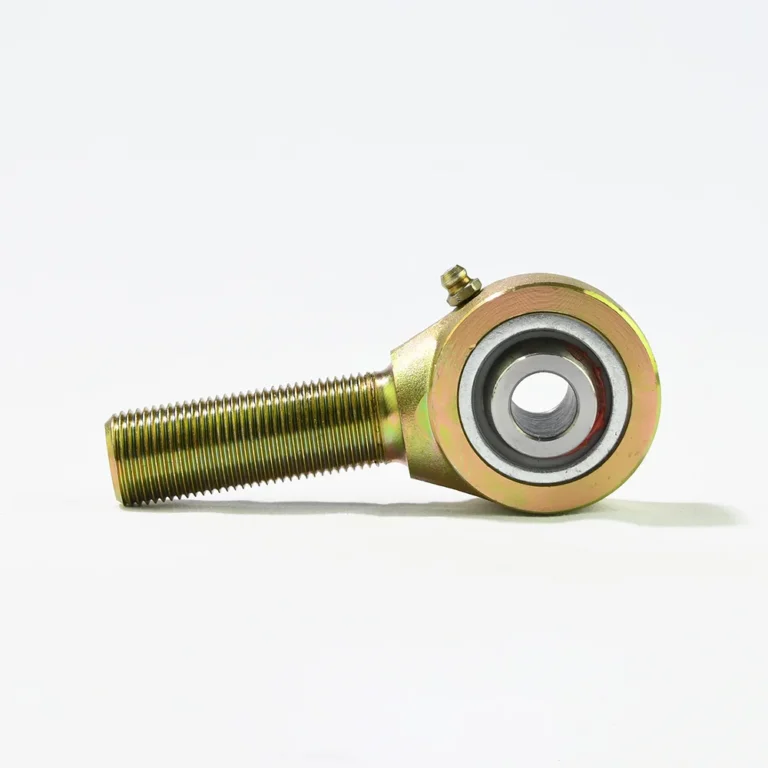
Rod ends sit at pivot points, clamping arms, positioner linkages, and adjustment mechanisms throughout a welding fixture. They’re compact, load-bearing, and easily overlooked during the design phase — until the fixture starts producing out-of-tolerance welds three months into production. By then, the problem is often misdiagnosed as robot drift, tooling wear, or thermal distortion. The rod ends are rarely the first thing anyone checks.
The Precision Chain Problem: Why Every Joint Matters
Robotic welding fixtures are precision motion systems. A robot arm positions a torch to within ±0.05 mm. The fixture holds the workpiece to within ±0.1 mm. The cumulative tolerance at the weld joint — the actual number that determines whether the bead lands correctly — is the sum of every mechanical link in between.
In a typical BIW (body-in-white) fixture, that chain includes locating pins, clamp arms, toggle mechanisms, and positioner linkages. Each link adds tolerance. Each pivot joint introduces potential for play. Common industry practice, reflected in standards including AIAG CQI-15, requires that weld joint positioning be maintained within ±half the welding wire diameter — for standard 0.045″ wire, that’s ±0.022″ (roughly ±0.56 mm). For finer wire gauges used in aluminum BIW work, the window narrows further.
Rod ends contribute to this tolerance chain at every articulated joint. A well-specified, freshly installed rod end introduces very little play — but “very little” is not zero. Standard industrial rod ends carry a defined radial clearance of roughly 0.03 to 0.05 mm. In a system where the robot’s repeatability envelope is ±0.05 mm, that clearance alone consumes a significant portion of the entire positional budget — before accounting for any wear. In the highest-precision welding applications, this is worth addressing at the design stage: zero-clearance or pre-loaded rod end variants exist specifically for robotic systems where standard clearances eat into the tolerance chain from day one.
A worn rod end, or one that was undersized from the start, makes this worse fast. Multiply backlash across several clamp arm pivots and a positioner linkage, and the fixture that held ±0.1 mm at commissioning now struggles to hold ±0.3 mm. The robot is still accurate. The fixture isn’t.
A Welding Environment Is Harder on Rod Ends Than Most Machine Applications
Welding fixtures don’t operate in controlled conditions. They cycle constantly — in high-volume automotive production, a single fixture may complete 4,000 to 6,000 open-close cycles per shift. Between each cycle: a burst of radiant heat from the arc, weld spatter at 1,400–1,600°C, vibration from electrode contact, and mechanical shock from clamp actuation.
Most rod end specifications cover static load and misalignment angle. Fewer address what happens in a welding environment specifically.
Heat, Spatter, and Thermal Stress
Weld spatter reaching a rod end isn’t just a contamination problem — it’s a thermal event. A spatter particle landing on or near a bearing cup transfers heat rapidly into the surrounding metal. PTFE-lined rod ends — the standard recommendation for high-cycle automation — have a continuous operating limit of approximately +120°C to +150°C for the liner material, with high-temperature formulations reaching +200°C.
In direct spatter zones, that threshold can be exceeded locally and briefly. The practical fix is deliberate shielding: metal guards or spatter-resistant coatings positioned to protect bearing cup areas. It doesn’t require exotic engineering — it requires that someone on the design team thinks about spatter trajectory before the fixture goes to the floor.
Thermal expansion in the fixture frame creates a related problem. As the structure heats during production, it pushes and pulls against the rod end pivots — imposing axial stress on joints that were designed primarily for radial load. This causes the linkage to bind if there’s no angular float to absorb the geometry shift. Adequate misalignment angle in the rod end selection is what prevents binding; selecting for load rating alone doesn’t address it.
Stray Current: The Failure Mode Nobody Writes Into the BOM
In a welding cell with a poor or indirect ground path, welding current will find the easiest route back to the power source. That route is sometimes through the fixture structure — and through any metallic pivot points in its path, including rod end bearings.
Even small arc events between the ball and race surface cause pitting. A few hundred pitting events in a PTFE liner destroy it. Steel-on-steel bearings fare slightly better in terms of thermal tolerance, but pitting causes the same progressive wear degradation. The fix is grounding discipline: ensure the welding circuit ground path is direct and bypasses articulated fixture joints, or add electrical isolation between the rod end and the fixture current path. This is a fixture wiring and setup issue, not a rod end selection issue — but it causes rod end failures that get blamed on specification or quality.
High-Cycle Mechanical Fatigue
A fixture cycling 5,000 times per shift, three shifts per day, accumulates approximately 2.7 million load cycles over a six-month maintenance interval. This is high-cycle fatigue territory. Static load rating, which is what most rod end specifications lead with, says nothing about performance at 2.7 million cycles.
Angular Misalignment Compensation: What Actually Holds the Fixture Together
Installation in a welding fixture is never geometrically perfect. Clamp arms are welded into position with dimensional variation. Actuators mount at slight angles. Even well-built fixtures have angular offsets at pivot points that accumulate from assembly tolerances.
Rod ends exist to handle this.
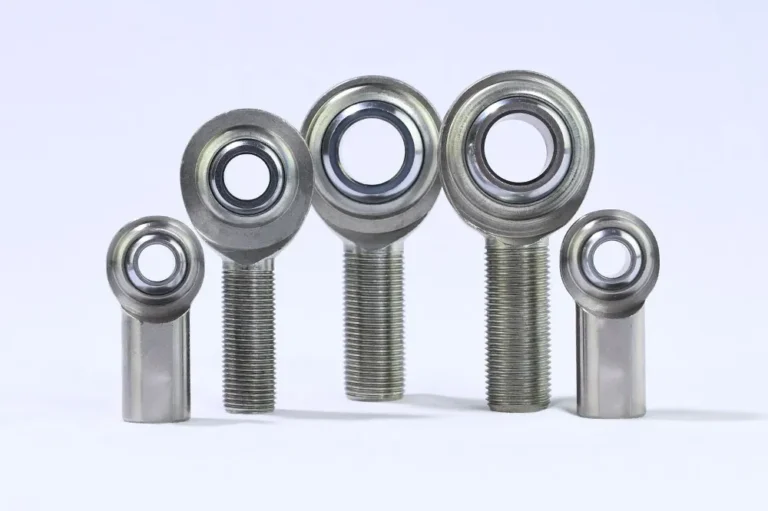
A standard rod end provides ±6° to ±8.5° of angular misalignment, depending on bore size and design. High-misalignment configurations reach ±25° or more. Within that envelope, the spherical ball rotates freely, allowing the connected actuator or linkage to move without transmitting bending stress into the shaft or housing.
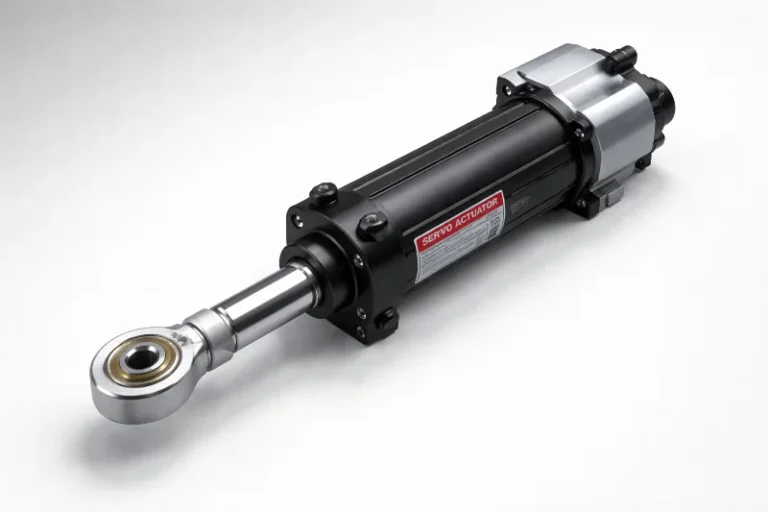
Without angular float, even small assembly misalignments load the actuator shaft sideways. Pneumatic cylinder rod seals start failing earlier than expected. Servo actuator shaft bearings wear unevenly. The fixture “wears out faster than it should” — a complaint that’s common enough to be nearly a cliché in welding cell maintenance — and angular side loading at rod end joints is often a contributing cause that goes unexamined.
In multi-axis positioner linkages — used in BIW lines to reorient workpieces between weld stations — rod ends allow the linkage geometry to absorb angular variation as the positioner moves through its range of motion. This matters particularly in coordinated-motion welding cells, where the positioner is controlled as an additional robot axis and any binding in the linkage translates directly to positioning error.
PTFE-Lined vs. Steel-on-Steel: The Decision That Determines Maintenance Frequency
The most consequential bearing interface decision in rod end selection for welding fixtures is PTFE-lined versus steel-on-steel (greaseable).
Why PTFE-Lined Dominates High-Cycle Applications
PTFE-lined rod ends use a thin polytetrafluoroethylene layer between the hardened alloy steel ball and the race. The liner eliminates relubrication — a practical necessity when bearing positions in a welding fixture are often inaccessible without partial fixture disassembly, and when grease contamination from spatter exposure is a maintenance liability rather than a solved problem.
One detail worth knowing: not all PTFE-lined rod ends are the same. Standard PTFE-lined variants use bonded or sprayed-on coatings adequate for moderate-cycle applications. For fixtures running 4,000+ cycles per shift, PTFE fabric-lined bearings — where the liner is a woven composite rather than a coating — provide substantially higher wear resistance and are the appropriate specification for sustained high-cycle welding environments.
In high-cycle welding environments, PTFE consistency matters as much as PTFE presence. Greased steel-on-steel bearings change friction characteristics as they cycle — grease distributes, depletes at high-load zones, and eventually allows metal-to-metal contact. PTFE fabric liners maintain a more stable friction coefficient across millions of cycles. For fixture clamping arms, that consistency translates into more consistent clamp force — which translates into more consistent weld joint gap.
Standard PTFE-lined rod ends operate reliably from –30°C to +120°C. Higher-temperature formulations extend to approximately +200°C.
| Configuration | Load Capacity | Lubrication | Temp Range | Best For |
|---|---|---|---|---|
| PTFE fabric-lined | High | Self-lubricating | –30°C to +120°C | High-cycle fixtures (4,000+/shift), inaccessible positions |
| Standard PTFE-lined | High | Self-lubricating | –30°C to +120°C | Moderate-cycle fixtures |
| Steel-on-steel (greaseable) | Higher | Requires greasing | –40°C to +150°C | Low-cycle, accessible positions, heavy-duty clamping |
| Stainless steel + PTFE | Medium-High | Self-lubricating | –50°C to +120°C | Wash-down or corrosive environments |
When Steel-on-Steel Is a Reasonable Choice
For very heavy clamping loads in large structural welding fixtures — frame rails, heavy equipment subassemblies — steel-on-steel rod ends provide higher ultimate static load capacity. If the position is genuinely accessible for scheduled greasing and cycle count is low (say, under 500 per shift), greaseable configurations work.
The practical risk: positions that “require” lubrication rarely get it on schedule in production environments. The outcome — a rod end running dry, wear accelerating, play developing — is common enough that the burden of proof should sit with steel-on-steel. The default for anything cycling above 1,000 times per shift should be PTFE-lined.
Selection checkpoint
Before specifying the bearing interface, answer three questions:
- Can this position actually be accessed for relubrication during a normal maintenance window?
- How many cycles per shift? Under 500 cycles: steel-on-steel may work. Over 2,000 cycles: PTFE-lined is the safer default.
- Is this position in a direct spatter zone? If yes: shield the bearing AND specify PTFE fabric-lined.
Load Rating, Fatigue Life, and the Safety Factor That Actually Matters
The static radial load rating on a rod end is the force at which the ball or race fractures. For welding fixture applications, this is the floor — not the sizing criterion.
Fatigue Life Is the Design Constraint, Not Peak Load
In a fixture cycling millions of times, the engineering question is not “can this rod end survive the maximum clamp force?” — it almost certainly can. The question is: at what percentage of the rated load is the rod end running per cycle, and does that percentage give adequate fatigue life?
General mechanical design practice: for rod ends expected to exceed 1 million cycles, keep the working load per cycle at 20–30% of the static rating. For applications above 10 million cycles — reachable within a year in a three-shift BIW operation — the margin may need to be wider still, or the bore diameter stepped up.
A fixture engineer sizing a rod end with “2x safety factor on peak clamp load” has addressed static strength. Fatigue life requires a different calculation and, typically, a larger safety factor.
Radial vs. Axial Load Orientation
Rod ends are rated for radial load — force perpendicular to the shank axis. Axial capacity (along the shank) is typically 5–10% of the radial rating. Clamping arms or linkages that inadvertently load a rod end axially will see premature failure that looks like defective hardware. The correct fix is always design geometry, not a stronger component: keep the bearing centerplane aligned with the functional load plane.
For detailed reference on rod end load rating methodology, mounting orientation, and fatigue life estimation, New Hampshire Ball Bearings’ engineering reference covers the subject thoroughly.
Putting It Together: A Selection Framework for Welding Fixture Engineers
Rod end selection for robotic welding fixtures comes down to three factors, in priority order:
1. Match the cycle regime, not just the load.
Calculate expected lifetime cycles. Size the rod end so the working load per cycle sits at 25–30% or less of the static rating for applications above 1 million cycles. Use PTFE fabric-lined configurations for fixtures running above 4,000 cycles per shift.
2. Specify PTFE-lined as the default.
In welding environments, the maintenance assumption behind steel-on-steel rod ends is often unrealistic. PTFE fabric-lined configurations eliminate a lubrication variable that, when ignored, causes accuracy degradation that gets attributed to everything except the rod end.
3. Size misalignment angle to actual assembly geometry.
Standard ±6–8° handles most fixture joints. Positioner linkages with larger angular travel need verification. Underspecifying misalignment angle transfers stress to the actuator shaft — degrading fixture accuracy through a different failure mode than bearing wear, but with similar consequences.
Two additional points from the field: verify the welding ground path doesn’t route through rod end pivot joints, and specify zero-clearance or pre-loaded rod ends for the highest-precision fixture positions where standard bearing clearances are non-trivial relative to the system tolerance budget.
For fixture tolerance management, GD&T true position control is the standard methodology for keeping cumulative tolerance chains under control. GD&T Basics’ tolerance stack-up guide is a useful starting reference.
SYZ Machine supplies industrial rod ends in bore sizes M5 through M30 — PTFE-lined self-lubricating configurations, high-strength chromoly variants, and stainless steel options for corrosive environments — with dimensional tolerances suited to precision automation applications. Custom bore and thread configurations are available for non-standard fixture geometries.