
Rod Ends & Heim Joints Buyers’ Guide
A rod end — also called a heim joint or rose joint — is a threaded spherical bearing that transmits push-pull load while allowing angular misalignment. This guide explains what a rod end is, how it is built, how it behaves in a linkage, and how to choose the right series from SYZ’s chromoly, carbon steel, stainless and 7075-T6 aluminum range.
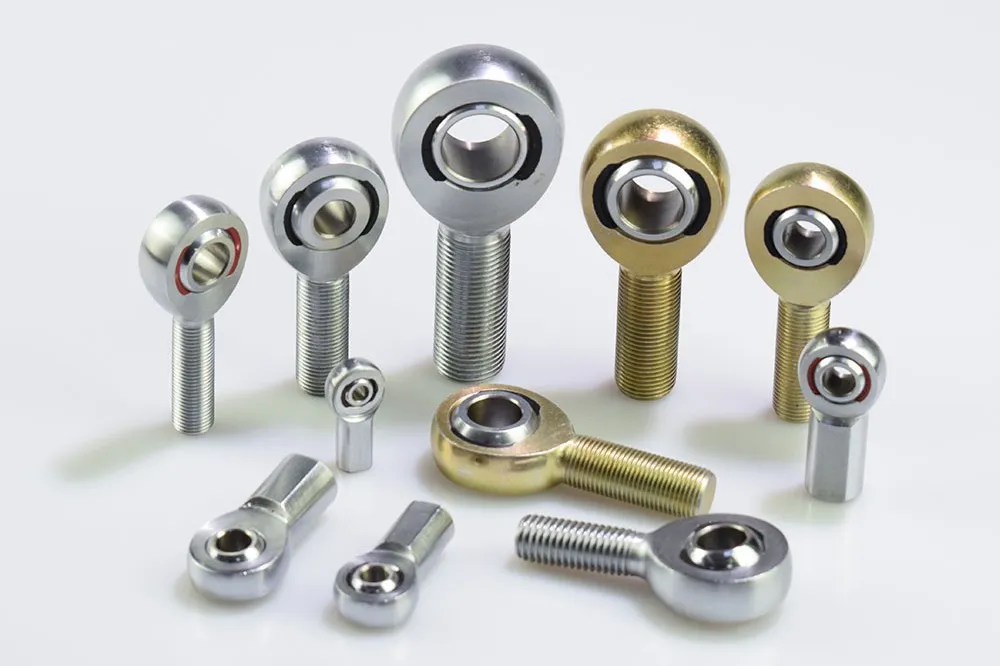
What Is a Rod End?
DefinitionA rod end is a mechanical articulating joint used at the end of control rods, linkages and steering systems. A hardened spherical ball is swaged into a housing that carries either an integral threaded shank (male) or a threaded bore (female). The ball swivels inside its race to absorb angular misalignment while the housing transfers tension or compression along the rod axis.
Two things set a rod end’s operating limits: the race or liner, which defines how the ball slides (greased metal, self-lubricating PTFE, nylon or bronze), and the housing geometry, which defines how far the joint can tilt before the shank bottoms out — the misalignment angle. In North America the same part is called a heim joint; in the UK and Commonwealth, a rose joint. Engineering drawings simply say rod end.
A rod end is a complete, ready-to-thread assembly. That distinguishes it from a spherical plain bearing, which is the ball-in-ring bearing element alone and must be mounted into a housing before it can be used.
- Also called
- Heim joint · rose joint
- Core function
- Push-pull load + articulation
- Bore range
- 3/16″–2″ · M3–M30+
- Configurations
- Male / female · RH / LH
Anatomy of a Rod End
StructureEvery rod end is built from the same four functional elements. Understanding each one makes the selection criteria in this guide readable.
Housing Body
The load-carrying shell, machined or forged from chromoly, carbon steel, stainless steel or 7075-T6 aluminum. The body material sets the strength and corrosion class; its geometry carries the male thread or female bore.
Spherical Ball
A hardened, precision-ground bearing ball — 52100 steel across most series, 440C stainless in the stainless range. The ball is the swiveling element and carries the misalignment movement.
Race / Liner
The sliding interface between ball and body: a heat-treated alloy-steel race (metal-to-metal), a bonded PTFE liner, a reinforced nylon + PTFE race, oil-impregnated sintered bronze or a copper-alloy PTFE race. This choice sets friction, lubrication and service life.
Thread Connection
The male shank or female bore that joins the rod end into the linkage. Inch series use UNF fine threads, metric series use ISO threads; right- and left-hand versions support turnbuckle-style length adjustment.
2-Piece Construction
The spherical ball is swaged directly into the housing body. Simpler and highly cost-effective, with fewer parts and a lower stack height. The trade-off is looser ball-to-race tolerance and lower radial capacity per bore size.
Suited to general industrial, agricultural and light-duty linkage where loads are moderate and cost matters.
3-Piece Construction
A separate insert race retains the ball inside the housing. This buys tighter ball-to-race clearance, higher radial load capacity per bore diameter, and a clean seat for a bonded PTFE liner on the -T versions.
The standard choice for precision linkages, high-cycle motion and applications where load per size is critical.
What a Rod End Does in a Mechanism
FunctionJudged from the engineering side, a rod end has to do four jobs at once — and each job maps to a selection criterion.
Transmit push-pull load
The joint carries tension and compression along the rod axis between linkage elements. Selection starts from the maximum static radial load — dead load plus dynamic plus shock — with a housing rating of at least 1.5× that figure, and 2–3× for severe impact service such as suspension and steering.
Absorb angular misalignment
The ball tilts inside the race to absorb tolerance stack-up, frame flex and stroke geometry, while the load path stays straight. The tilt limit is the misalignment angle: exceed it and the shank bottoms against the housing, bending shanks or cracking housings. High-misalignment series (PCM, PCYM, HJMX) and misalignment spacers extend the working angle.
Set and adjust link length
Because the joint is threaded, it doubles as the length adjuster of the linkage. A right-hand / left-hand pair works like a turnbuckle: rotating the tube or adjuster changes overall length, and a jam nut locks the setting against vibration.
Match maintenance to the install
The liner decides the service behavior. PTFE-lined and molded nylon + PTFE races run self-lubricating and maintenance-free — the default for sealed assemblies, clean environments and joints that cannot be reached with a grease gun. Metal-to-metal alloy races carry higher static and impact loads but need periodic grease purges.
Where rod ends fail in the field
- Sizing by thread size alone while ignoring radial load capacity.
- Specifying metal-to-metal joints where grease access is blocked.
- Mounting unprotected carbon steel in outdoor, corrosive service.
- Exceeding the rated misalignment angle under articulation.
Choose the Body Material First
MaterialsSYZ rod ends span four body-material families. The ball stays a hardened bearing steel (52100, or 440C stainless) in every family — the housing material is what you are choosing. Pick the family by your dominant requirement, then narrow to a series.
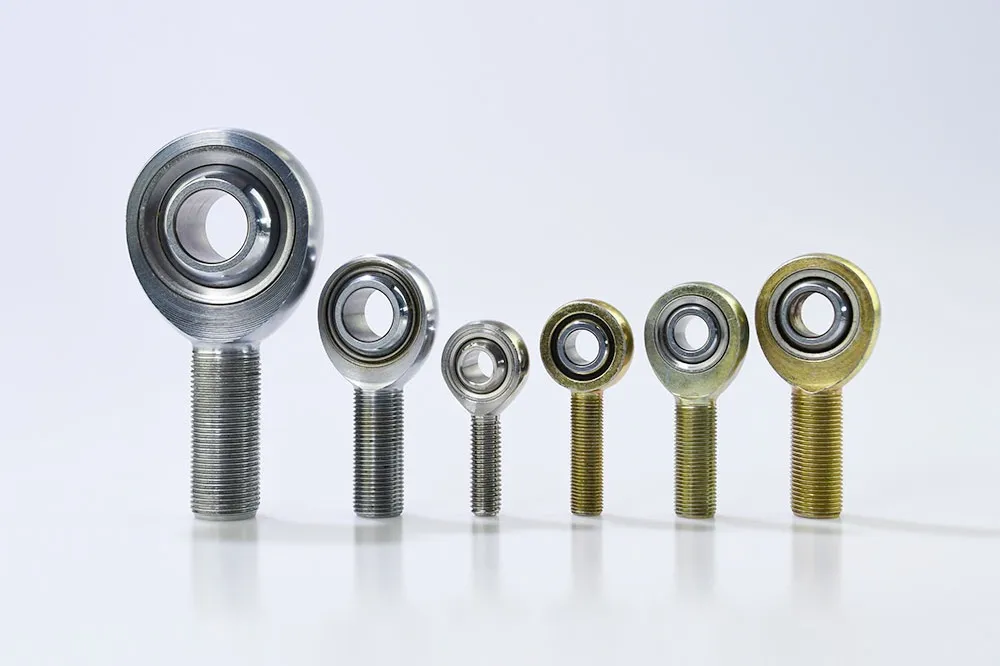
4130 Chromoly
Highest strength & fatigue lifeHeat-treated chrome-molybdenum alloy steel for high-shock, high-cycle service where a joint cannot be allowed to fail. Ball: 52100, hard chrome plated. Finish: hard chrome or silver zinc by series; black oxide on PCM / PCYM.
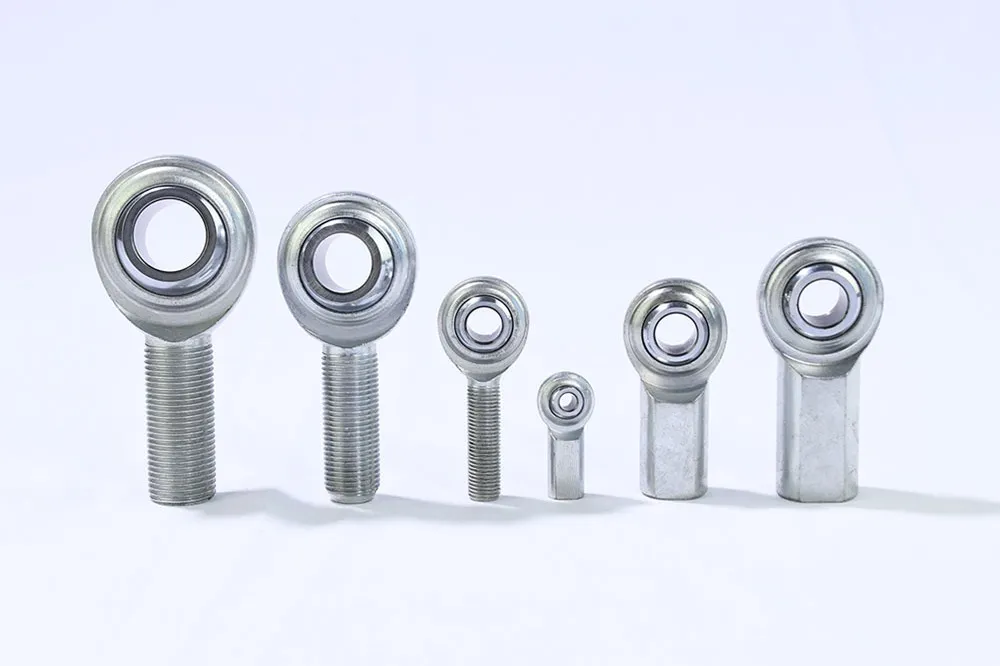
Carbon Steel
Economical workhorseSolid strength at the lowest cost for moderate-load general linkage. Dimensionally compatible with chromoly series, so it substitutes where the extra strength is not required. Ball: 52100, hard chrome plated. Finish: zinc plated (silver or yellow).
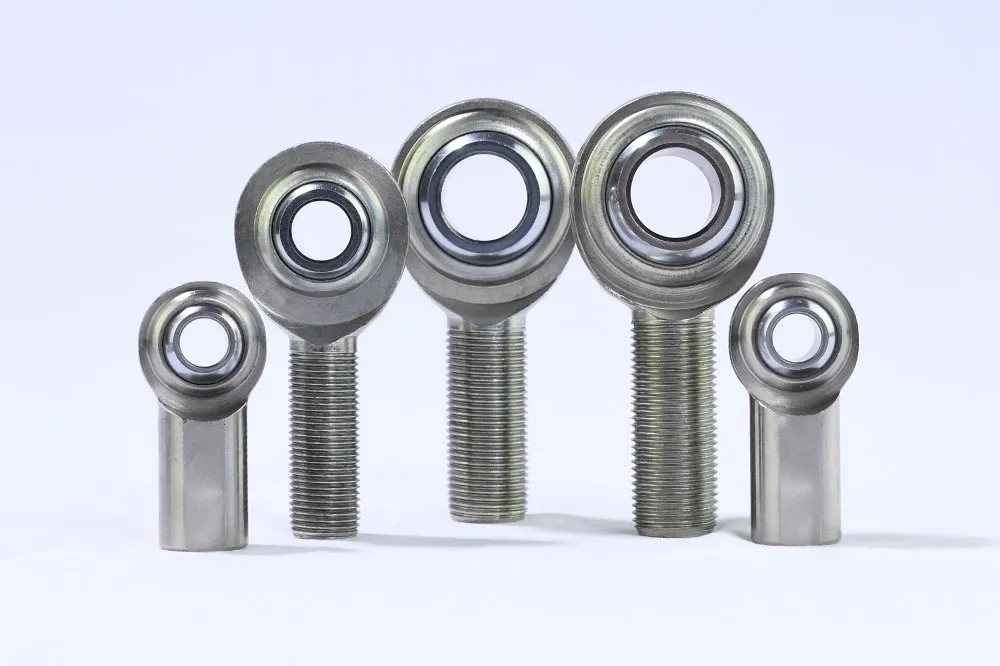
Stainless Steel
Corrosion resistance first304 stainless housings with 440C stainless balls and self-lubricating PTFE liners — the material itself is the corrosion strategy, no plating required. For saltwater, washdown, food and chemical service.
7075-T6 Aluminum
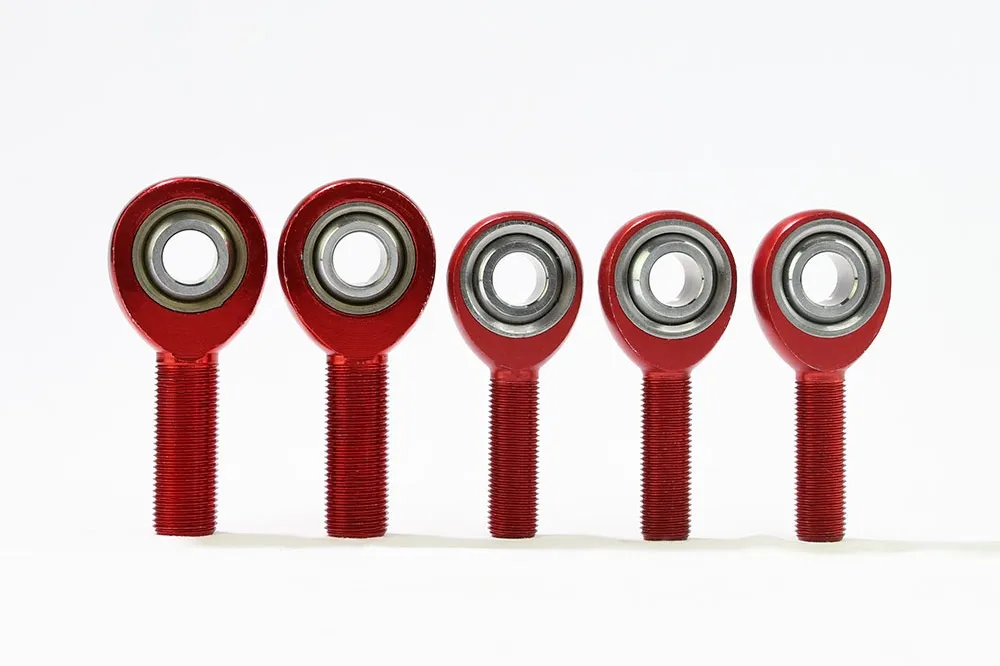
Weight-critical linkageAerospace-grade aluminum bodies cut joint mass to roughly one third of steel. The trade-off is lower shock-load margin, so aluminum wins on light-to-moderate, well-inspected links — not on impact-loaded suspension. Ball: 52100 — aluminum is never used for the ball. Finish: anodized red or black.
Finishes: What Protects Each Part
Surface treatmentOn a rod end, surface engineering does two different jobs: the swiveling ball needs a hard, low-friction wear surface, while the housing needs corrosion protection matched to its environment.
| Treatment | Applied to | Series examples | What it does |
|---|---|---|---|
| Hard chrome plating | 52100 balls (all families); some chromoly bodies | JMX(-T), HJMX(-T), XM/XF | Hard, low-friction, wear-resistant surface on the swiveling ball; extends life under high-cycle articulation. |
| Silver zinc plating | Carbon steel and chromoly housings | CM(-T)/CF(-T), JM(-T), SA-TK | Sacrificial coating — the zinc corrodes preferentially and protects the base steel in general industrial service. |
| Yellow zinc plating | Carbon steel housings | EXM/EXF, PM/PF, VM/VF, MPM/MPF, JM-M/JF-M | Same sacrificial protection with added passivation layers and the recognizable gold finish used across the industrial range. |
| Black oxide | 4130 chromoly housings | PCM(-T), PCYM-T / PCYF-T | Conversion finish that adds mild corrosion resistance without dimensional build-up on precision chromoly bodies. |
| Anodizing (red / black) | 7075-T6 aluminum housings | AM/AF, ALJM(-T) | Hardened oxide layer that protects the aluminum and provides the color coding used on racing and robotics links. |
| Stainless 304 / 440C | Housing and ball as material choice | SCM-T / SCF-T, SCM-MT / SCF-MT | No plating — corrosion resistance comes from the alloy itself, for marine, washdown and chemical environments. |
Finish varies by series — always confirm the finish on the series spec page before ordering. Non-standard platings and custom finishes are available on request.
Where Rod Ends Perform
ApplicationsThe same four functions — load, articulation, adjustment, maintenance behavior — look different in each industry. These are the application patterns SYZ rod ends are built around.
Off-Road & Motorsport
Backbone joints for competition suspension and steering: 4-link systems, panhard bars, sway-bar links and steering columns under high shock and continuous misalignment.
JMX(-T)HJMX(-T)PCM(-T)PCYM-TMotorcycle & Performance Street
Custom linkage, suspension and steering builds where compact spherical articulation and threaded adjustment are needed on weight-sensitive machines.
XM/XFJMX(-T)AM/AFIndustrial Automation
Linkages for packaging machines, conveyors, pneumatic and hydraulic cylinders, actuators and pick-and-place systems running long, predictable cycles.
CM(-T)JM(-T)SCM-TAgriculture & Heavy Duty
Severe-duty implements, harvester and baler stroke links, tractor hitch connections and heavy cylinder mounting in dusty, high-impact service.
JM(-T)/JF(-T)EXM/EXFVM/VFMarine & Corrosive
Rudder steering, throttle linkages, hatch lifters, deck hardware and tilt/trim actuators exposed to saltwater, washdown chemicals and constant moisture.
SCM-T / SCF-TSCM-MTRobotics, UAV & Precision
Unmanned aerial vehicles, robotics, motion simulators and instrumentation where moving mass and responsive, repeatable articulation matter most.
ALJM(-T)AM/AFHow to Choose: 5 Steps, Then the Series Table
Selection referenceLoad Rating
Estimate maximum static radial load (dead + dynamic + shock). Choose a housing rating at least 1.5× that figure; use 2–3× for severe impact loads.
Thread Fit
Match thread pitch and standard: UNF for inch, ISO for metric. Confirm RH vs LH — left-hand threads are required for turnbuckle and adjuster pairs.
Bore Alignment
Select the bore to match your mounting bolt or pin — 3/16″ to 2″ and M3 to M30+ across the catalog — and check the misalignment angle clears your stroke.
Body Material
Corrosion-prone → stainless. Rotating mass → 7075 aluminum. Heavy shock and suspension → 4130 chromoly. General duty on a budget → carbon steel.
Liner Compound
Accessible, high-impact joints → greaseable metal-to-metal. Sealed or maintenance-free → PTFE. High-articulation off-road → polyurethane rebuildable flex joints.
| Series | Design | Race / Liner | Body & Finish | Thread | Specs |
|---|---|---|---|---|---|
| 4130 Chromoly — high shock & fatigue | |||||
| XM / XF | 2-piece, heavy-duty shank | Reinforced nylon + PTFE, self-lubricating | 4130 chromoly | Inch UNF | View |
| JMX(-T) / JFX(-T) | 3-piece precision | Alloy-steel race; PTFE-lined on -T | Heat-treated 4130 chromoly | Inch UNF | View |
| JMX-M / JFX-M | 3-piece precision | PTFE-lined optional | Heat-treated alloy steel | Metric | View |
| MXM / MXF | Heavy-duty molded race | Self-lubricating PTFE race | 4130 chromoly | Metric | View |
| XM-C | 2-piece, extended shank | Self-lubricating nylon race | 4130 chromoly | Inch UNF | View |
| HJMX(-T) | 3-piece, heavy-duty high-misalignment | PTFE lined | Heat-treated 4130, chrome plated | Inch UNF | View |
| XM-OS / JMX-OS | Offset head design | Self-lubricating nylon race | 4130 chromoly | Inch UNF | View |
| PCM(-T) | 2-piece raceless, high strength | PTFE-lined optional | 4130 chromoly, black oxide | Inch UNF | View |
| PCYM-T / PCYF-T | 2-piece, built-in spacers, up to 24° articulation | PTFE lined | 4130 chromoly, black oxide | Metric | View |
| Carbon Steel — economical general linkage | |||||
| CM(-T) / CF(-T) | 2-piece commercial | Metal-to-metal; PTFE-lined on -T | Carbon steel, silver zinc plated | Inch UNF | View |
| CM-M / CF-M | 2-piece commercial | PTFE-lined optional | Carbon steel, zinc plated | Metric | View |
| JM(-T) / JF(-T) | 3-piece precision | Alloy-steel race; PTFE-lined on -T | Carbon steel | Inch UNF | View |
| JM-M / JF-M | 3-piece precision | PTFE-lined optional | Carbon steel, yellow zinc plated | Metric | View |
| EXM / EXF | Loaded slot design, extended shank | Self-lubricating nylon race | Carbon steel, yellow zinc plated | Inch UNF | View |
| PM / PF | Molded race precision | Injection-molded nylon, self-lubricating | Carbon steel, yellow zinc plated | Inch UNF | View |
| VM / VF | 3-piece | Oil-impregnated sintered bronze | Carbon steel, yellow zinc plated | Inch UNF | View |
| SA-TK / SI-TK | 3-piece self-lubricating | Copper alloy, PTFE lined | Carbon steel, silver zinc plated | Metric | View |
| MPM / MPF | Molded race | Injection-molded PTFE race | Carbon steel, yellow zinc plated | Metric | View |
| 7075-T6 Aluminum — weight-critical linkage | |||||
| AM / AF | 2-piece, loader slot design | Self-lubricating nylon race | 7075-T6, anodized red / black | Inch UNF | View |
| ALJM(-T) / ALRSM(-T) / ALJF(-T) | 3-piece precision | PTFE-lined optional | 7075-T6, anodized | Inch UNF | View |
| Stainless — marine, washdown & chemical | |||||
| SCM-T / SCF-T | 2-piece | PTFE lined, self-lubricating | 304 body / 440C ball | Inch UNF | View |
| SCM-MT / SCF-MT | 2-piece | PTFE lined, self-lubricating | 304 body / 440C ball | Metric | View |
Cross-referencing FK, QA1 or Aurora parts? Every SYZ spec page includes a competitor cross-search tool covering FK, QA1, Aurora, Alinabal and Midwest Control part numbers. Or start from the complete rod end range hub to compare all 57 series.
Get Selection HelpRod End Buyers’ Questions
FAQQ1What is the difference between a rod end and a spherical bearing?
Q2What does “PTFE-lined” mean?
Q3Should I choose a 2-piece or 3-piece rod end?
Q4Should I choose a male or female rod end?
Q5What thread standard do SYZ rod ends use?
Q6What is misalignment angle?
Q7Can rod ends be used in continuous rotation?
Selecting Rod Ends for Your Build?
Send us your load, thread and environment requirements — or a competitor part number to cross-reference. SYZ engineers reply with the right series, sizing support and factory-direct pricing from sample to full-container quantities.