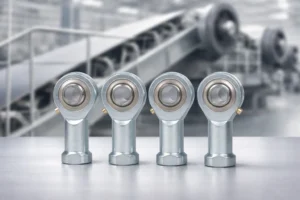


Discussions about humanoid robots frequently focus on artificial intelligence (AI), deep learning, and motion planning. However, the mechanical components that enable these robots to execute complex movements are equally critical. One such essential component is the rod end (also known as a Heim Joint). These mechanical joints are central to the articulation of humanoid robots, facilitating fluid, human-like motion across various joints.
For professionals in mechanical design, sourcing, or procurement, determining the precise quantity of rod ends a typical robot requires is a crucial calculation. It is a core component influencing performance, manufacturing cost, and long-term maintenance needs. We will analyze the technical necessity and estimate the quantities based on current industry design practices.
The Rod End's Role in Humanoid Articulation
Why is a specific type of bearing necessary when standard motors are in use? Because robotic movement rarely involves simple, single-axis rotation. Humanoid joints, mirroring human anatomy, must handle multi-directional, complex loading that standard rolling bearings cannot effectively manage.
A conventional rolling bearing supports only single-axis rotation. In contrast, a rod end—featuring a spherical sliding surface—can simultaneously accommodate tilting, angular deviation, and heavy multi-directional loads. This self-aligning bearing characteristic is fundamental to achieving precise, fluid motion in robotics.
This component is most often integrated into the rotary + linkage configuration (a key semantic key phrase). When a rotary actuator (motor) is linked to a multi-linkage mechanism, flexible pivot points are mandatory. The rod end provides this robust, flexible connection, translating rotary power into precise, complex linear or oscillating movements, especially in joints like the knee and ankle where movements are highly non-linear.
Breaking Down the Key Joints
The total requirement for rod ends is fundamentally dictated by the robot’s Degrees of Freedom (DOF) and its kinematic structure, specifically where actuator linkage for humanoid robot design is implemented.
Based on industry analysis and observation of advanced bipedal robot designs, we can derive estimated quantities for the primary joints.
**Note: As robot designs vary, these figures represent highly plausible potential counts based on common structural approaches.
The Upper Body: Elbows and Wrists
Below is a picture demonstrating Tesla Optimus‘s elbow structure.
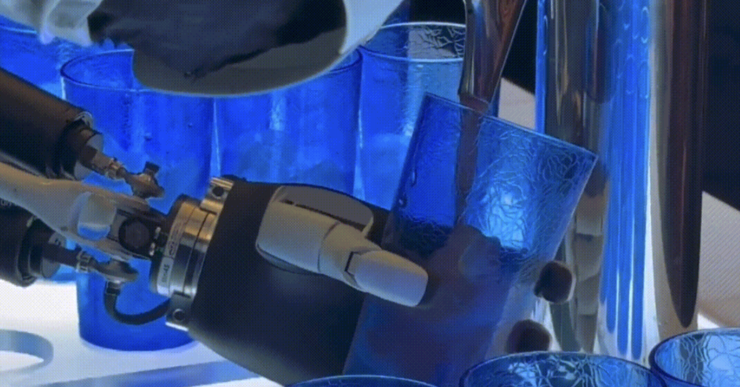
Pitching and rolling
Deflection rotating
Achieving human-level dexterity requires careful design, with the wrist being a critical articulation point for rod ends.
Elbow Joint: We estimate a potential use of 2 rod ends per elbow. Linkage systems are often deployed here to optimize the force curve within a compact envelope.
Wrist Joint: This joint demands complex multi-DOF movement (pitching, yawing, and side-to-side deviation). A design that functionally replicates the human wrist requires approximately 3 rod ends to ensure flexible deviation and balanced load distribution under multi-directional forces.
Total for both arms (Elbows + Wrists): 2 (Elbow) + 3 (Wrist) = 5 rod ends per arm.
The Lower Body: Ankles, Knees and Hips
The lower body joints sustain high impact and stress, requiring high radial load capacity and excellent anti-shock properties. These areas are primary applications for spherical plain bearings in robotics.
Below is a picture demonstrating XPENG IRON‘s ankle and knee structure.

Ankle Joint: Crucial for stability and absorbing multi-directional ground reaction forces, the ankle often uses a dual-linear actuator configuration requiring 3 rod ends per ankle. This ensures compliance and stability, making them essential mechanical joints in bipedal robots.
- Knee Joint: Analyzing bionic structures and multi-linkage mechanisms (as seen in public domain analyses of advanced knees), a single knee joint could potentially utilize up to 5 rod ends. This quantity supports the complex linkage mechanism that manages torque, load, and motion trajectory during demanding actions like walking and squatting.
Below is a picture demonstrating XPENG IRON’s ankle and knee structure.

Hip Joint: As the central pivot, the hip requires high DOF (front swing, side lift, rotation). Utilizing a linkage structure offers advantages in structural simplicity, cost, and space-saving. A single hip joint is likely to incorporate between 3 to 5 rod ends.
The Fingers
The quest for genuine manipulation capability necessitates complex robot manipulator joint components.
Fingers (Dexterous Hand): For designs employing a linkage solution to maximize structural simplicity and flexibility, each individual finger joint could potentially use 2 to 4 rod ends. If a robot incorporates five fingers per hand, the quantity increases rapidly. For a conservative count, we estimate 2 rod ends per finger linkage point.
A Plausible Total Estimate
To directly address the question, “How many rod ends do a humanoid robot need?” we compile a conservative estimate based on the single-axis application quantities discussed. This represents one plausible kinematic model (a key long tail key phrase), and actual numbers will vary based on the specific humanoid robot joint design.
| Joint Location | Estimated Rod Ends Per Joint | Total Joints (L+R) | Estimated Total Rod Ends |
|---|---|---|---|
| Wrist | 3 | 2 | 6 |
| Elbow | 2 | 2 | 4 |
| Knee | 5 | 2 | 10 |
| Ankle | 3 | 2 | 6 |
| Hip | 3 | 2 | 6 |
| Fingers (5 fingers/hand) | 2 (per finger) | 10 | 20 |
| Conservative Subtotal | - | - | 52 |
A single humanoid robot, utilizing robust linkage systems in its primary joints and hands, could conservatively require approximately 52 rod ends.
Final Considerations
The main insight here is that the rod end, despite its small size, is a significant component in the total bill of materials (BOM) due to its high required quantity—potentially over fifty units per robot, which will spawn billions of dollars in sales opportunities.
For professionals selecting these parts, the selection criteria are highly specific: you need high control over backlash and stiffness in robotic joints, excellent radial load-carrying capacity, and a compact design. Selecting the correct self-aligning bearing for robotics directly influences the robot’s articulation precision and long-term operational reliability.
As mass production of humanoid robots approaches (scaling to millions of units), the demand for high-quality, durable, and cost-effective rod ends will drive a substantial market increase. These components are essential mechanical facilitators, enabling the advanced capabilities of the next generation of robotics.