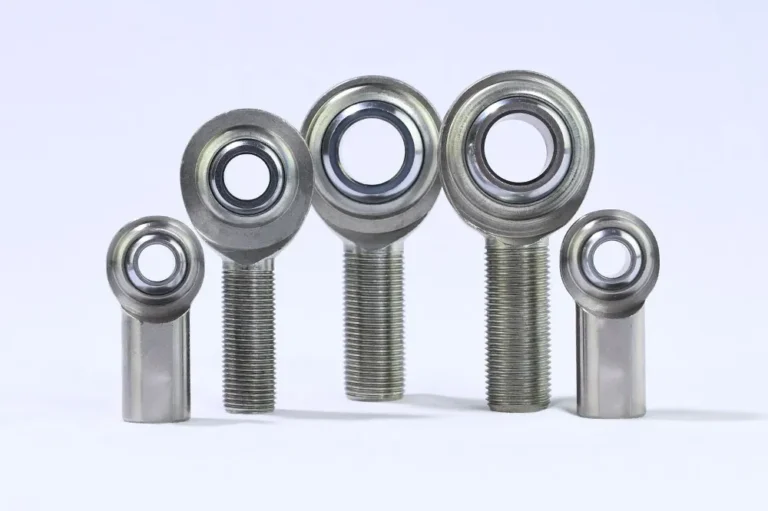
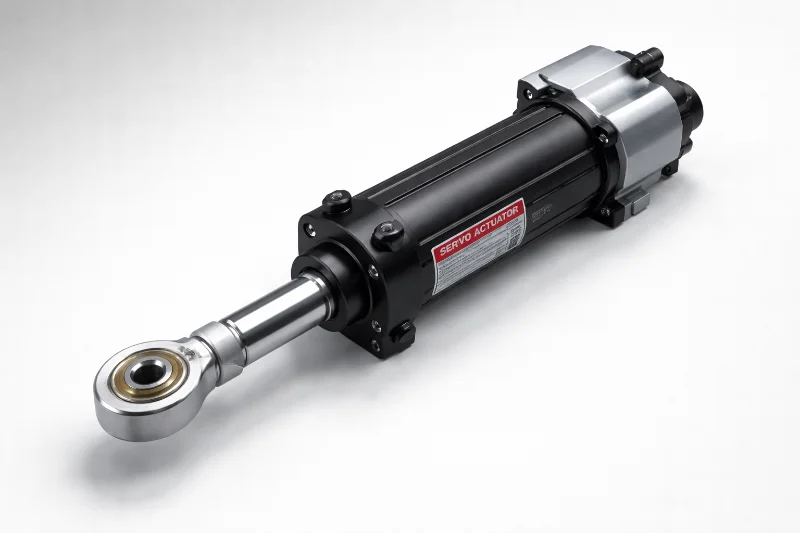
Servo actuator linkages operate under conditions that expose every weakness in your component selection. Frame flex, thermal expansion, dynamic loading, and installation tolerances that pass in static machinery become precision errors in servo-driven systems. The rod end sitting at the pivot point of that linkage bears all of it—and its selection is often the last thing on the spec sheet.
Most component lists treat rod ends as hardware, not engineering decisions. That attitude shows up in field performance: premature wear, backlash growth, and lost positioning accuracy that no controller tuning can fix. What follows works through the selection factors that actually determine whether a rod end holds up in a servo application—starting with load analysis, but not stopping there.
Why the servo environment demands more
Static machinery and low-cycle mechanisms can get away with generic rod ends because they rarely push the component’s limits. Servo-driven linkages are a different situation. The combination of high-cycle loading, dynamic force reversal, and strict positional tolerances creates a demanding environment that most standard rod end specifications weren’t built around.
Combined loading is the rule, not the exception
In a typical servo actuator linkage, the rod end rarely sees pure axial or pure radial loading. What actually happens is a combination of axial thrust, moment loads, and lateral forces—all varying in magnitude and direction as the actuator cycles. That combined state drives bearing contact stresses well above what a single-axis load rating suggests.
ISO 12240-1 provides static and dynamic load ratings for spherical plain bearings and rod ends based on specific geometric relationships between bore diameter, body length, and ball diameter. What it doesn’t automatically account for is the combined loading factor. For servo applications, calculating the equivalent load explicitly is worth the extra step: the equivalent dynamic load P can be 20–40% higher than the pure radial load Fr when even moderate axial components are present. That margin can push a borderline selection into underspecification.
Service life in high-cycle sliding contact
Servo systems run cycles that static or low-frequency mechanisms never approach. A servo axis in an industrial robot or packaging machine can hit 60–100 cycles per minute continuously, accumulating millions of oscillation cycles over a machine’s service life. And this is where a common conceptual mistake occurs: rod ends are spherical plain bearings operating in sliding contact, not rolling element bearings. They don’t fail by subsurface fatigue. They wear out.
The relevant parameter is the pv value—the product of contact surface pressure (p, in MPa) and sliding velocity (v, in m/s). Most rod end manufacturers publish pv limits and wear-based service life charts. The correct approach for servo applications is to calculate expected service life in sliding distance or hours against the manufacturer’s rated pv limit, then verify it exceeds the maintenance interval target. If the calculation shows 2,000 hours of wear life and the machine runs 24/7, field replacements will arrive well before the first scheduled maintenance.
Misalignment compensation: function, not tolerance
The spherical bearing inside a rod end allows the ball to tilt relative to the housing within a rated angular range—commonly ±7° to ±15°, depending on design and bore diameter. In servo applications, that compensation does real engineering work that static specifications don’t capture.
Installation misalignment is always present
In theory, a servo actuator and its connected linkage are perfectly aligned. In practice, machined mounting surfaces have flatness tolerances, bore positions accumulate stack-up, and even well-made assemblies land somewhere short of geometric perfection. A servo actuator mounted to a steel frame with ±0.1 mm positional accuracy at the pivot creates measurable angular error at the rod end. Rigid connections under these conditions generate side-loading on the actuator shaft and stress concentrations in the linkage—eventually visible as wear patterns on the actuator’s internal linear bearing surfaces.
The rod end’s misalignment capacity absorbs this without generating reactive forces in the system. Not slop. Intentional compliance that protects the servo actuator from side loads its internal bearings aren’t rated to handle.
Structural deflection and thermal expansion
Under load, the structural members of a machine linkage deflect. The deflection is often fractions of a millimeter, but the angular error it creates at the rod end pivot is real. Differential thermal expansion adds to this: steel actuator housings and aluminum structural frames expand at different rates. For machines cycling between ambient startup and 60–80°C operating temperature, this dimensional shift consumes a meaningful portion of available bearing clearance in any rigid connection.
Rod end misalignment compensation handles both effects passively, without generating load spikes in the linkage. In force-controlled servo applications specifically, unexpected load transients affect controller performance—so passive misalignment absorption has value beyond just protecting the hardware.
Material and liner selection: matching performance to maintenance reality
The choice between metal-to-metal rod ends and PTFE-lined versions comes down to three factors: operating load, environment, and maintenance access. There’s no universal answer.
Metal-to-metal: higher load capacity, requires lubrication
Standard steel-on-steel rod ends—hardened chrome-molybdenum (Cr-Mo) steel bodies, case-hardened or chrome-plated balls—provide the highest load capacity for a given bore diameter. The metal contact zone handles high surface pressures without deformation under sustained loading.
The limitation is lubrication dependency. Metal-to-metal rod ends in servo linkages need periodic grease replenishment. Run them dry and wear accelerates significantly. In accessible installations with real service intervals, this is manageable. In inaccessible locations—overhead gantry systems, encapsulated robotic joints, multi-axis wrist assemblies—it becomes a maintenance liability that’s easy to underestimate when specifying components.
PTFE-lined: maintenance-free, with real limits
PTFE composite liners press into the bearing race and provide a self-lubricating contact surface. Under typical servo loading—roughly below 35–40% of the rod end’s static load rating, depending on the specific liner geometry—PTFE-lined rod ends achieve useful service life without external lubrication. The liner transfers a thin film to the ball surface, creating a stable low-friction interface that handles the oscillatory motion typical of servo linkages well.
The tradeoffs are load capacity and temperature range. Liner compression limits effective load ratings compared to metal-to-metal versions of the same bore size. And here’s where the temperature specification often gets quoted wrong: PTFE composite liners—which include bonding resins and fiber reinforcement—have a practical operating temperature limit of around 120–150°C for standard industrial grades. That’s well below the pure PTFE base material degradation point, because the adhesive bonding the liner to the race is the limiting factor, not the PTFE itself. For servo applications near heat sources, welding robots, or environments with aggressive thermal cycling, verify the liner’s actual rated temperature with the manufacturer. Don’t rely on base material data.
For most servo actuator linkages in standard industrial settings, PTFE-lined rod ends cover the load requirements and eliminate the lubrication scheduling problem. That trade is usually worth taking.
The maintenance reality check: If a rod end is difficult to service in the field, a PTFE-lined version running at 65–70% of its static load capacity is worth more than a metal-to-metal version that won’t receive the lubrication it needs. Plan for actual maintenance practice, not ideal maintenance schedules.
Standard rod ends are designed for structural linkages. They hold loads and provide articulation, but they’re manufactured with internal clearance in the bearing assembly. In servo systems, that clearance is backlash in the closed control loop—and backlash creates problems that no amount of gain tuning can fix.
Precision grade and backlash: the servo-specific variable
Standard vs. precision
Standard-grade rod ends (per DIN 648 or equivalent) carry internal bearing clearance. In general linkage applications, this serves a purpose: it accommodates dimensional variation, absorbs installation imprecision, provides a buffer against misload. In a servo linkage, each micrometer of that clearance shows up as dead band in the position feedback loop. The controller commands motion, the actuator responds, and the mechanical dead band produces a position error that looks like lag—leading to hunting oscillation at higher loop gains.
Precision-grade rod ends address this with tighter manufacturing tolerances and, in many designs, controlled preload that eliminates internal clearance entirely. The preload is applied during assembly: the outer ring is pressed to a geometry that places the ball under slight compression, removing all play while still allowing angular displacement within the rated range. The trade-off is increased friction moment and slightly higher loop stiffness. For servo positioning applications, that’s typically a net benefit—stiffer loops respond faster, and the modest friction increase is small relative to actuator rated force.
Dimensional accuracy of the body
Beyond internal bearing clearance, the rod end body’s dimensional accuracy matters. The bore—interface with the connecting pin or shaft—should be h6 tolerance or tighter for servo applications. Thread engagement on the rod end shank should be verified against the mating component; accumulated pitch variation in longer shanks contributes axial position uncertainty that shows up as repeatability error at the end effector.
For applications requiring sub-millimeter positional repeatability, verifying the complete dimensional chain—thread runout, bore concentricity—at incoming inspection is standard practice in precision machine building. In high-volume production, this is handled through statistical process control at the supplier. In lower-volume precision machine builds, individual verification is common.
Where rod ends show up in real servo systems
Industrial servo systems cover a wide range of configurations. Rod ends appear in different forms depending on the kinematic requirements of each application.
Robotic joint linkages
In serial-arm industrial robots, rod ends are common at wrist and elbow linkages where the actuator output connects to a driven link across a range of angular positions. High cycle rates, multi-axis load paths, and tight precision requirements push toward precision-grade, PTFE-lined rod ends with preloaded bearings. Some robot manufacturers specify proprietary precision joints that follow rod end geometry but with tolerances tighter than standard catalog parts—custom-qualified versions of the standard component, essentially.
CNC machine tool mechanisms
In CNC machine tools, rod ends appear in coolant delivery mechanisms, tool-change actuators, and servo-actuated fixture clamping systems—wherever a servo-driven motion needs a pivoting connection. Load requirements tend to be high, cycle rates moderate compared to robotic applications. Metal-to-metal rod ends are common here, with scheduled maintenance tied to spindle-hour intervals.
Linear actuator output connections
Electric servo linear actuators—the workhorses of precision industrial positioning—often use rod ends directly at the actuator output. The rod end serves as both structural connection and misalignment absorber between the actuator’s linear axis and the driven mechanism. Actuator manufacturers typically specify a recommended rod end size based on the actuator’s force rating with a design safety factor applied. Going below that specification to save cost or reduce envelope size is one of the more reliable ways to generate early field failures.
According to a rod end and spherical plain bearing technical documentation, the equivalent dynamic load under combined radial and axial loading follows P = XFr + YFa, where X and Y are geometry-specific load factors. Working through this calculation explicitly—rather than relying on simplified application tables—is where most proper servo-application sizing starts. For a broader framework on servo component selection in closed-loop positioning systems, the Association for Advancing Automation (A3) publishes technical resources that address actuator linkage design in the context of servo system performance.
The practical selection framework
Five steps. None of them optional.
First, calculate the actual equivalent load. Use the manufacturer’s combined-load formula (P = XFr + YFa). Peak actuator force alone isn’t the right input—combined loading consistently produces higher equivalent loads than any single component suggests.
Second, run the service life calculation. Use the rod end’s dynamic load rating and rated pv limit to estimate wear life in sliding distance or hours. Verify it clears the target maintenance interval. For servo applications in continuous-duty industrial machines, 20,000 hours is a reasonable working target.
Third, pick liner type based on maintenance reality. Not the planned maintenance schedule—actual field access. PTFE-lined for hard-to-reach locations; metal-to-metal where lubrication will genuinely happen on schedule.
Fourth, specify precision grade where the control loop requires it. If backlash shows up in the position error budget, standard-clearance rod ends won’t solve it. Precision-grade or preloaded designs are the answer. The cost premium is real but modest relative to the field service costs of hunting-related problems.
Fifth, verify the full dimensional chain. Bore tolerance, thread accuracy, body runout. For high-precision applications, specify and verify at incoming inspection.
SYZ Machine manufactures precision rod ends for industrial servo and automation applications—PTFE-lined and metal-to-metal variants from M6 to M48 bore diameter. Custom configurations including stainless steel bodies, extended thread lengths, and preloaded designs for zero-backlash applications are available for specific servo actuator integration requirements.
The rod end isn’t the most complex component in a servo system. But it’s the mechanical interface between the actuator’s precisely controlled output and everything it’s connected to. Getting that interface right doesn’t require exotic engineering. It requires working through the load analysis, the service life calculation, and the precision requirements without treating any step as optional. Most field problems in this area trace back to exactly that.