
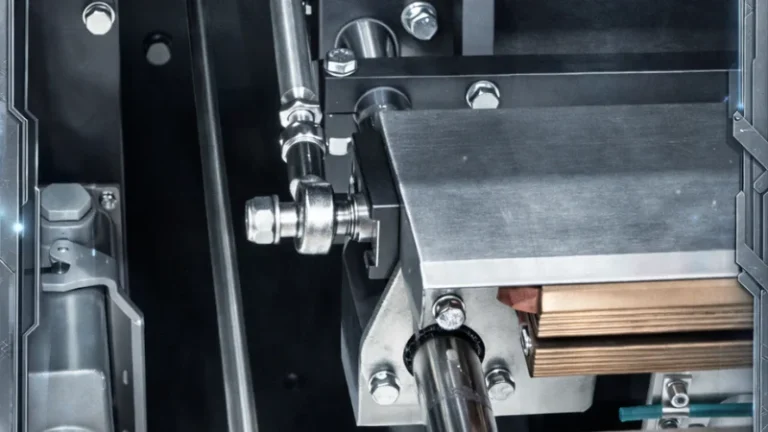
Unplanned downtime in a consumer goods packaging facility doesn’t come cheap. A single stop on a high-speed pouch filling line can translate to tens of thousands of dollars in lost throughput per hour, plus whatever the maintenance crew charges to figure out what failed. And yet, some of the most common failure points aren’t the sealing jaws, the film drives, or the filling heads. They’re the connecting rod ends buried inside the linkage systems, absorbing misalignment for mechanical stress, hour after hour, cycle after cycle.
Rod ends don’t fail dramatically. They wear quietly. The machine starts running slightly off-spec — seal quality drifts, register errors creep in, cycle times stretch. By the time someone isolates the root cause, the downtime tab has already climbed.
In packaging machinery applications ranging from vertical form-fill-seal systems to cam-driven pick-and-place units, rod ends are active working joints. When the wrong type gets specified, or the right type doesn’t get maintained, the consequences travel through the entire line.
Where rod ends actually live in packaging machines
Packaging machinery converts continuous rotational motion — motors, cams, crankshafts — into precise, repeatable reciprocating and oscillating movements. Rod ends sit throughout that conversion chain, at every point where motion changes direction or angle.
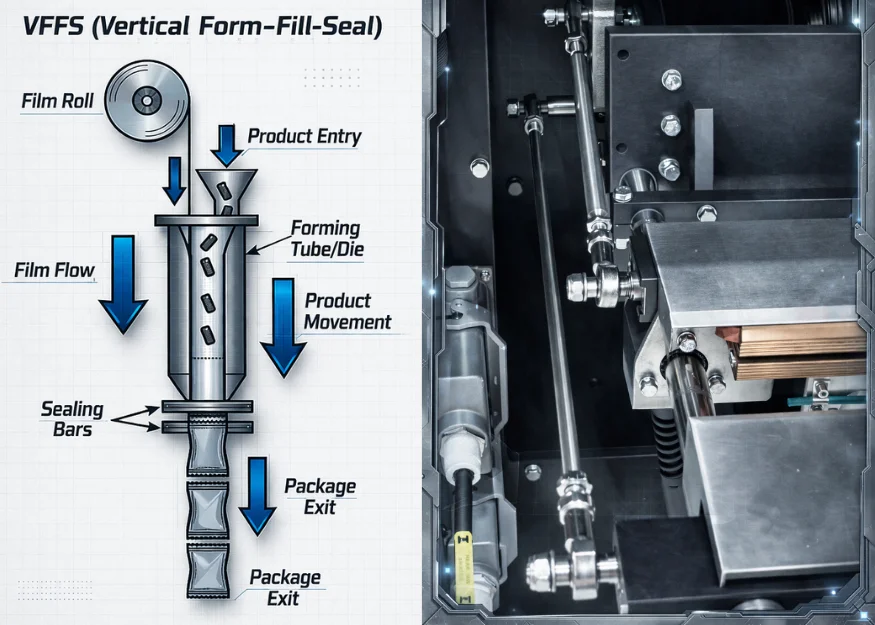
VFFS and HFFS sealing bar mechanisms
In vertical form-fill-seal machines, the sealing bars need to execute tight, repeatable strokes at high speed while pressing against film that’s slightly elastic and unevenly tensioned. The linkage driving those bars can’t use rigid joints: thermal expansion of the sealing elements, combined with frame deflection at high cycle rates, produces constant low-level angular misalignment between connected components.
Rod ends handle this by design. The spherical inner ring lets the ball articulate within the housing, absorbing angular displacement without transmitting bending stress into the shank or the connected structure. In [flow-wrapping applications](https://www.igus.co.uk/industry/food-and-packaging/packaging-technology/flow-wrapping-machines), rod end bearings paired with linear shaft guides to support sealing bars sustain consistent sealing pressure even as thermal gradients shift the system geometry.
Horizontal form-fill-seal machines face similar dynamics. The film transport mechanism, cross-sealing jaw motion, and knife actuator all involve linkages that need the same self-aligning capability.
Pick-and-place and robotic arm linkages
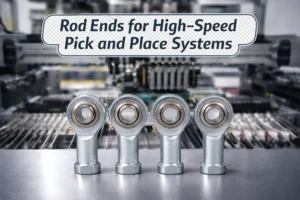
Delta robots and linear pick-and-place units in packaging lines run at 60 to 150 picks per minute on mid-to-high-speed systems. The parallel link arms connecting the drive unit to the end effector need rod ends at both ends — these accommodate the changing angular relationship between links as the arm traces its trajectory. Any rigidity creates side loading on the joints, and side loading at 100 cycles per minute destroys bearings quickly.
For delta robots at the upper end of that speed range, moving mass matters. Lightweight aluminum or composite-body rod ends are often specified specifically to reduce the inertia that drives must accelerate and decelerate on every pick cycle.
Cam-driven mechanisms
Dosing units, product transfer mechanisms, and registration systems are commonly driven by rotating cam profiles. The follower arms tracking the cam are connected through rod ends to the output mechanism. These joints experience intermittent shock loads each time the follower enters a rise or drop on the cam profile. In high-speed applications, those shock events can reach 2–3x the nominal calculated operating load, which makes dynamic load capacity and shock tolerance the critical selection criteria — not the static catalog number.
The misalignment problem — why standard bearings don't work here
“Misalignment” in a packaging machinery context covers several overlapping phenomena. None of them are exotic. They’re built into the machine.
What actually causes misalignment
Manufacturing tolerances in welded frames accumulate. A frame that looks perfectly square at room temperature distorts slightly under operating conditions — thermal gradients from sealing elements, vibration from drives, bolted joints settling in. Over the machine’s service life, wear in pivot points and guide bushings adds further geometric drift.
Standard fixed-bore bearings don’t give when subjected to angular misalignment. They load unevenly. The rolling elements or sliding surfaces carry concentrated stress at their edges rather than distributing it across the full contact area. The result is accelerated wear and, eventually, spalling or seizure.
The self-aligning geometry advantage
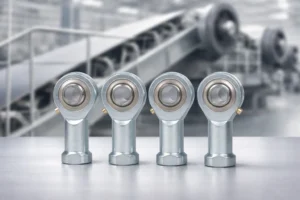
A spherical rod end places a ball with a convex outside diameter inside a housing with a matching concave bore. The ball can rotate in any plane passing through its center, so the inner ring can angle relative to the outer housing while the bearing continues to carry load across its full contact area.
There’s also a practical installation benefit that plain bushings don’t offer: the threaded shank is adjustable in length. In a packaging machine linkage, the assembly can be fine-tuned at commissioning to eliminate pre-load or play without shimming. That saves real time during machine build and line changeover.
Material selection — getting it right before the machine is built
Material selection for rod ends in packaging machinery isn’t just a procurement call. In regulated environments, it directly affects compliance costs, cleaning protocol complexity, and contamination risk.
Carbon steel: the default option and its limits
Carbon steel rod ends offer the highest load capacity at the lowest price. For dry, non-food industrial packaging — cardboard boxing machines, general goods palletizers — carbon steel is often the right answer. The tradeoff is rust. In any environment with washdown cycles, humidity, or product residue exposure, unprotected carbon steel corrodes. Replacing corroded rod ends is cheap per unit; the unplanned downtime and contamination risk are not.
Stainless steel: the food-grade baseline
For food and beverage, dairy, pharmaceutical, and cosmetic packaging, stainless steel rod ends with AISI 304 housings and 440C heat-treated, precision-ground ball components are the standard starting point. The 304 austenitic body handles most cleaning chemicals without surface degradation. The 440C martensitic ball is chosen for hardness and wear resistance — its heat treatment gives it the surface integrity that a softer 304 ball would lose quickly under load. The two materials complement each other: the housing resists corrosion, the ball resists mechanical wear.
One non-negotiable here: stainless-on-stainless metal contact is prone to galling — cold welding where mating surfaces seize under load and friction. In any stainless rod end application involving consistent load and motion, a PTFE liner or specialized lubricant isn’t optional. It’s what prevents the ball from seizing inside the housing.
Stainless rod ends typically cost 30–50% more than carbon steel depending on configuration. That premium changes appearance when you measure it against the alternative: compliance costs in a food-grade environment, documentation burden from a corrosion-related contamination event, and more frequent replacements.
PTFE-lined and maintenance-free: the long-interval solution
PTFE-lined rod ends add a composite liner between the ball and the housing bore. PTFE is chemically inert against most processing chemicals, has very low friction, and is FDA compliant for food-contact adjacent applications. The operating range of approximately -54°C to 163°C (-65°F to 325°F) covers most packaging line temperature profiles, including in-line heat tunnels and sterilization-adjacent zones.
The practical benefit is no scheduled greasing, no lubrication-related downtime, no risk of lubricant contamination reaching the product stream. For high-cycle applications where stopping to grease linkage points adds up to hours annually, or for lines where food-grade lubricants are mandatory (adding both cost and documentation overhead), the PTFE premium typically pays back within a single maintenance cycle.
Material quick reference
| Application environment | Recommended rod end |
|---|---|
| Dry industrial packaging (cardboard, general goods) | Carbon steel, standard grease-lubricated |
| Food, beverage, dairy (regular washdown) | 304SS housing + 440C ball, PTFE-lined |
| Pharmaceutical / cosmetic (strict hygiene) | Full 316L stainless + PTFE composite, maintenance-free |
| High-speed continuous lines (max uptime priority) | Maintenance-free, any compliant material |
Load, speed, and fatigue — what the numbers actually mean
Numbers on a rod end datasheet matter, but they need to be applied to the actual loading pattern of the application. A few things worth knowing before you finalize a spec.
Radial vs axial load capacity
Most packaging machine linkage applications load rod ends primarily in the radial direction. Sealing bar drive linkages often have an axial component as well, particularly when the linkage geometry changes at the extremes of travel. Specifying a rod end sized only for its radial rating without accounting for axial loading leads to premature spherical bearing wear. Keep axial loading below 10–15% of the static radial load rating — beyond that threshold, the ball migrates within the race and accelerates edge wear.
Cycle rate and fatigue life
A rod end in a VFFS machine running at 80 bags per minute executes 4,800 full oscillation cycles per hour. Running two full 8-hour shifts, that’s close to 77,000 cycles per day. Most rod end manufacturers publish dynamic load ratings using Hertz contact stress methodology, but the relevant number for high-cycle machinery is the fatigue-modified rating — the load at which the bearing achieves a defined L10 life in millions of cycles.
Ball-type rod ends handle higher speeds and lighter loads with lower friction. Roller-type rod ends carry heavier loads but add internal friction that limits maximum cycle rate. Packaging machinery generally falls in the ball-type range, unless the application involves unusually heavy product weights or long lever arms.
Shock load factor
Cam-driven and pneumatically actuated packaging components generate shock events. Dynamic loads during cam follower transitions commonly reach 2–3x the nominal operating load. Standard practice is to apply a shock factor of 1.5–2.5x to the calculated dynamic load before checking against the bearing’s dynamic rating. Note that the static load rating (C₀) is the threshold for permanent deformation — a shock load exceeding C₀ means immediate damage. The shock factor calculation is applied to the dynamic rating, not compared against C₀ as a safe multiple.
Maintenance strategy — lubricated vs maintenance-free in practice
The choice between standard lubricated rod ends and maintenance-free variants gets framed as a cost question. It’s more useful to treat it as a risk question.
The hidden cost of lubrication schedules
Standard rod ends with grease fittings need periodic lubrication — typically every 500 to 2,000 operating hours depending on load and speed. On a packaging line with dozens of rod ends across multiple mechanisms, that adds up. Calculate the technician time per lubrication event, multiply by frequency across all joints, and the annual labor cost of keeping those joints properly greased often exceeds the price difference between standard and maintenance-free units.
Under-lubrication is the more common failure mode. In a busy production environment, lubrication intervals slip. A dry rod end running under load generates heat, the bearing surface wears rapidly, and radial play develops. The machine starts producing off-spec output before anyone traces the root cause to a rod end that went dry six weeks earlier.
Over-lubrication isn’t better. Excess grease migrates to product contact zones, triggering food safety protocols that stop the line for cleaning.
When maintenance-free makes economic sense
Maintenance-free rod ends deliver consistent performance throughout their rated service life without intervention. The break-even point versus standard lubricated units depends on three things: line speed (higher speed means more cycles means more frequent greasing), accessibility of the joint (hard-to-reach joints cost more to service), and the regulatory environment (food-grade lubricants cost more and require documentation).
For high-speed food and pharmaceutical packaging lines, the math usually comes out clearly. Total cost of ownership — lubricant, technician time, food-grade compliance, and unplanned downtime from missed lubrication events — consistently favors the maintenance-free option.
Wear detection and replacement timing
Radial play in a rod end is detectable by hand during scheduled inspections. Grip the connected component and check for movement relative to the housing. Manufacturers typically specify maximum allowable play before replacement, commonly 0.05–0.15mm depending on bearing size and application. Catching rod ends at this stage, before they cause process drift, is the difference between a planned replacement and an unplanned line stop.
Selection checklist
Specifying a rod end for a packaging machine comes down to five questions, asked in this order:
1. Load direction and magnitude. Is loading primarily radial, axial, or combined? Apply a 1.5–2.5x shock factor if the mechanism involves cam-driven or impact events, and verify against the dynamic rating — not against C₀.
2. Motion type and cycle rate. Oscillating, rotating, or multi-directional? Calculate expected annual cycles against the bearing’s L10 fatigue life to confirm adequate service life.
3. Environmental conditions. Moisture, cleaning chemicals, product residue? This determines material: carbon steel for dry industrial environments, stainless for food-grade, PTFE-lined stainless for maximum chemical resistance.
4. Maintenance access and interval. Can the joint be serviced at the required frequency without stopping the line? If access is difficult or intervals are tight, step up to a maintenance-free design.
5. Regulatory requirements. Food, pharmaceutical, or cosmetic production requires FDA-compliant materials. Confirm bearing liner and housing compliance before the specification is finalized.
Matched to these five factors, rod ends from standard industrial grade to full stainless PTFE-lined configurations cover the full range of automated packaging machine requirements. SYZ Machine produces industrial rod ends across these material families — carbon steel, stainless steel, and PTFE-lined variants — all CNC-machined to tight dimensional tolerances that support the precise alignment packaging machinery demands.
When a packaging line starts producing off-spec seals or inconsistent dosing, check the rod ends in the linkage system. They’re small, they’re distributed throughout the mechanism, and when they’re right, nobody notices them. That’s the point.