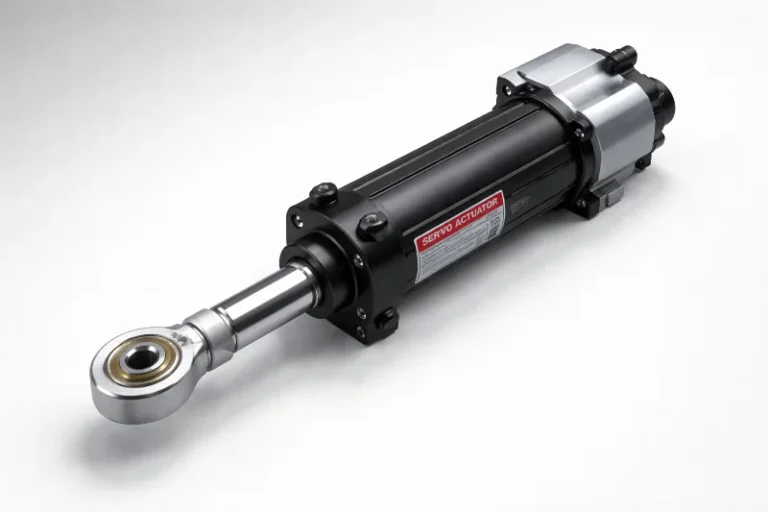
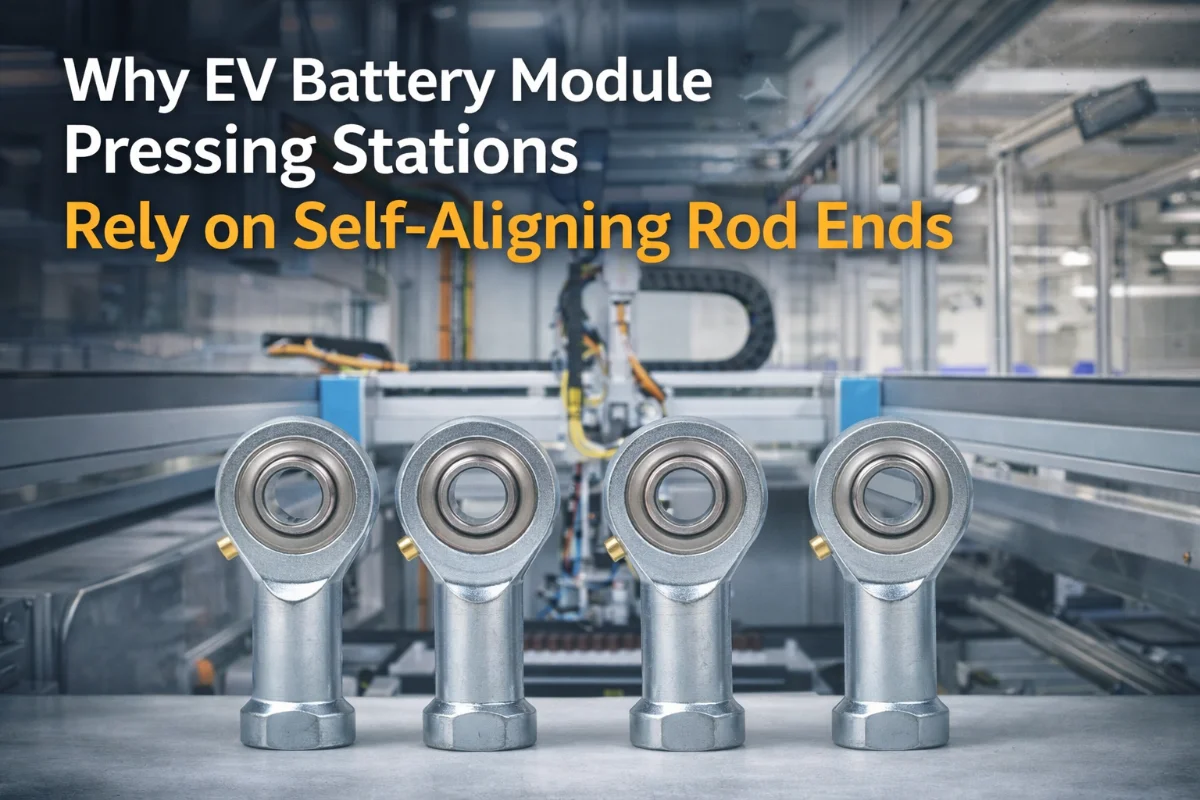
Battery module pressing stations look straightforward on paper: a servo actuator pushes a tooling plate down onto a stack of cells, applies controlled force, and holds position. The actual mechanics are considerably more demanding. The cells being pressed are expensive, sensitive to uneven loading, and dimensionally intolerant of tooling that wanders even a fraction of a millimeter off-axis. And the press hardware—actuators, frames, tooling plates, guide columns—never behaves as perfectly as the CAD model suggests.
That gap between the ideal and the real is exactly where rod ends earn their place.
The Precision Challenge Inside a Battery Module Press
Modern EV battery modules—prismatic, pouch, or cylindrical—are assembled under tightly controlled mechanical conditions. Pressing operations typically serve one of several purposes: compressing cell stacks to establish electrical and thermal contact between cells and cooling plates, seating end plates under load before welding or fastening, or pressing bus bars and connectors into position with precise force profiles.
The force requirements vary considerably. Light compression passes on pouch cell stacks might apply 20–50 kN spread across the module length. End plate pressing for larger prismatic modules regularly reaches 100–200 kN or higher. What all of these operations share is a demand for the applied force to be uniformly distributed—not concentrated at one edge of the tooling, not skewed by a misaligned actuator rod, not shifted by the frame moving slightly under load.
Sub-millimeter cell alignment is a baseline expectation in this environment. The electrodes inside each cell have been positioned to tight tolerances during cell manufacture. Any lateral or tilting force introduced during module assembly risks compromising cell integrity—or at minimum throwing off the dimensional control that downstream fastening and welding operations depend on.
Three Sources of Misalignment in a Pressing Station
- A pressing station frame doesn’t deform randomly. But it does deform. Under full press load, the vertical columns deflect by calculable amounts; mounting surfaces tilt; the relationship between the cylinder attachment point and the tooling contact face shifts slightly from its unloaded geometry. For a machine pressing at 100 kN, frame deflection of 0.1–0.3 mm is realistic and well-documented in industrial press literature.
- Thermal drift adds another variable. A pressing station running several hundred cycles per hour generates heat in the actuator, the guide columns, and the frame itself. Differential thermal expansion between steel frames and aluminum tooling plates—common in EV manufacturing where lightweight tooling is preferred—introduces geometric changes that are gradual, hard to measure during production, and cumulative over a shift.
- The third factor is tolerance stack-up. Every part in the assembly chain—the actuator flange, the adapter plate, the tooling body—is manufactured to a tolerance. Stack those tolerances across eight or ten interfaces and the theoretical centerline of the cylinder rod and the center of the tooling contact surface may disagree by several tenths of a millimeter before the machine has pressed a single module.
None of these are failures of design or manufacturing. They are normal behaviors of real mechanical systems under real operating conditions. The engineering question is how to accommodate them without introducing parasitic loads into components that can’t handle them.
The Critical Interface: Actuator to Tooling Plate
The connection between the actuator rod and the tooling plate is where misalignment damage accumulates fastest—and where rod ends deliver their most important function.
Without a self-aligning joint at this interface, any angular offset between the cylinder axis and the tooling plate face gets resolved as a bending moment on the cylinder rod. Servo cylinders and ball screw actuators are designed to handle axial loads precisely. They are not designed to handle bending. A sustained side load of even 1–2 kN on a cylinder rod—small relative to the pressing force—is enough to accelerate seal wear, distort the rod’s travel path, and introduce position errors that accumulate over thousands of cycles. In a high-volume EV production environment, that translates to unplanned downtime and recalibration cycles.
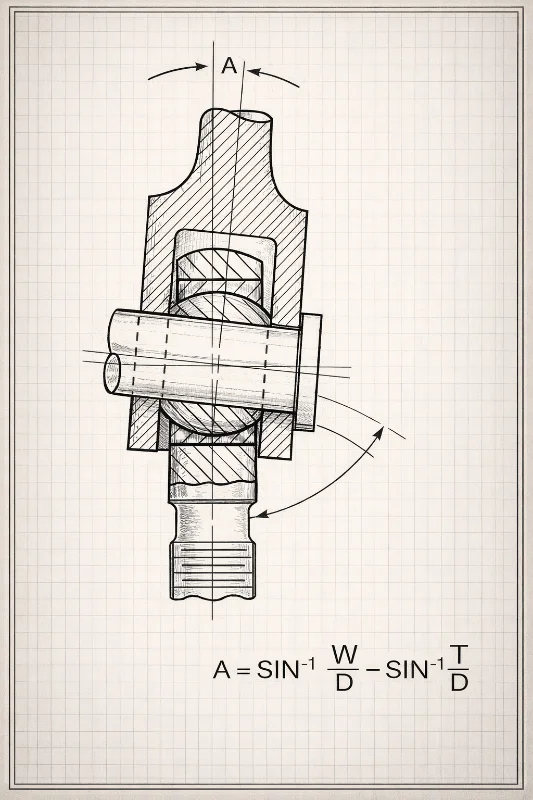
A rod end at the cylinder-to-tooling connection resolves this. The spherical bearing inside the rod end housing allows the tooling plate to find its natural flat contact position against the module surface, while the cylinder rod stays on its designed axial load path. Parasitic bending moments are absorbed by the rod end’s geometry rather than transmitted into the actuator.
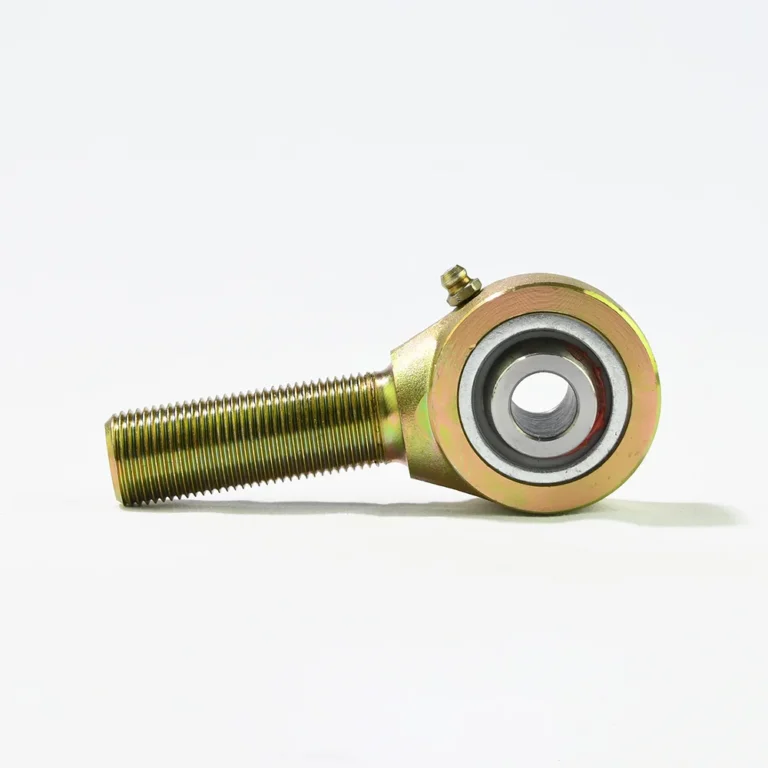
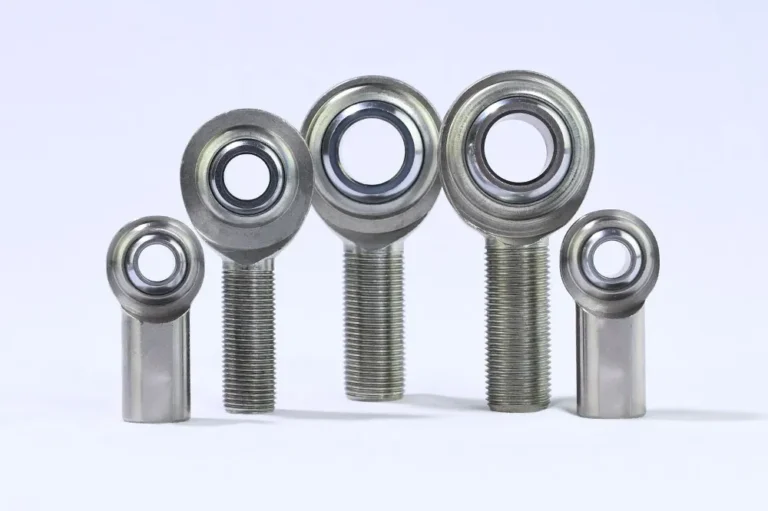
Typical configurations use a male-thread rod end on the cylinder rod side, paired with a clevis bracket or flanged mount on the tooling plate side. The thread engagement allows fine adjustment of the working length—useful during initial setup and tooling changeovers. Angular misalignment capacity of ±6° to ±10° covers the real-world offsets encountered in most pressing station installations, with margin to spare.
For pressing forces in the 50–200 kN range typical of battery module operations, rod ends with static radial load ratings of 150–600 kN are commonly specified, applying a safety factor of 3–5× to account for dynamic loading and the cyclic nature of pressing operations.
One point worth flagging for structural engineers: adding a rod end at the cylinder rod connection converts what was a “fixed-guided” end condition into a “pinned” end. This lowers the Euler buckling limit for the rod. According to press engineering references, this is manageable with correct rod diameter selection but must be re-verified during the design phase—particularly for long-stroke actuators operating near their load capacity.
On force measurement: a rod end at this interface doesn’t just protect the actuator—it protects accuracy. When the connection is rigid and misaligned, the load cell sees a combination of the intended pressing force and the unintended side load, skewing readings by 2–8% depending on installation geometry. The rod end keeps the force vector perpendicular to the load cell’s sensing axis, which is what strain gauge bridges are calibrated to measure. The reading gets cleaner.
Other Locations Where Rod Ends Show Up
The actuator-to-tooling interface gets the most engineering attention, but experienced press designers know it’s rarely the only place rod ends are needed.
Tooling height and position adjusters are a common second application. Battery pressing stations often handle several module variants, requiring tooling plate position adjustments between model changeovers. A rod-and-turnbuckle arrangement with a right-hand thread rod end on one end and a left-hand thread on the other lets technicians extend or shorten the effective rod length precisely—one full turn on a 2 mm pitch thread advances 2 mm; a quarter turn moves 0.5 mm. No hydraulics, no shimming, and the left/right thread combination resists unintended rotation under vibration better than a single-thread setup.
Load cell protection is another place where a rod end is doing quiet but critical work. Load cells are calibrated for pure axial loading. Any bending moment from a misaligned press ram introduces parasitic signal into the measurement—the sensor reads the intended pressing force plus whatever side load is present. Depending on installation geometry, this measurement error can reach 5–10% of the value at typical press forces. A rod end at the load cell interface keeps the force vector properly aligned with the sensing axis and eliminates this error source over the machine’s operating life.
End plate clamping arms benefit from rod ends at their pivot points, particularly where the actuating cylinder connects to the clamping lever. As the arm swings through its travel arc, the geometry between the cylinder axis and the lever changes continuously. A rod end pivot handles this naturally while remaining rigid against the clamping load direction.
Guide pillar connections deserve a more careful note. In some pressing station designs—particularly “floating platen” architectures where the platen is intentionally allowed to self-level under load—rod ends or spherical plain bearings at the guide column interfaces allow controlled angular compliance and prevent binding. This is a deliberate design strategy, not a general recommendation. Standard pressing stations with rigid linear guide bushings do not need this treatment and would be compromised by it. If the design intent is a rigid guided platen, linear bushings remain the correct choice.
Selecting Rod Ends for EV Battery Manufacturing Environments
A standard catalog rod end from an automotive racing supplier is not automatically the right choice here. The manufacturing environment introduces requirements that most motorsport applications don’t face.
Lubrication-free operation. Battery cell manufacturing lines run at cleanliness levels incompatible with oil or grease on mechanical components. Lubricant contamination of battery cells or electrodes is a yield problem, and a rod end weeping grease near the tooling is not an acceptable risk. PTFE-lined rod ends address this directly: the PTFE/fabric composite liner between the ball and race provides self-lubrication with zero external lubricant. Relubrication intervals—a real operational cost in high-cycle press equipment—are eliminated. PTFE-lined stainless rod ends used in pharmaceutical and clean manufacturing environments consistently show longer service life under regular sanitization conditions than standard steel alternatives.
PTFE liners are typically rated for operating temperatures up to 120–150°C, which covers battery pressing stations in normal operation. The trade-off is reduced dynamic load capacity compared to hardened steel-on-steel configurations—which is why the safety factor matters more, not less, in maintenance-free applications. In high-speed EV lines running 3–6 second cycle times, the dynamic load rating and liner wear life are often the actual limiting factors for maintenance intervals, not the static load capacity.
Material: 316L body, 440C ball. Pressing stations in EV manufacturing environments are cleaned regularly with mild aqueous agents or alcohol-based wipes. Carbon steel with standard zinc plating corrodes under these conditions over time. The body and housing should be 316L stainless steel for corrosion resistance. The ball, which takes the contact load and wear, is typically 440C stainless or hard-chrome plated steel—harder and more wear-resistant than 316L, which is too soft for bearing surfaces under cyclic load. Both materials coexist in most quality maintenance-free rod end designs.
Angular misalignment range and the trade-off. Battery pressing station geometry typically requires ±4° to ±8° at the main actuator interface. Tooling adjuster linkages may need ±15° or more. Worth understanding the trade-off: angular misalignment capacity and radial load capacity move in opposite directions as misalignment angle increases. A rod end with ±25° misalignment will have a lower static load rating than the equivalent body size at ±6°. Specify the angle you actually need, not the maximum available.
Internal clearance in precision applications. Standard rod ends carry internal radial clearance of roughly 0.02–0.05 mm between the ball and the liner. In most pressing applications this is inconsequential. For stations with very tight compression depth tolerances—say, ±0.05 mm or tighter—this clearance creates a small mechanical dead-band during the transition from approach to pressing. For these cases, pre-loaded or zero-clearance spherical bearings are available and worth specifying.
Thread retention. In high-cycle pressing applications, the threaded shank can work loose from vibration. Proper installation includes thread locking compound or mechanical retention—jam nuts, safety wire—to prevent loosening. As documented in rod end installation references, this is especially relevant in vertical installations where gravity-assisted loosening adds to the vibration effect. Left-hand/right-hand thread combinations in turnbuckle arrangements are inherently more secure than single-thread configurations.
A Practical Checklist for Pressing Station Rod End Selection
The engineering considerations above break down into a workable selection sequence.
Load and geometry first:
- Calculate maximum static press force, then apply a 3–5× safety factor for the rod end static radial load rating
- For long-stroke actuators, re-verify buckling load after adding a pinned end condition at the rod end
- Estimate maximum angular misalignment at each interface, factoring in frame deflection, thermal drift, and tolerance stack-up
- Confirm thread size and engagement length match actuator rod specifications
Environment second:
- Lubrication-free required? Specify PTFE-lined
- Regular cleaning with aqueous or solvent-based agents? Specify 316L body with 440C ball
- Confirm PTFE liner temperature range covers operating conditions (−65°C to +150°C handles all standard pressing station environments)
Application-specific last:
- Tooling adjusters: specify left-hand/right-hand thread pair; the self-locking geometry is worth the small extra cost
- Load cell interfaces: select rod end with low-friction liner to minimize force measurement hysteresis
- Ultra-high precision compression depth control (±0.05 mm or tighter): consider pre-loaded zero-clearance spherical bearings
- High-cycle installations: add jam nuts and thread locking compound regardless of orientation; plan for periodic inspection
SYZ Machine supplies industrial rod ends in standard steel and full stainless configurations, with PTFE-lined options across common metric thread sizes (M10–M64) used in industrial pressing equipment. Custom thread forms and body configurations are available for stations with non-standard actuator interfaces.