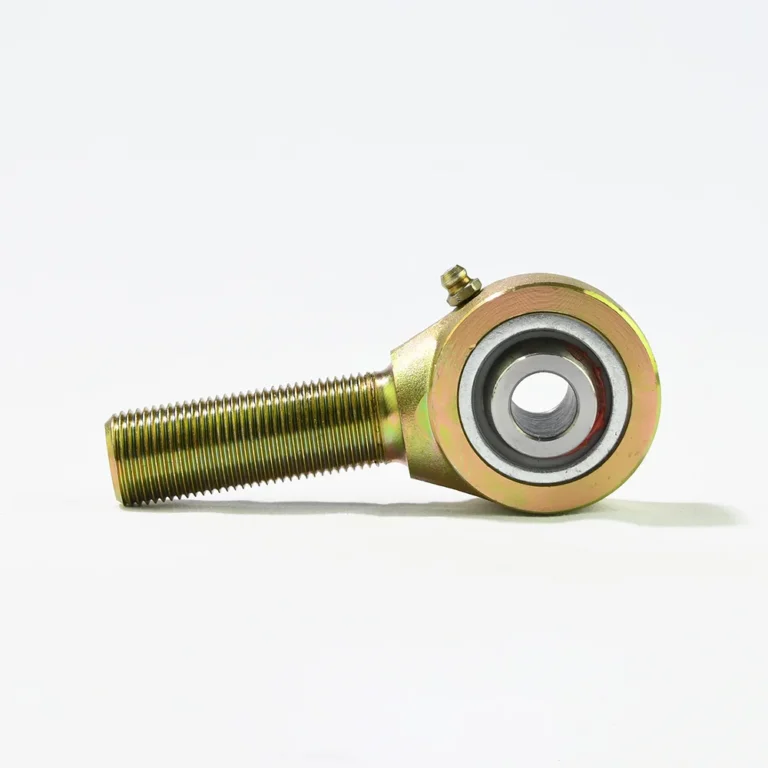
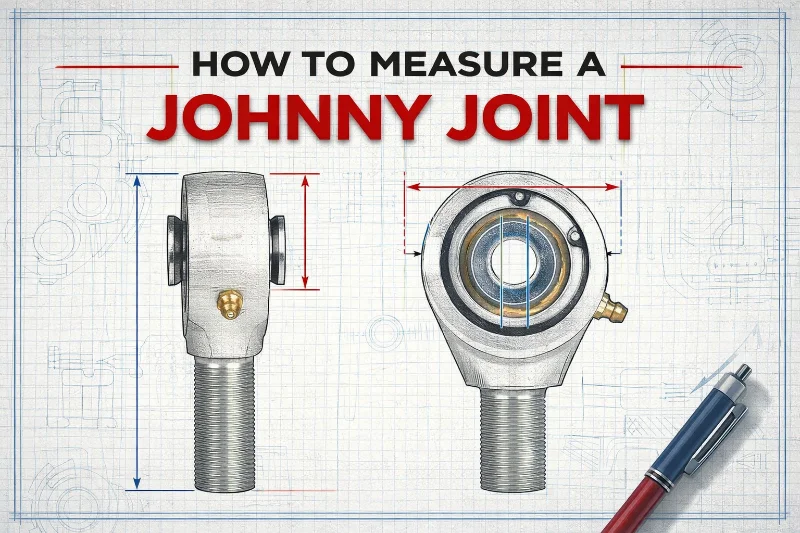
A johnny joint that doesn’t fit is worse than no joint at all. Buy the wrong size and you’re waiting on another order, your build is stalled, and you still have the wrong part on your bench. The frustrating part: most fitment errors happen not because the catalog description is wrong, but because the builder measured the wrong dimension — or didn’t measure at all and guessed by eye.
Johnny joints have size critical dimensions. Each one matters for a different reason. Miss one, and the joint either won’t thread onto your link, won’t clear the chassis bracket, won’t accept your clevis pin, or will articulate less than your suspension geometry demands. This guide covers exactly which dimensions to measure, how to take each measurement correctly, and what to do with the numbers once you have them.
Why You Can’t Just Match by Housing Size
The outside diameter of the housing is what most builders look at first. It’s visible, easy to measure, and feels like the obvious place to start. It’s also close to useless on its own.
A 1.25″ housing OD can sit on a 3/4″ bore, a 7/8″ bore, or a 1″ bore depending on the manufacturer. Two joints with identical housing ODs can have different body widths — narrow versus standard — that change whether they clear a specific bracket. The thread size on the shank or body end can be 3/4″-16, 7/8″-14, or any of several others regardless of the housing diameter.
The housing OD tells you one thing: whether the joint physically fits into the space it needs to occupy. The other four dimensions determine whether it actually works.
The Tools You Actually Need
Before touching the joint, get the right tools. Using a tape measure or a steel rule for this work produces numbers that are wrong by enough to matter.
Digital calipers — the primary tool for every measurement except thread pitch. A 6″ digital caliper with 0.001″ (0.02 mm) resolution is sufficient. Harbor Freight’s version is accurate enough for this purpose if budget is the constraint; a Mitutoyo or Starrett unit is better if you measure parts regularly. Vernier calipers work but require more care to read accurately.
Thread pitch gauge — a set of folding thread combs is inexpensive and makes thread identification definitive. Without one, you’re guessing, and thread identification by eye is unreliable between coarse and fine pitches on similar-diameter shanks.
Angle finder or smartphone inclinometer app — for articulation angle, either a mechanical angle gauge or the level/angle function in a smartphone app is adequate. This measurement doesn’t require precision to the degree — you’re confirming the joint can reach the geometry your suspension demands, not certifying a dimension for a technical drawing.
A 12″ steel rule is useful for overall body length if your calipers are only 6″ and the joint is longer. Everything else the calipers handle.
Dimension 1: Body Outer Diameter
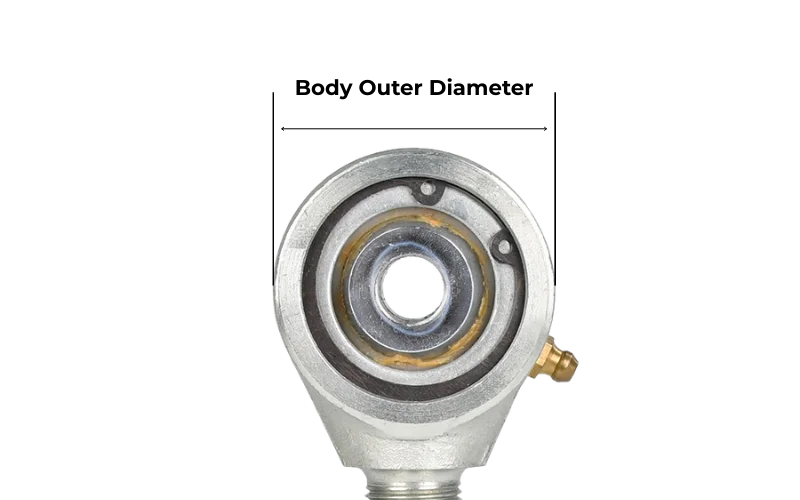
The body OD determines fit into chassis brackets and link body tubing. If you’re replacing an existing joint, measure the housing of the joint you’re removing — not the bracket hole. Worn joints in worn brackets create clearance that a new joint won’t have.
How to measure: Open the caliper jaws, place them across the widest point of the joint housing — perpendicular to the bore axis — and read. Take the measurement in two or three orientations 90° apart to check for housing wear or ovality. On a new joint, the readings will agree. On a worn joint, the difference tells you something about how the housing was loaded.
Common sizes for off-road truck applications: 1.25″ (31.75 mm), 1.5″ (38.1 mm), and 2.0″ (50.8 mm) housing OD. Jeep-family builds concentrate around 1.25″; light truck and larger fabrication work runs heavier.
Dimension 2: Body Width (Narrow vs. Standard)
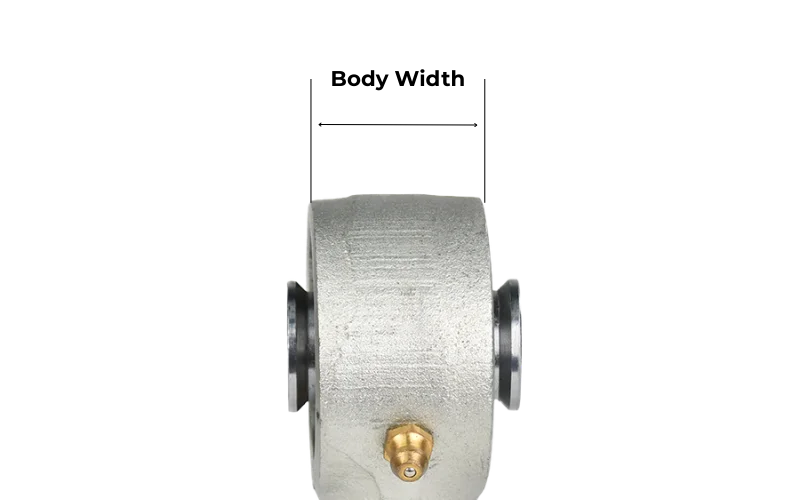
This is the measurement that surprises builders who didn’t know narrow and standard configurations exist. Body width is the distance across the joint housing parallel to the bore axis — in other words, the face-to-face thickness of the housing that sits inside a clevis or bracket.
How to measure: Flip the caliper to use the depth rod or the step jaws. Place the jaws against the two flat faces of the joint housing (the faces that contact the clevis bracket, not the curved bearing surface). Record the dimension.
Narrow body joints typically measure around 1.25″ to 1.5″ across this face. Standard body joints run wider, typically 1.75″ to 2.0″ or more. The difference matters when the bracket slot width is fixed — as it is on most manufactured crossmembers and link brackets. A standard-body joint in a narrow-bracket application simply doesn’t fit. A narrow-body joint in a standard-bracket application has excess slop unless you add spacers.
If you’re building brackets from scratch, this measurement tells you the slot width to cut. If you’re fitting into existing brackets, measure the slot and then select the body width accordingly.
Dimension 3: Mounting Width (Ball Width)
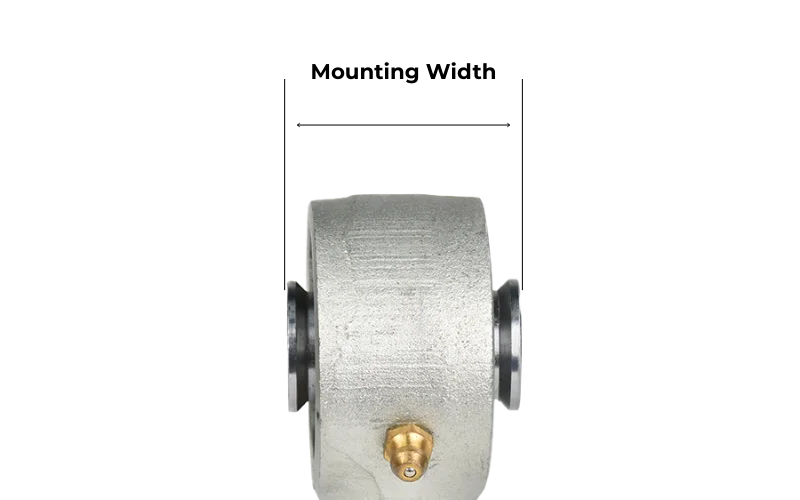
While body width dictates housing clearance, mounting width is the dimension that determines if the joint will physically bolt into your chassis brackets. This is the total distance measured across the flat faces of the inner pivot ball (the part the bolt passes through).
How to measure: Use the outer jaws of the caliper. Place them firmly against the two parallel flat faces of the center steel ball. Ensure the caliper is centered on the bore to get the widest point of the flats. On a new joint, these surfaces are precision-ground and should be perfectly parallel. On a used joint, check for “mushrooming” or deformation around the bolt hole caused by under-torqued hardware, which can artificially increase this measurement.
Common mounting widths: The industry standard for most Jeep and off-road suspension brackets is 2.625″ (2-5/8″). Other common sizes include 2.0″, 2.44″, and 3.0″ for custom or heavy-duty fabrication. It is vital to match this to your bracket’s internal spread. A 2.625″ joint will not fit into a 2.5″ bracket, and putting a 2.0″ joint into a 2.625″ bracket creates a dangerous gap that even high-grade bolts cannot safely “crush” closed.
Why it matters for fitment: This is the “make or break” specification for installation. If you are sourcing joints for existing tabs or brackets, measure the inside distance between the bracket faces first. The mounting width of the Johnny Joint should match this distance within a few thousandths of an inch. If there is a slight gap (less than 1/16″), hardened stainless steel spacers or shims can be used to center the joint, but for high-stress suspension links, a direct-fit mounting width is always preferred to ensure the bracket maintains its structural integrity when the bolt is torqued to spec.
Dimension 4: Bore Diameter (Pin Diameter)
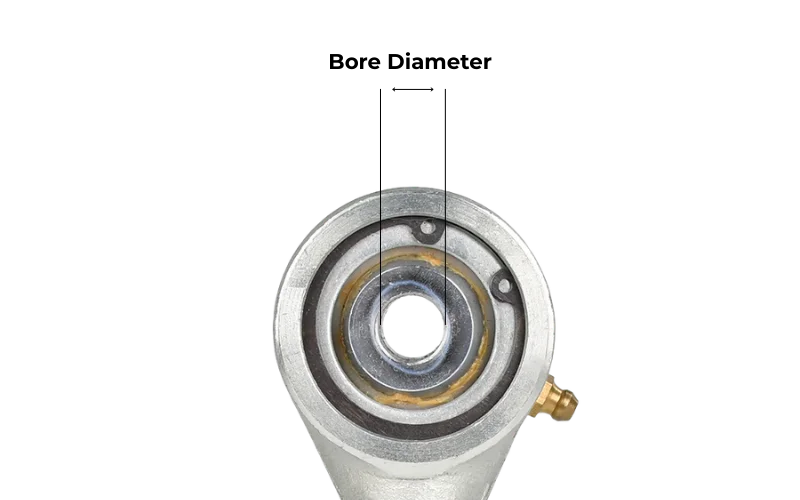
The bore is the hole through the center of the spherical bearing — the hole your clevis pin or mounting bolt passes through. This is the most mechanically critical dimension. An undersized bore means the pin won’t go in. An oversized bore means the pin has sloppy lateral play, which creates articulation slop that has nothing to do with the joint’s angular range.
How to measure: Use the inside jaw of the digital caliper — the smaller, stepped jaw tips above the main jaws. Open them to just contact the bore wall on both sides. Measure through the bore at 0°, 90°, and if accessible, 45°. The readings should agree on a new joint. Worn joints develop elongation in the bore from pin contact cycles.
Common bore sizes: 3/4″ (19.05 mm), 7/8″ (22.23 mm), and 1″ (25.4 mm). Metric bores — 19 mm, 22 mm, 25 mm — can be deceptively close to the inch equivalents. A 3/4″ pin is 19.05 mm; a 19 mm bore is 0.05 mm undersized for it. That’s tight enough to require a press on some joint and pin combinations, and loose enough on others to slip through with no interference. Verify whether the dimensions are imperial or metric before ordering.
Checking bore-to-pin fit: If you already have the clevis pin, test it before installing. The pin should slide through with moderate hand pressure — no binding, no rotational slop. A pin that requires a mallet indicates undersized bore or dimensional interference somewhere. A pin that rattles sideways indicates oversized bore or undersized pin.
Dimension 5: Thread Size and Pitch
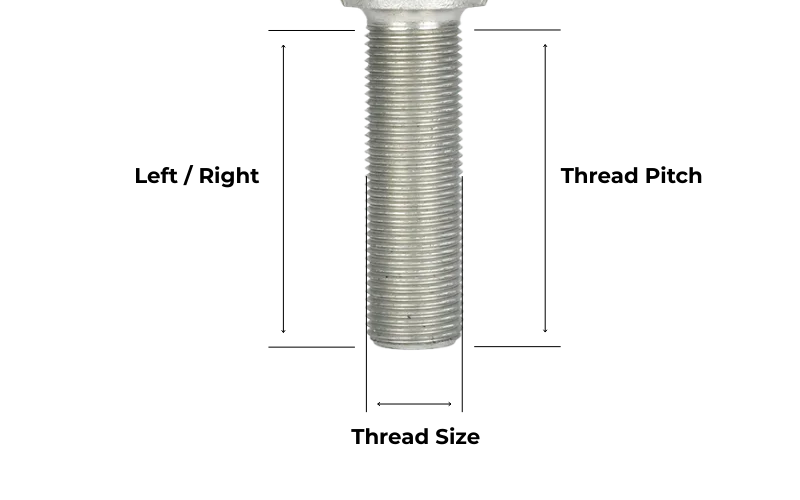
Johnny joints attach to link tubes either by a threaded shank on the joint body or by threading a female receptacle onto a threaded link end. Either way, the thread must match the link end or tube weld-in. Mismatch here means the joint doesn’t attach at all.
Thread diameter: Measure the shank OD using the outer jaws of the caliper across the thread crests. This gives the nominal thread diameter — but thread diameter alone is not enough to identify the thread.
Thread pitch: Run the thread pitch gauge across the shank threads until a comb seats cleanly with no rocking. Common thread specifications on johnny joint shanks: 3/4″-16, 7/8″-14, 1″-14, 1″-12, and 5/8″-18 on smaller joints. The nominal diameter measured with calipers should match the labeled diameter on the pitch gauge comb that seats cleanly.
If you don’t have a pitch gauge, count threads across a 1″ span and compare to common pitch values — but this is imprecise and risks a miss between 14 tpi and 16 tpi or between metric and near-metric pitches. A thread pitch gauge costs under $15 and makes the identification definitive.
Right-hand or left-hand: Johnny joints on the opposite end of a link from a turnbuckle arrangement are often left-hand threaded — when you need to adjust link length by rotating the tube, both ends need to thread in opposite directions. Left-hand threads have a visual indicator: an undercut groove or notch on the shank near the body in most catalog products, but not all. If the joint is coming off a used vehicle, check the thread direction before assuming it’s standard right-hand.
Dimension 6: Articulation Angle
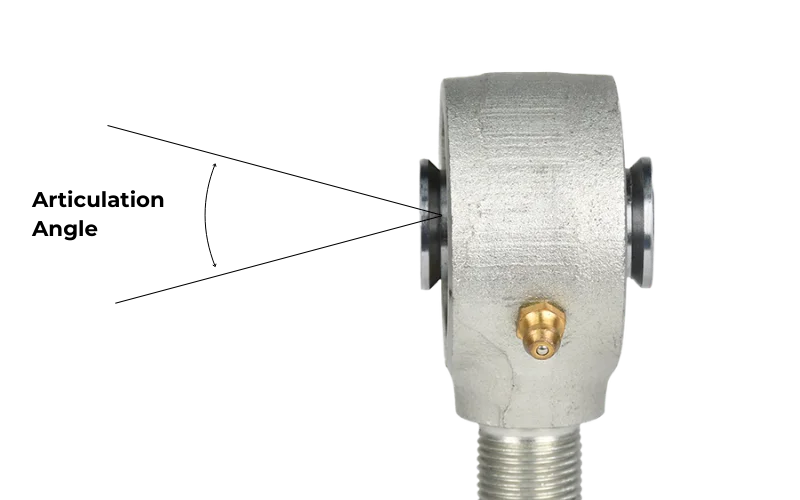
Articulation angle is the angular range through which the bearing can rotate before the ball contacts the housing and locks. This is not a caliper measurement — it’s a functional test or a catalog specification to verify against your suspension geometry requirement.
How to measure on an in-hand joint: Secure the joint body and rotate the shank (or the bore, depending on configuration) until it contacts the housing stop. The angle between the centered position and the hard stop is the rated articulation angle. Most builders use a digital angle finder: set it on the shank in the centered position, zero it, then rotate to the stop and read the angle. Some joints are symmetric (equal angle each direction); some are asymmetric depending on how the housing is designed.
What the number means in practice: A joint rated at ±30° total articulation gives ±15° each side of center. If your suspension geometry at full droop requires the joint to reach 18° of offset, a ±30° joint fails. The math is simple; the mistake is assuming that more articulation is always available without checking.
Common ranges by application:
- Light off-road use: ±30° to ±36° total articulation
- Dedicated rock crawling: ±40° or more is common for long-travel setups
- Narrow body joints often have slightly reduced articulation compared to standard body equivalents at the same housing size, because the narrower housing limits the housing cutout depth
If a used joint is on the bench and you’re assessing whether it’s still serviceable, check that it articulates smoothly without catching or grinding through the full range. A joint that moves freely at center but binds at 10° has a worn or damaged liner — the angle rating on the box is irrelevant if the bearing isn’t operating cleanly.
Putting the Measurements Together: A Quick Reference Checklist
Before ordering a replacement or specifying a new joint, confirm all six dimensions:
Johnny joint measurement checklist
- Body OD: _____ inches / mm (bracket fit, link body clearance)
- Body width: _____ inches / mm (narrow or standard — check bracket slot width)
- Mounting Width: _____ inches / mm (distance across ball flats — must match bracket internal spread)
- Bore diameter: _____ inches / mm (confirm against clevis pin or mounting bolt OD)
- Thread: _____ diameter × _____ pitch, right-hand / left-hand
- Articulation: _____ degrees total (verify against max suspension geometry offset)
When the Numbers Don’t Match Any Standard Size
Older OEM linkage joints and some aftermarket assemblies were built to non-standard dimensions — metric housing OD with imperial threads, or bore sizes that don’t align with common clevis pin diameters. When this happens, you have three options: source a direct dimensional Johnny joint match from a specialty supplier, re-bore or re-thread the mating hardware to match a standard joint, or redesign the bracket to accept a standard joint.
Redesigning the bracket is usually the cleanest long-term answer. A custom bracket takes an afternoon; sourcing unusual joints takes indefinitely.