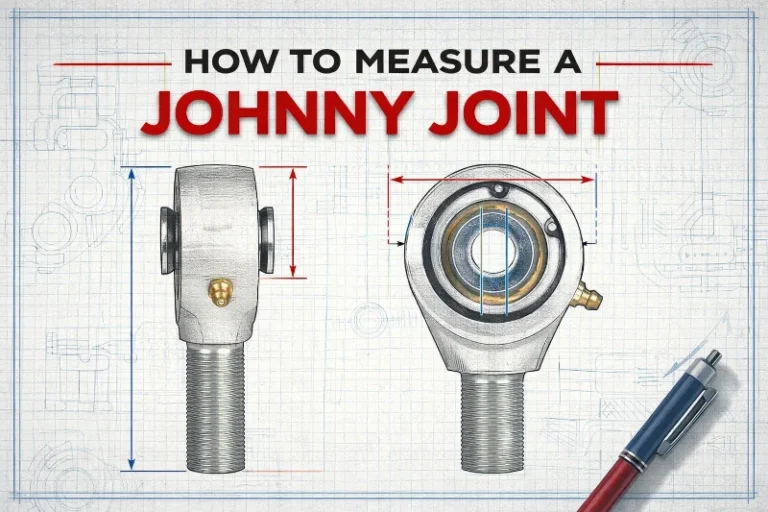

Ordering a replacement heim joint without measuring the existing one is how builders end up with a box of parts that won’t thread onto their linkage, won’t accept their clevis pin, and won’t clear their bracket — and then have to wait two weeks for the right one. The heim joint specification system looks simple from the outside: you pick a thread size and that’s it. It isn’t. Thread size is one of seven dimensions you need to verify before placing an order or specifying a new joint.
This guide covers all seven. For each one, you’ll get a clear explanation of what it controls, how to take the measurement with a digital caliper and thread pitch gauge, and what the common values look like in practice.
Why Thread Size Alone Isn't Enough
The thread specification — say, 1/2″-20 or M12×1.25 — is the number stamped on most packaging and referenced in most catalog search filters. It’s what builders use to order a replacement and it’s usually sufficient for a direct swap from one catalog brand to another. But it tells you only that the joint will thread onto your link end or tube. It tells you nothing about whether the spherical bearing bore matches your clevis pin, whether the housing fits your bracket, whether the joint has the misalignment angle your geometry demands, or whether the overall joint length changes your adjusted link length in a way that throws off alignment.
Measure the thread first, then measure the rest. All seven dimensions work together; getting four right and missing the fifth means the joint still doesn’t work.
The Tools You Need
Digital calipers — every measurement except thread pitch runs through here. A 6″ digital caliper with 0.001″ (0.02 mm) resolution is sufficient. Mitutoyo and Starrett are reliable; Harbor Freight’s house brand works for occasional use. Vernier calipers are accurate but slower to read. Either is better than a tape measure by a wide margin.
Thread pitch gauge — a folding set of thread combs identifies pitch definitively. Without one, you’re comparing thread pitch by eye between specifications that look nearly identical (3/8″-24 and 3/8″-16 look similar on the shank until you put a pitch gauge to them). A thread pitch gauge set costs under $15 and eliminates guessing entirely.
Angle finder or inclinometer app — for misalignment angle, a digital angle gauge or the angle function in a smartphone level app is accurate enough. You’re verifying that the joint can reach the offset your geometry requires, not certifying a dimension to a tolerance.
A 6″ steel rule is useful for overall length if the joint is longer than your caliper reach. Otherwise, calipers and a pitch gauge cover everything.
Dimension 1: Thread Size and Pitch

Thread specification is the starting point and the most commonly referenced dimension on a heim joint. It determines whether the joint will attach to your link tube end, turnbuckle body, or threaded rod end housing.
Thread diameter: Measure the shank OD (on a male joint) using the outer jaws of the caliper across the thread crests. This gives the nominal thread diameter. On a female joint, measure the thread ID using the inside jaws.
Thread pitch: Seat the thread pitch gauge combs against the threads until one comb fits cleanly without rocking. Common inch specifications on heim joints: 1/4″-28, 5/16″-24, 3/8″-24, 1/2″-20, 5/8″-18, 3/4″-16. Common metric specifications: M6×1.0, M8×1.25, M10×1.25, M12×1.25, M14×1.5, M16×1.5. The metric and inch systems overlap enough in nominal diameter to create confusion — a 3/8″-24 shank and an M10×1.25 shank are both close to 10 mm in OD. The pitch is different; the threads are not interchangeable; and forcing one into the other damages both.
Right-hand or left-hand thread: Standard heim joints are right-hand threaded. Left-hand versions are used in turnbuckle and adjustment applications where one end of a link must thread in the opposite direction from the other so the tube can rotate to adjust length without disconnecting. Left-hand thread joints are usually marked with an undercut groove or an “LH” stamp on the shank, but not always. If you’re removing a joint from an existing linkage, confirm thread direction before ordering a replacement.
Male versus female: Male joints have a threaded shank that screws into a tube or clevis. Female joints have a threaded bore in the body that accepts a stud or bolt. The thread specification is the same type of measurement for both — diameter and pitch — but the joint body is a different geometry. Confirm which configuration your application requires before measuring.
Dimension 2: Bore Diameter (Pin Hole)

The bore is the hole through the center of the spherical bearing — the opening your clevis pin, mounting bolt, or pivot shaft passes through. This is the most mechanically critical fit dimension. An undersized bore means the pin won’t go in without force. An oversized bore means the pin has lateral slop that lets the joint rattle under load even when everything else fits correctly.
How to measure: Use the inside jaws of the digital caliper — the small stepped jaws above the main jaws. Open them to contact the bore wall on opposite sides. Measure through the bore at 0°, then rotate 90° and measure again. On a new joint the readings should agree within your caliper resolution. A worn joint develops elongation in the bore from repeated load cycles against the pin — the two measurements will diverge, which tells you the joint has seen significant use.
Common bore sizes: Inch bore sizes: 1/4″ (6.35 mm), 5/16″ (7.94 mm), 3/8″ (9.53 mm), 1/2″ (12.7 mm), 5/8″ (15.88 mm), 3/4″ (19.05 mm).
Metric bore sizes: 6 mm, 8 mm, 10 mm, 12 mm, 14 mm, 16 mm, 20 mm.
The same overlap caution applies here as with threads: a 3/8″ bore is 9.53 mm; a 10 mm bore is 10 mm. Those 0.47 mm could be a press fit or a sloppy fit depending on your pin. Verify whether the specification is imperial or metric before assuming they’re interchangeable.
Bore-to-pin fit check: If you have the clevis pin in hand, test it before assembling. The pin should slide through with moderate hand pressure — no binding, no lateral rattle. A pin that requires a mallet to start means the bore is undersized or the pin is oversized; forcing it will damage the liner. A pin that shifts sideways when you try to wiggle it means the bore is oversized or the pin is undersized; that slop appears at the joint under load.
Dimension 3: Housing Outer Diameter

The housing OD is the outside diameter of the ring or body section that contains the spherical bearing — the widest point of the joint when measured perpendicular to the bore axis. This dimension determines whether the joint clears its surrounding structure: the bracket, the chassis tube, the rod end housing on the other end of the link.
How to measure: Open the outer jaws of the caliper and place them across the widest point of the joint body, perpendicular to the bore axis. Take the measurement in two orientations 90° apart to confirm the housing is round. On a new joint, the readings agree. A housing that’s been overloaded and deformed will show different readings at different orientations — a useful diagnostic on used joints.
What this dimension controls: Housing OD matters most when you’re fitting a joint into an existing bracket with a fixed cavity, or when you’re clearing a tube or structural member near the joint location. In direct-replacement applications where a catalog joint substitutes for another, housing OD varies less than bore and thread between equivalent-spec joints — but it does vary, especially between manufacturers. Don’t assume that a 1/2″-20 joint from one supplier has the same housing OD as a 1/2″-20 joint from another.
Common housing OD ranges by thread size (approximate, not exact across all manufacturers):
| Thread | Approximate Housing OD |
|---|---|
| 1/4"-28 / M6 | 16–18 mm |
| 3/8"-24 / M10 | 22–26 mm |
| 1/2"-20 / M12 | 28–32 mm |
| 5/8"-18 / M16 | 36–40 mm |
| 3/4"-16 / M20 | 44–50 mm |
Verify against your actual joint — these are representative ranges, not fixed specifications.
While the OD tells you the total width, the distance from the pivot center to the top—Dimension 6—is what dictates your internal bracket clearance.
Dimension 4: Housing Body Width and Overall Length

These two dimensions together determine how the joint occupies space in your assembly: the body width (also called ring width or housing width) tells you how much axial space the joint takes up at its widest point, and the overall length tells you the total joint dimension from the end of the shank to the opposite face of the housing.
Body width: The face-to-face distance across the flat sides of the housing — the faces that contact the bracket or clevis. Use the outer jaws or the depth rod of the caliper. This dimension determines the bracket slot width you need. A body that’s wider than the bracket slot won’t seat. A body that’s narrower than the bracket slot needs spacers to eliminate axial play.
Overall length: The total length from the end of the shank to the opposite face of the housing on a male joint, or from the end of the housing to the opposite end on a female joint. This dimension affects adjusted link length. If you’re replacing a worn joint with a new one from a different manufacturer, a difference of a few millimeters in overall length changes your link geometry unless you re-adjust at assembly. On critical steering and suspension linkages, account for the difference before locking in the adjustment.
How to measure overall length: Place the end of the shank flat against the fixed jaw of the caliper and bring the sliding jaw to contact the opposite face of the housing. On a long joint this can exceed the reach of a 6″ caliper — use a 12″ rule with the caliper to check if necessary.
On catalog datasheets, overall length is typically labeled **L** or **C**, body width is labeled **B** or **W**, and housing width is sometimes listed as a separate entry from the ring outside diameter. These labels vary between catalog standards (ISO, ANSI, JIS) — check which standard your supplier uses.
Note that Body Width refers to the housing itself; for the width of the pivot point, see Dimension 5.
Dimension 5: Mounting Width (Ball Width)

While Dimension 4 covers the housing thickness, the mounting width is the axial distance across the flat faces of the inner ball—the actual surface that contacts your spacers or bracket ears. In high-performance heim joints, the ball is almost always wider than the housing to allow for articulation without the link hitting the bracket.
How to measure: Use the outer jaws of the caliper to measure the distance between the two flat parallel faces of the internal rotating ball. Ensure the ball is centered within the housing before measuring. If the joint uses integrated high-misalignment spacers, measure from the outermost face of one spacer to the outermost face of the other.
Why this matters: This dimension determines the “stack height” of your hardware. If the mounting width is narrower than your bracket opening, you must fill the gap with shims or spacers. If it is wider, the joint will not fit. For precision steering setups, even a 0.5 mm discrepancy can lead to axial play (slop) that degrades handling and creates audible “clunking” under load.
Dimension 6: Head Radial Height (Center-to-Top)

Head radial height is the distance from the exact center of the bore to the outermost edge of the housing head, measured along the vertical axis of the joint. It represents the “radius” of the joint’s head.
How to measure: This is a derived measurement. First, measure the Housing Outer Diameter (Dimension 3). If the housing is perfectly symmetrical, the Radial Height is exactly half of the OD. To verify manually, use the depth rod of your caliper: place the base of the caliper against the outer crown of the housing and extend the rod into the bore until it hits the center-point. Alternatively, measure from the top of the housing to the bottom edge of the bore, then add half of the Bore Diameter (Dimension 2).
Why this matters: This is the “clearance radius.” It tells you how much room you need inside a C-bracket or clevis so the joint doesn’t bottom out. If you are designing a custom suspension tab, the distance from your bolt hole to the back of the bracket must be greater than this radial height. If the housing is too “tall” (large radial height), the joint will bind against the bracket before it even begins to tilt, limiting your effective range of motion.
Dimension 7: Misalignment Angle
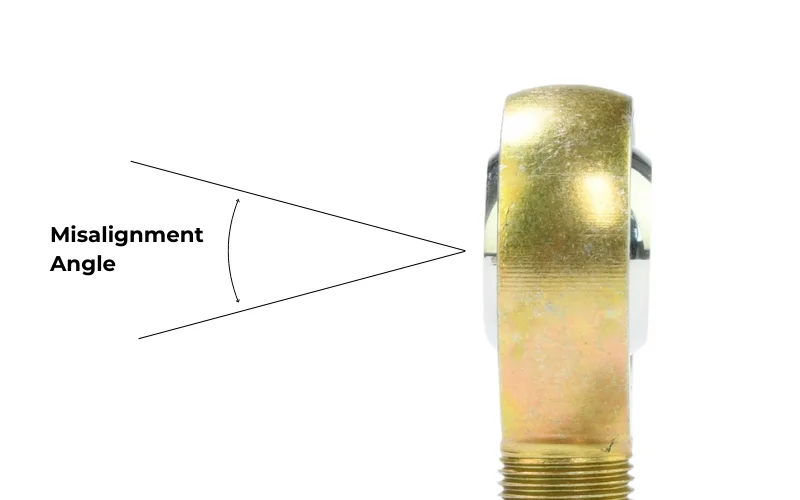
Misalignment angle is the angular range through which the spherical bearing can rotate before the ball contacts the housing and stops. This is not a caliper measurement — it’s a functional check or a catalog specification to verify against your application’s geometric requirement.
How to measure on a joint in hand: Hold the joint body fixed and rotate the bore axis (the hole) until it contacts the housing at the hard stop. The angle between the centered position and the stop is the misalignment angle. Use a digital angle finder: set it on the shank in the centered position, zero it, then rotate to the stop and read the angle. Alternatively, use the angle function in a smartphone level app against a flat surface that spans the bore axis.
Misalignment angle is typically rated as a total value: a joint rated ±25° total has 25° each direction from center. Some datasheets list the total; some list per-side. Read the spec description carefully before comparing values.
Common misalignment angles by joint type:
- Standard sintered liner or PTFE-lined joints: ±12° to ±15° per side (±24° to ±30° total)
- Wide-angle or high-misalignment joints: ±25° to ±30° per side
- Precision steel-on-steel joints: ±8° to ±12° per side (lower angle, higher load capacity)
Why this matters: If your suspension geometry at full droop or your steering linkage at full lock requires a joint to reach 20° of angular offset, a standard ±12°-per-side joint fails at that position. The joint will bind before the suspension reaches full travel, and either the joint or the linkage will absorb the resulting force — neither outcome is good.
Checking a used joint for serviceable articulation: Run the bearing through its full angular range by hand. It should move smoothly without sticking, catching, or grinding at any point in the arc. A joint that articulates freely at center but binds at 8° has a damaged or worn liner. The rated angle on the original packaging is irrelevant once the liner is compromised.
Putting the Measurements Together: A Quick Reference Checklist
Before ordering a replacement or specifying a new joint for a build, confirm all five dimensions:
Heim joint measurement checklist
Thread: _____ diameter × _____ pitch, male / female, RH / LH
Bore: _____ inches / mm (Pin fit)
Housing OD: _____ inches / mm (External clearance)
Body Width / Length: _____ / _____ (Bracket slot & Link geometry)
Mounting Width: _____ (Ball face-to-face / Stack height)
Radial Height: _____ (Center-to-top clearance)
Misalignment: _____ degrees total (Angular travel)
A direct replacement needs to match all five. A new application specification needs to match bore and thread to your hardware, fit the housing into your bracket envelope, and reach the misalignment angle your geometry requires.
Metric Versus Inch: How to Tell Which System You're Working In
Heim joints follow different dimensional standards depending on country of origin and industry convention. Automotive racing and off-road fabrication in North America predominantly uses inch specifications. European automotive, industrial machinery, agricultural equipment, and most Asian-manufactured products use metric.
The easiest check: look at the stamping or engraving on the body. Most joints have the thread size marked on the shank (male) or near the threaded bore (female). If the marking says M10, M12, M14 — metric. If it says 3/8, 1/2, 5/8 — inch. If there’s no marking, measure the thread OD with calipers and run the pitch gauge. A 3/8″-24 shank measures ~9.5 mm OD with a 24-tpi pitch; an M10×1.25 shank measures ~10 mm OD with a 1.25 mm pitch. The ODs are close enough to be confused by eye; the pitch gauges for inch and metric are clearly different.
When the hardware in your application is inch (clevis pins, link tube ends, weld-in bungs) and the joint you’re evaluating is metric, measure both and compare numerically. Close isn’t interchangeable.
When Measurements Don't Match Any Standard Size
Older OEM linkage joints, some agricultural equipment joints, and certain imported products were made to non-standard dimensions — metric bore with inch threads, housing ODs that fall between common catalog sizes, or bore sizes that don’t align with standard clevis pin diameters. When none of the catalog options match your measurements:
Source a dimensional match from a specialty or custom supplier. Standard catalogs cover the most common combinations. Suppliers who do custom work can hit specific bore diameters, thread pitches, and housing dimensions.
Re-bore or re-thread the mating hardware to accept a standard joint. This is the machine shop answer — broach the bore to the next standard size, or re-thread the tube end.
Redesign the bracket or end fitting to accept a standard joint. This is typically the cleanest long-term solution on a fabricated assembly: replace a non-standard hardware point with one that accepts a standard joint and standard clevis hardware.
SYZ ROD ENDS supplies heim joints in male and female configurations, inch and metric thread specifications, bore sizes from 1/4″ to 3/4″ and M6 to M20, in chromoly steel and stainless steel with PTFE-lined and metal-on-metal bearing options. For applications with non-standard bore or thread requirements, custom configurations are available on request.