
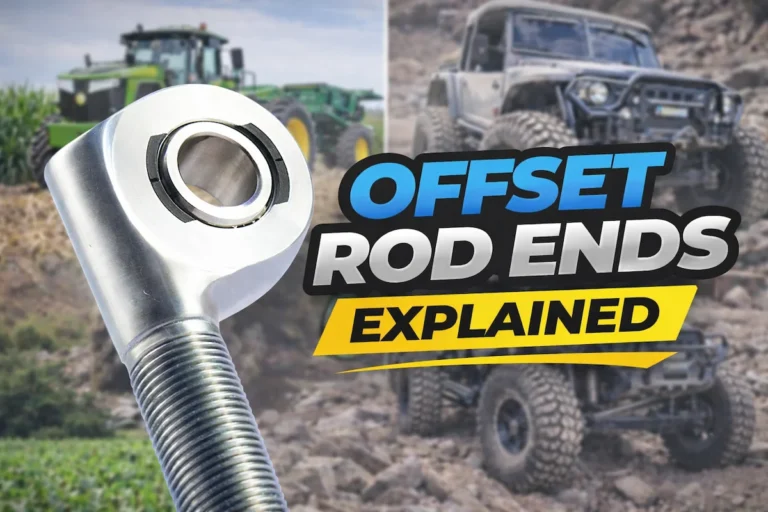
Spent hours staring at suspension interference? Tried three different linkage lengths? Adjusted angles until your head spun? Here’s the frustrating truth: the problem probably isn’t length or angle. It’s offset—a detail most builders overlook until it’s too late.
What Is an Offset Rod End?
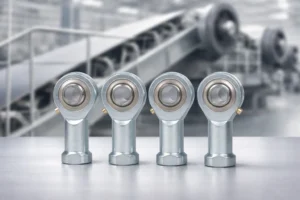
Rod ends (also called heim joints or spherical bearings) are workhorses in suspension and steering systems. The standard design is simple enough: ball bearing in a housing, threaded shank attached, ball center aligned perfectly with the shank’s centerline. Works great in most applications—until real estate gets tight.
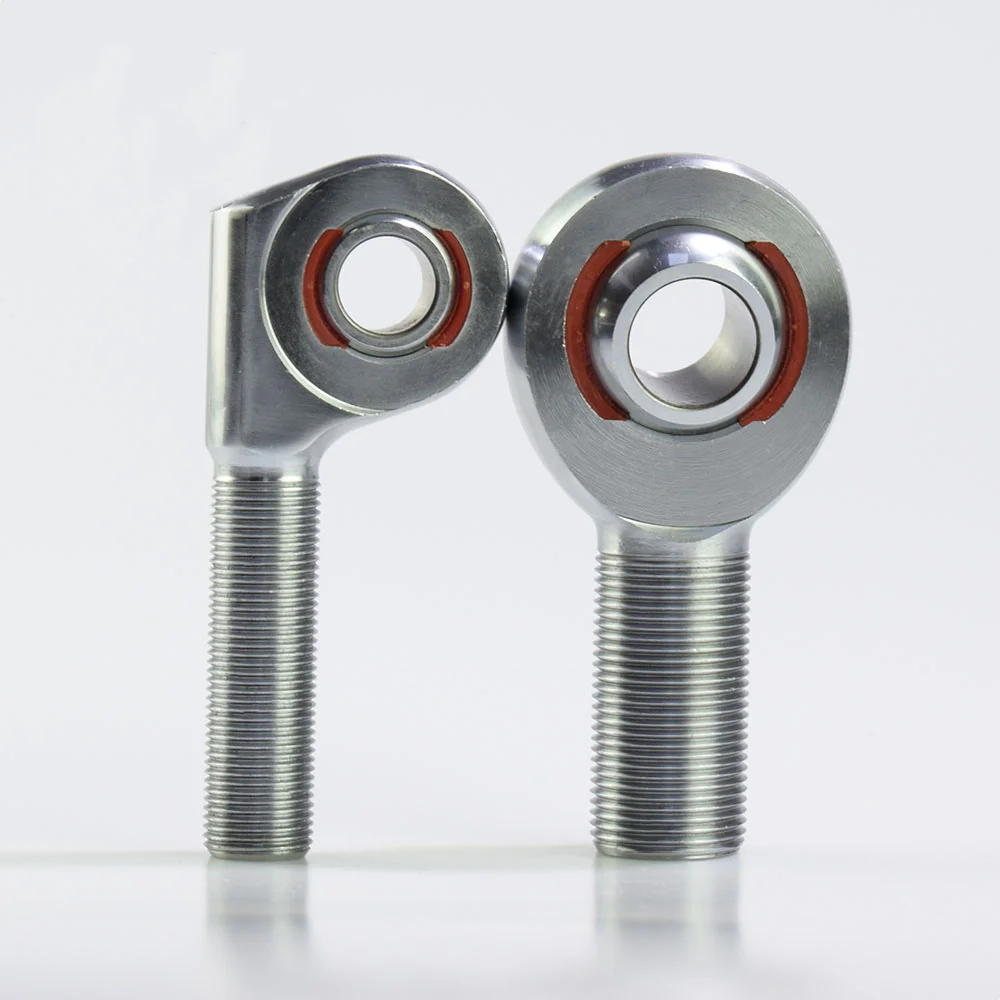
Offset rod ends break that alignment. The ball center sits laterally displaced from the shank centerline. Sounds minor, but in cramped chassis layouts, this offset makes the difference between “fits perfectly” and “doesn’t fit at all.” Market offerings typically range from 5-15mm offset, scaled to bore size and application.
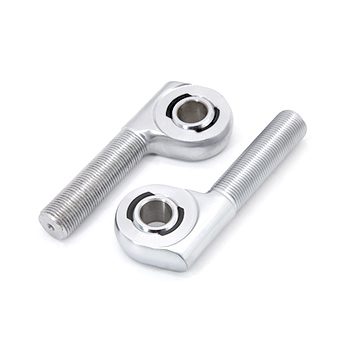
The visual difference is immediate. Standard rod end: ball center lines up with the shank from any angle. Offset rod end: ball center is visibly shifted 5-15mm off-axis. Small displacement, massive impact when you’re fighting for every millimeter of clearance.
The Geometry Behind Clearance Gain
Understanding offset requires some geometric thinking. When your linkage interferes with the fuel tank or frame rail using a standard rod end, what’s the actual problem? The ball center is locked onto the shank’s extension line—right where you don’t want it.
How Lateral Displacement Works
Offset design shifts the load point (ball center) sideways from the mounting plane. Direct translation: clearance gain. When linkage runs parallel to an obstacle (fuel tank, frame rail, steering box), offset amount roughly equals clearance gain. Install at an angle? Actual gain drops per triangular geometry—steeper angle, smaller effective gain.
Real example: tie rod sits 5mm from the fuel tank with standard hardware. Swap in a 10mm offset tie rod end. Under parallel mounting, you gain nearly the full 10mm, bumping total clearance from 5mm to 13-15mm—enough to go from “grazing contact” to “safe margin.” Actual gain varies slightly with installation angle and routing, but the improvement is substantial. Rock crawler builds repeatedly confirm: 10mm offset in typical front geometry transforms “barely touching” into “clear sailing.”
Angular Compensation Adds Another Layer
Offset isn’t just about physical clearance. In 4-link suspension setups, it improves geometry at extreme angles too.
Consider 4-link at full compression. Linkage angles get steep. With standard rod ends, the ball bearing’s contact surface can hit the edge, creating binding that kills suspension smoothness. Offset rod ends change the ball position, maintaining better triangulated geometry even at compression limits.
Ridetech’s suspension geometry resources emphasize this: good 4-link geometry avoids binding at both full compression and full droop. Field experience backs it up—properly spec’d offset heim joints prevent binding by keeping the ball within its safe articulation range, avoiding that moment when geometry forces the bearing past its limit. Result: smoother action through the entire travel range.
Where Offset Rod Ends Shine
Applications stretch far beyond what most people expect—from trail rigs to industrial hydraulics.
Off-Road and Racing
- Rock crawlers are offset tie rod end territory. Upgrade to an oversized fuel tank for range? Install an aftermarket oil pan? Factory tie rod routing now conflicts with these additions. Multiple builds show the same solution: offset tie rod ends up front. No steering geometry redesign. No fuel tank relocation. Swap the parts, gain the clearance.
- 4-link suspensions thrive on the geometric flexibility offset heim joints provide. Upper links, lower links—doesn’t matter. Offset lets fabricators nail ideal anti-squat and anti-dive numbers within tight chassis confines. Talk to professional builders working on custom buggies and rock bouncers: offset isn’t optional equipment. It’s standard.
- Buggies and UTVs pack everything into minimal chassis volume. Offset rod ends often represent the only path to solving interference without frame redesign. Especially where steering linkage crosses suspension control arms—offset creates layouts physically impossible with standard components.
⚙️ Quick Check: Linkage within 1-2 inches of frame rails, fuel tanks, or steering components? You probably need offset rod ends.
Industrial and Agricultural Machinery
Offset rod ends work beyond automotive. Industrial hydraulic systems use offset to dodge conflicts between cylinder linkage and plumbing or control valves. Equipment manufacturers report significant bracket reduction—in tight hydraulic layouts, offset solutions can eliminate 20-30% of custom bracket design. Simpler design, lower costs, faster delivery.
Agricultural equipment folding mechanisms (harvesters, planters) need big motion in small spaces. Offset rod ends deliver necessary clearance at articulation points without sacrificing strength or reliability.
Construction machinery sees benefits too. Excavator boom linkage, for instance—areas packed with hydraulic lines, cables, accessories. Offset rod ends carve out precious space for these critical components.
Custom Fabrication
Industry data from professional fabricators: 20-30% of custom projects hit situations requiring offset solutions. Highly customized race cars and show vehicles push that percentage higher. When you’re building from scratch or heavily modifying existing structure, off-the-shelf “standard” assumptions break down. Offset becomes the tool that makes ideal geometry physically achievable.
Offset Rod End vs. Standard Rod End
Offset isn’t always the answer. Smart selection balances geometric needs, cost, and installation realities.
When Offset Rod End Is Necessary
- Physical interference sends the clearest signal. Measure linkage-to-obstacle clearance under 20mm? Standard rod end won’t work. Either redesign bracket positions or run offset—latter is usually simpler.
- Geometric binding is another red flag. Install standard rod end and steering feels heavy or notchy? Suspension action isn’t smooth? Binding might be the culprit. Offset improves ball bearing working angles, often solving the problem immediately.
- Extreme angle applications make offset nearly mandatory. When suspension total travel (compression + droop) exceeds 12 inches or single-direction travel tops 6-8 inches (150-200mm), standard rod ends approach angular capacity limits at extreme positions. Offset’s extra angular clearance keeps the bearing working in its sweet spot even at full travel.
When Standard Rod End Is Fine
- Open layouts with ample space (clearance over 50mm) don’t need offset. Spending 20-30% extra for functionality you won’t use? Poor value proposition.
- Straight linkage with minimal angle variation works fine with standard rod ends. Angular capability is already sufficient. Offset’s geometric advantages become academic.
- Cost-sensitive builds warrant careful evaluation. Offset typically runs 20-30% over equivalent standard models. Tight budget? Try adjusting bracket positions or linkage routing first. Only go offset when adjustments can’t solve the problem.
Decision Framework
Measure clearance
Linkage to nearest obstacle
Evaluate angles
Linkage angle change through full travel
Check budget
Can you absorb the offset premium?
Decide
Weigh all three factors
| Factor | Standard Rod End | Offset Rod End |
|---|---|---|
| Clearance | >50mm | <20mm |
| Angles | <15° | >20° or extreme travel |
| Budget | Cost-focused | Performance-focused |
| Flexibility | Can redesign mounts | Can't modify frame |
**Table provides general guidelines. Actual applications require measurement and geometric analysis. Borderline cases (25-45mm clearance, 15-20° angles) need individual assessment.
Technical Specs and Selection Guide
Choosing the right offset rod end means understanding key parameters.
Core Specifications
Offset amount: Typically 5-15mm, scaled to bore size. Larger bores generally mean more offset. Market survey shows 5/8″ bore offset rod ends usually offer 6-8mm displacement, while 3/4″ and 7/8″ bores reach 10-15mm.
Thread specs must match your linkage:
– 5/8″-18 (lightweight applications)
– 3/4″-16 (medium-duty)
– 7/8″-14 (heavy-duty, one-ton steering territory)
Bore diameter follows load requirements. 5/8″ suits light-to-medium loads, 3/4″ dominates rock crawler and buggy applications, 7/8″+ handles heavy-duty work.
Material standard drives performance and longevity. High-performance configuration: chromoly steel housing + 52100 bearing steel ball + PTFE liner. This combo balances strength, wear resistance, and low friction.
Installation Must-Dos
Double-shear mounting (heim joint types): Both sides supported, mandatory. Single-shear (cantilevered) overloads the bolt with bending forces. Loosening or failure follows.
Fastener grade: Grade 8 minimum. AN (Air Force-Navy) hardware recommended. High-grade fasteners handle vibration and impact without backing out.
Clearance verification: After install, manually cycle full suspension travel. Check every position for contact. Don’t skip full droop (suspension fully extended)—commonly overlooked but interference-prone. Offset solves one direction; poor installation angle can create new problems elsewhere.
Making the Right Call
Offset rod ends aren’t universal solutions. But in the right application, they’re elegant fixes to geometry and clearance challenges.
Bottom Line:
- Offset creates clearance by laterally displacing the ball center from the shank centerline
- Beyond physical clearance, offset optimizes geometry at extreme angles
- Core applications: space-limited suspension, steering systems, industrial/agricultural machinery
Your Next Move:
- Rock crawler or off-road builder? Front suspension offset tie rod ends after fuel tank or oil pan upgrades. Simplest, most reliable interference fix.
- Chassis fabricator? Design offset capability into initial plans. Even using standard initially, build adjustment margin into linkage mounts. Flexibility during assembly is priceless.
- Industrial equipment engineer? Assess offset for hydraulic cylinders and articulation points. Real-world data shows significant custom bracket reduction, simplified design, faster delivery.
- Budget-conscious DIY builder? Exhaust adjustment options first. Tweak angles, reposition brackets, measure everything twice. Offset is the solution when geometry leaves no other option.
SYZ Machine delivers Complete offset rod end range, 5/8″ to 1″ bore. Chromoly steel housings, PTFE liners, custom offset amounts and thread specs. Lightweight buggies to heavy industrial equipment—we’ve got you covered.
Starting your build? Measure twice, choose once. That offset rod end might be exactly the clearance solution you’ve been hunting—not changing your design philosophy, just making it physically possible.