
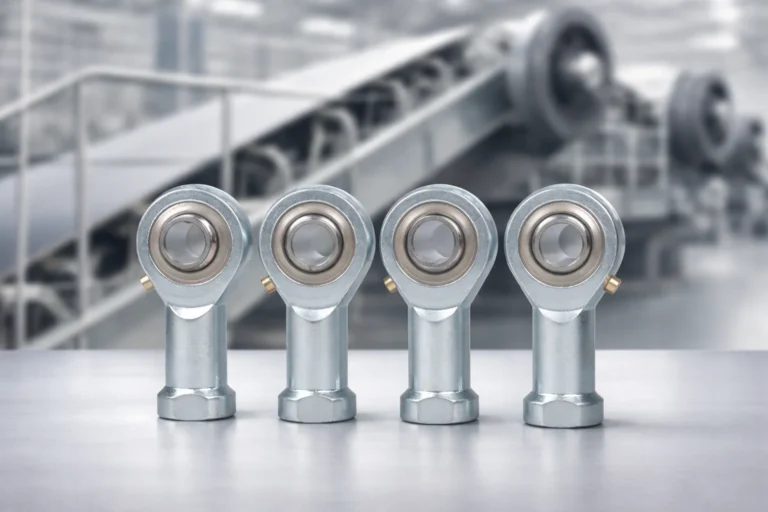
Conveyor belt tension failures rarely announce themselves. More often, you find out something is wrong when the belt slips off a pulley at 2 a.m., or when a technician notices the takeup carriage has drifted three inches and nobody knows how long it’s been that way. Tracing those failures back to their root cause often leads to a small, overlooked component: the rod end connecting the tensioning mechanism to the takeup bearing frame.
Rod ends don’t typically get a dedicated chapter in conveyor system design guides. They’re specified late in the engineering process, often selected from whatever’s in stock. That’s a mistake. In a tensioning system, rod ends carry the belt load transmitted through the takeup carriage, absorb the misalignment that frames inevitably develop over time, and do it all in environments ranging from mildly dusty to aggressively corrosive. Getting the selection wrong costs more than the part.
What Rod Ends Do in a Tensioning System
The mechanical role a rod end plays in a conveyor tensioner is different from most other rod end applications — and understanding that difference is what separates a good selection from an expensive callback.
In a screw tensioning system (the most common configuration for conveyors under roughly 80–100 meters), the tensioning screw transmits force from the adjustment point to the takeup bearing carriage. A rod end sits between the tensioning screw and the carriage, or as part of the linkage in a gravity or hydraulic take-up. The shank threads into the screw assembly; the bore (eye) connects to the carriage via a pin. The belt tension load runs from carriage → pin through the bore → ball → housing → shank → back into the screw. That load direction — along the shank axis, perpendicular to the bore pin — is what rod end bearing catalogs call “radial load capacity”. It’s the primary rated capacity of the component, which is why tension rod and linkage applications are exactly what rod ends are designed for.
But load transmission is only half the job. The rod end’s real value in this application is misalignment accommodation: even a well-manufactured conveyor frame flexes under load, thermal cycles move mounting points, and foundations settle. Over the operating life of a conveyor, the takeup carriage axis and the screw axis will drift out of collinearity. A rigid connection would translate that misalignment into bending stress at the thread engagement — leading to thread wear, galling, or frame cracking. The spherical bearing inside the rod end absorbs that angular offset, allowing the screw to stay in pure tension while the carriage moves along its guides.
Load Analysis — Get the Numbers Right Before Picking Anything
Most rod end selection errors start with the wrong load figure. Conveyor tensioners are located on the slack side of the system — their job is to maintain T₂ (slack-side tension), which gives the drive pulley enough belt friction to avoid slippage. The drive pulley itself generates T₁ by pulling against T₂. What this means for sizing: the load your rod end sees is not T₁, and it’s not simply T₂ either.
For a tail pulley with approximately 180° belt wrap (standard for a simple head-drive conveyor with a tail takeup), the resultant force on the takeup carriage is approximately 2 × T₂ — the vector sum of the two belt spans running away from the pulley on opposite sides. On a system where T₂ = 15 kN, the rod end(s) supporting the carriage are carrying roughly 30 kN of resultant load. If your tensioner uses a single central screw, one rod end carries that full resultant. If it uses two side screws, the load is split approximately equally between them.
Static vs. Dynamic Loading
Conveyor tensioners are primarily statically loaded — belt tension is set during commissioning and doesn’t swing dramatically in normal operation. However, startup torque surges, belt splices passing over the drive pulley, and jam-clearing events introduce transient dynamic loads that can reach 1.5–2× the nominal value. Account for this with a safety factor: for industrial conveyor applications with vibration and environmental degradation, a minimum 3× safety factor against the rated static load capacity is standard engineering practice. This means a rod end carrying 10 kN of steady-state carriage load should be rated at a minimum of 30 kN static.
A 20 kN rated rod end is not suitable for a 12 kN application — the apparent 1.6× margin disappears quickly once environmental factors and cyclic loading are factored in.
Axial Load vs. Radial Load in the Rod End Context
One terminology point worth clarifying: in rod end bearing catalogs, “radial load” means load perpendicular to the bore pin axis — which corresponds to load along the shank axis. “Axial load” means load along the bore pin axis, which manufacturers typically limit to 10–20% of the radial rating. In a correctly installed tensioner rod end, the belt tension load runs along the shank (= radial load in catalog terms). If you find your rod end is seeing significant bore-axis loading, the installation geometry is wrong.
Material Selection — The Choice That Sets Your Maintenance Frequency
Three friction pairings cover most conveyor tensioner applications:
Steel/Bronze — A hardened steel ball running in a phosphor-bronze or brass race. Good load capacity, tolerates moderate shock, and relubrication-capable. The practical ceiling is maintenance discipline: this combination needs fresh grease every 500–1,000 operating hours depending on environment. Where maintenance is scheduled and access is easy, steel/bronze delivers solid performance per dollar. Where maintenance windows are short or infrequent, the bronze race wears quickly once the lubricant film breaks down — often faster than anyone realizes, because the wear happens silently.
Steel/PTFE composite — A PTFE-based liner eliminates external lubrication. Worth the 40–60% price premium over steel/bronze in applications where relubrication is genuinely impractical: elevated positions on tall structures, food-grade environments where grease contamination is prohibited, or dusty environments where grease attracts abrasive particles that turn into grinding compound around the bearing.
One commonly overlooked limitation: PTFE composite liners have a lower sustained load limit than metal-on-metal designs of equivalent size. Under prolonged high compression, the liner material cold-flows — essentially creeping under constant pressure — which increases bearing play over time. For heavy-duty, high-tension applications, check the liner’s specific sustained load rating against the actual steady-state load, not just the dynamic rating. Also note: liner bonding resins in many PTFE composite designs begin to soften above 90–100°C; if your application runs hot, confirm the temperature rating with the manufacturer rather than assuming the 120°C headline figure applies to all configurations.
Steel/Steel — Hardened steel ball against hardened steel race. Highest load capacity per unit size, smallest footprint for a given rating. Used in heavy-duty applications where the load is high and installation is accessible for regular lubrication. Running steel/steel dry is not survivable — seizure happens quickly, and the damage usually takes the entire tensioner assembly with it.
Material selection quick reference
- Accessible location + predictable maintenance schedule + high load → Steel/Bronze
- Hard-to-reach location, or dusty/food-grade environment → Steel/PTFE composite
- High load + regular access + reliable lubrication program → Steel/Steel
- Wet, coastal, or chemical environments → Stainless steel body regardless of friction pair
Misalignment Capacity and Environmental Fit
Getting the Angle Right
Rod ends are rated for a maximum angular misalignment — the angular offset between the shank centerline and the bore pin centerline that the spherical bearing can accommodate without the ball race contacting the housing edge. Typical industrial rod ends range from ±5° on heavy-duty compact designs to ±15° on lighter types.
For conveyor tensioners, the required accommodation depends on frame geometry and expected deflection. Short, rigid conveyors with a single-span structure might only see 2–3° of angular drift over time. Long systems with steel structures subject to thermal movement, or systems on mobile or floating foundations, can easily see 8–10°. A rule of thumb that holds up in practice: size for the expected misalignment angle with at least 30–40% margin, and don’t operate continuously near the rated limit. A rod end running at 90–100% of its rated misalignment angle wears significantly faster than one running at 60–70%.
Environmental Fit
Dust and abrasives: Sealed self-lubricating rod ends consistently outperform greased designs in aggregate processing, mining, and cement conveyor environments. Grease attracts fine particles and turns abrasive; each relubrication cycle pushes some particles deeper into the contact zone. Field experience from quarry installations typically shows sealed units running 2–3× longer between replacements versus maintained greased units in the same environment.
Moisture and corrosion: Standard carbon steel rod ends corrode quickly in wet environments or coastal locations. Options in ascending order of corrosion resistance: zinc-plated body, chrome-plated ball, stainless steel body (304 or 316), full stainless with stainless ball. For port terminals, seafood processing, or chemical handling, stainless construction is the correct starting point, not an upgrade.
Temperature: Standard PTFE composite liners are rated from –50°C to approximately +120°C, but check the specific bonding resin temperature rating for your application if temperatures are sustained above 90°C. For greased steel/bronze units, standard lithium-based greases lose effectiveness above 120°C; high-temperature polyurea or synthetic greases extend working range to 150–180°C. Below –20°C, standard grease viscosity increases sharply — specify low-temperature grease at commissioning.
Thread Engagement and Installation — Where Good Specifications Go Wrong
The bearing selection can be correct and the rod end still fails prematurely. Thread engagement and installation details account for more early failures than any single bearing specification error.
Thread Engagement Length
A rod end shank in a tensioner application needs enough engagement in the mating housing to distribute the load across an adequate contact area. The minimum accepted guideline is 1× nominal thread diameter; 1.5× is the more conservative standard. A 25 mm rod end with 20 mm of thread engagement carrying 30 kN of carriage load is working on a marginal contact length — thread stripping or galling becomes real during startup surges. If the tensioner housing has a fixed cavity depth that gives marginal engagement, selecting a rod end with a wider body (more thread area per unit diameter) or specifying a threaded insert sleeve in the housing are both preferable to leaving it at 20 mm.
Shank fatigue is the other side of this equation: the area at the root of the threaded section — where the shank meets the housing shoulder — is a stress concentration point under combined tension and misalignment. This is where fracture initiates in overloaded or undersized rod ends. Adequate engagement length reduces the bending moment at this point; going bigger than minimum isn’t overengineering here, it’s prudent.
Locking Against Rotation
Tensioning screws vibrate. An unlocked rod end will rotate — either tightening or backing off the tension setting without anyone knowing. Standard hex locknuts work acceptably on clean, stable installations. For outdoor systems, high-vibration conveyors, or applications subject to thermal cycling, nylon insert locknuts (for moderate temperatures) or all-metal prevailing-torque locknuts are more reliable. Medium-strength thread adhesive (Loctite 243 or equivalent) applied to the shank threads at assembly is a practical additional layer for high-vibration environments.
Left-Hand vs. Right-Hand Threads
On tensioners with a central screw and two opposing rod ends — a common configuration for tensioners spanning the full conveyor width — one rod end requires a left-hand thread. Rotating the central adjustment screw then moves both ends simultaneously (one threading in, the other threading out), achieving even tension across the belt width. Ordering two right-hand threaded rod ends for this assembly means one will back off as the other is tightened. It’s a procurement detail that derails commissioning every time it’s overlooked, and it’s easy to miss because left-hand thread rod ends aren’t stocked as commonly as standard right-hand.
The New Hampshire Ball Bearings engineering reference for rod end installation covers thread engagement and load-sharing considerations for back-to-back configurations in useful detail.
How Rod Ends Fail in Tensioner Applications
Failures in conveyor tensioner rod ends follow recognizable patterns. Knowing which pattern to look for saves time diagnosing the wrong component.
Wear groove in the ball race, load plane: Normal wear under sustained loading. In a correctly specified, maintained rod end, this develops slowly over years. Accelerated groove development usually points to an undersized rod end — check whether belt tension requirements have increased since original installation (new product, increased throughput, higher incline).
Wear groove in a secondary plane: The rod end is carrying load in a direction it shouldn’t be, usually because the takeup carriage guides are worn or seized. The carriage cants in its guide channels, converting what should be pure carriage tension into a combined load through the rod end. Replacing the rod end without fixing the guides produces the same failure within months.
Corrosion seizure: The ball freezes in the race. Typically seen after extended downtime in wet environments — water displaces the lubricant film, corrosion products build up between ball and race, and the first restart loads the frozen rod end as a rigid link. The angular misalignment that the bearing would normally accommodate now creates direct bending stress on the shank. Thread fracture follows. Prevention is straightforward: correct rod end material for the environment, and a pre-startup inspection after any extended shutdown.
Thread galling at the rod end shank: Inadequate thread engagement, no lubrication on the threads during assembly, or very close material hardness between the rod end shank and the mating housing (steel against steel without any plating difference). Anti-seize compound applied to the shank threads at installation prevents the majority of thread galling failures at essentially zero additional cost.
Failure mode quick-diagnosis
- Load-plane wear groove → undersized; verify belt tension and recalculate
- Off-plane wear groove → carriage guide problem; fix the guides first
- Corrosion seizure → rod end spec wrong for environment; upgrade material/sealing
- Thread galling → insufficient engagement or improper assembly; anti-seize at next installation
A Practical Selection Checklist
Rod end selection for a conveyor tensioner isn’t complicated once the right questions are asked in the right order.
1. What is T₂ (slack-side tension)? The take-up carriage load is approximately 2×T₂. Apply a minimum 3× safety factor to get the required static load rating. This is your primary filter.
2. Single screw or two-screw configuration? Determines whether one rod end carries the full carriage load or if it’s split between two.
3. What is the required misalignment angle? Measure or calculate the maximum expected angular offset across the operating life of the conveyor, including thermal movement and foundation settlement. Add 30–40% margin. Select accordingly.
4. What is the operating environment? Dust, moisture, chemical exposure, and temperature range determine material selection. Don’t let cost be the only filter here — environmental failures happen faster and cost more than the difference between a standard and a corrosion-resistant rod end.
5. What is the realistic maintenance schedule? If regular relubrication is genuinely feasible, steel/bronze is cost-effective. If not, pay the premium for sealed self-lubricating construction.
6. Left-hand or right-hand thread — and which thread standard? Confirm against the tensioner assembly design before ordering. Metric (M) and UNC/UNF inch threading are not interchangeable.
7. Is thread engagement adequate? Minimum 1× nominal diameter, preferably 1.5×. Verify against the housing cavity before the order is placed.
At SYZ Rod Ends, rod ends for conveyor tensioner applications are available in steel/bronze, steel/PTFE, and stainless configurations, covering metric and inch thread standards, left-hand thread options, and high load ratings for heavy-duty bulk material conveyor duty. Custom shank lengths for extended-engagement installations and non-standard bore dimensions are available on request.
The rod end is not the most visible component in a tensioning system. But the questions above — asked before ordering rather than after the first failure — determine whether the next service interval is measured in years or weeks.