
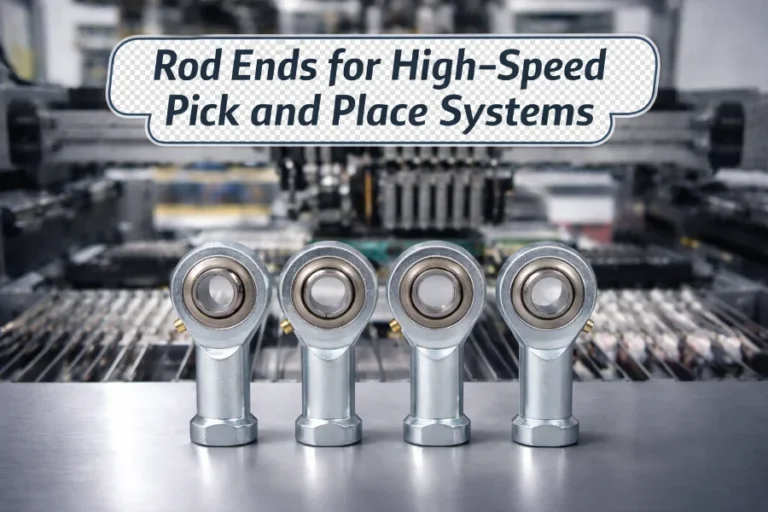
A pick and place head running at full production speed doesn’t give rod ends an easy life. At 50,000 components per hour — a standard mid-range throughput for modern SMT assembly equipment — the linkages connecting actuators to nozzle heads, gripper arms to servo outputs, and conveyor diverters to drive shafts are oscillating thousands of times per shift. The rod ends in those linkages are changing direction, absorbing inertial loads, and maintaining positional accuracy every fraction of a second. Most standard catalog rod ends aren’t built for that duty. The ones that are built for it have specific characteristics — and knowing which characteristics matter, and why, is what separates a linkage that runs clean for two years from one that develops slop in three months and starts costing you rejected boards and unplanned downtime.
Why Pick and Place Is One of the Hardest Duty Cycles for a Rod End
The phrase “light duty” gets thrown at pick and place applications because the loads sound small. A nozzle picking a 0402 resistor is not moving a car axle. Load magnitude is only one variable, though — and in this application, it’s the one that matters least. What makes high-speed pick and place genuinely difficult for a rod end is the combination of three factors that rarely appear together.
High cycle frequency
A machine running at 50,000 CPH is executing something close to 14 pick-and-place cycles per second. Many linkages oscillate on every cycle, which means over 800 direction changes per minute. Over a three-shift production day, that’s more than 1.2 million oscillation events. Conventional steel-on-steel spherical bearings depend on a lubrication film that needs time to reestablish after each oscillation. At these frequencies, there isn’t time.
High acceleration, not just high speed
Pick and place heads move at travel speeds exceeding 2 m/s, but the acceleration and deceleration phases are where the real loads occur. Published data from SMAC Corporation’s direct-drive linear actuators for PCB assembly show moving masses as low as 95 grams (versus 320 grams in legacy designs) specifically to reduce inertial forces on connected mechanical components. At 2G–5G acceleration — common in high-speed gantry systems — a complete head assembly weighing 0.5–2 kg generates instantaneous joint loads of 10–100 N per cycle. Those numbers repeat over a million times per shift. The forces aren’t enormous by themselves. The accumulation is.
Near-zero acceptable play
A SMT nozzle needs to place components to repeatability tolerances of ±0.05 mm or better. Any wear-induced slop in a rod end translates directly to placement error. A bearing that develops even 0.1 mm of internal clearance through wear is no longer acceptable, and replacing a rod end buried in an assembled head mid-production is never quick.
That combination — high frequency, high acceleration load, and near-zero tolerance for clearance growth — defines what the rod end needs to be.
Liner Material: Where the Selection Decision Actually Lives
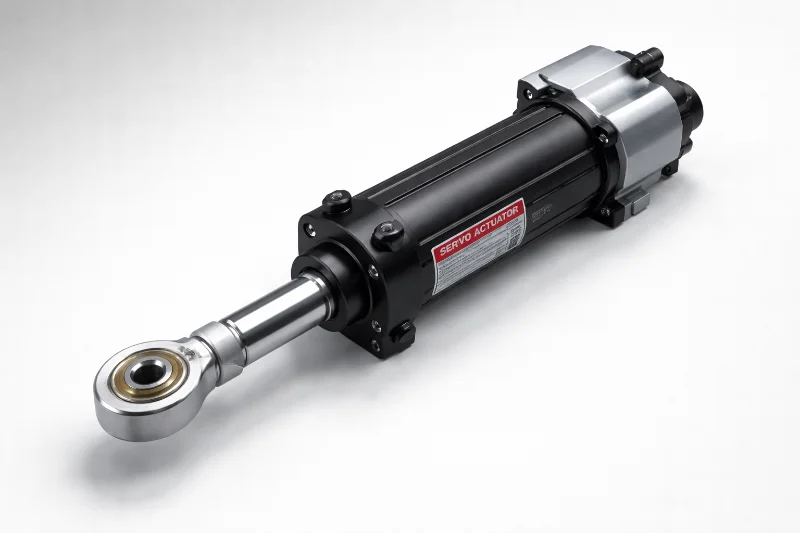
The spherical bearing liner — the material between the ball and the race — is the most consequential choice in a rod end for this application. It determines friction level, maintenance interval, wear rate, and whether the bearing survives high-frequency oscillation at all.
Steel-on-steel (lubricated)
The default configuration in most catalog rod ends. These require periodic relubrication to maintain the protective film between sliding surfaces. At high oscillation frequencies, the lubricant film is continuously displaced and needs time and motion to redistribute. Under high-cycle conditions, the film breaks down faster than it can reconstitute — accelerated metal-to-metal contact, accelerated wear. Steel-on-steel is fine for slower oscillating applications and for joints that rotate. It’s not the right choice for pick and place linkages oscillating at 10+ Hz.
PTFE composite liner.
The right choice for most high-speed pick and place applications. PTFE (polytetrafluoroethylene) composite liners — typically a woven or bonded fabric layer containing PTFE fibers — are self-lubricating. They don’t depend on a fluid film. PTFE transfers a microscopic dry film to the ball surface with each oscillation cycle, and that film persists regardless of frequency. Manufacturers including Aurora Bearing (now part of Timken) and ASKUBAL produce PTFE-lined rod ends rated for continuous oscillation service and maintenance-free operation, with temperature ranges covering roughly −65°F to +325°F (−54°C to +163°C).
The tradeoff: PTFE composite liners have lower load capacity than steel-on-steel under heavy loads. For pick and place linkages — moderate loads, high frequency — this isn’t a limiting factor. The IKO GE10EC spherical plain bearing (10 mm bore, PTFE composite liner) is a useful reference point: the “EC” suffix specifically designates the maintenance-free version. Worth noting because the GE10E without the suffix is steel-on-steel and requires manual greasing — an easy catalog mistake when ordering replacements under time pressure.
Bronze or sintered metal liners.
A middle ground for applications where loads exceed what PTFE handles but oscillation rates are too high for steel-on-steel. Less common in high-speed pick and place specifically.
Liner selection for pick and place, simplified:
- High-frequency oscillation (above ~5 Hz), light-to-moderate load: PTFE composite liner
- Low-frequency, heavy shock load: bronze liner or steel-on-steel with a lubrication schedule
- Mixed rotation and oscillation: needle roller or ball-bearing rod end type
- Clean room or food-grade environment: PTFE-lined stainless steel housing
Body Material and Weight: The Inertia Problem
In a high-speed system, every gram in a moving linkage is a gram that gets accelerated and decelerated thousands of times per shift. The rod end housing material is not just a structural decision — it directly affects how hard the servo works and how much inertial load the joint absorbs on every direction change.
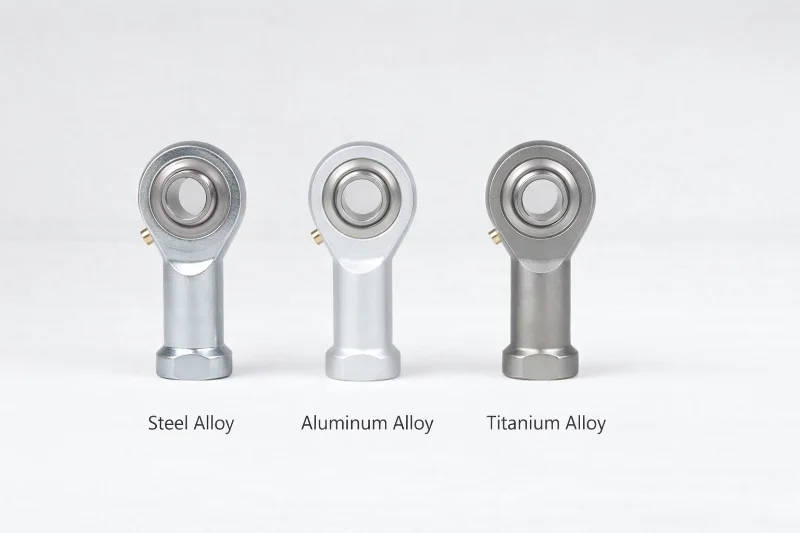
Steel rod ends are appropriate for high-load applications where weight isn’t a constraint. Chromoly steel (4130 or 4140) housings deliver yield strengths in the 415–655 MPa range depending on temper, with good fatigue resistance. In pick and place, steel rod ends show up in lower-speed systems and in structural framework linkages where cycle rates are lower and loads are larger.
Aluminum rod ends — typically 6061-T6 or 7075-T6 — are the common choice in high-speed automation linkages because weight matters. 6061-T6 has a density of 2.70 g/cm³ versus steel’s ~7.85 g/cm³, roughly a 65% weight reduction. A steel rod end at 45 grams replaced by a 6061-T6 equivalent at 16 grams saves 29 grams. At 5G acceleration, that 29-gram difference reduces the inertial load on the upstream actuator by about 1.4 N. Across every cycle, every linkage in the head, across every shift — these numbers accumulate into real differences in motor sizing, heat generation, and system throughput ceiling.
7075-T6 offers higher yield strength (503 MPa versus 276 MPa for 6061-T6) at a modest weight premium. For linkages where the rod end housing sees significant bending moments — not just axial and radial loads on the spherical bearing — 7075-T6 is the better call. For lighter linkages with well-constrained load paths, 6061-T6 is sufficient and easier to machine.
Titanium housings appear in aerospace pick and place and semiconductor handling equipment where both extreme weight reduction and corrosion resistance are non-negotiable. Material cost runs 3x–5x aluminum. Most industrial automation applications don’t need it.
Precision Grade and Internal Clearance: The Tolerance Stack Question
Rod ends come in commercial and precision grades. In static or low-cycle applications, the difference is rarely consequential. In high-speed pick and place, it almost always is.
Commercial-grade rod ends have internal radial clearances that allow measurable play between ball and race. For a 10 mm bore spherical bearing at normal clearance, that’s typically 0.032–0.068 mm per ISO 12240-1 — small by casual measure, but significant in a linkage that reverses direction a million times a month. In an oscillating linkage, every direction change causes the clearance to manifest as a snap-to-contact event. At high frequencies, these micro-impact events accelerate liner wear and create positional error that compounds over the bearing’s life.
High-precision-grade rod ends — those specifying reduced radial clearance or manufacturer-designated precision series — have tighter tolerances on ball sphericity and race conformity, resulting in initial clearance below 0.020 mm. Some designs ship preloaded with zero nominal internal clearance. This directly reduces the clearance-driven positional error in the linkage.
For any linkage where positional repeatability is a design requirement — which it is in every pick and place application — precision-grade rod ends are not optional. The cost premium over commercial grade is typically 30–60%. That sounds like a lot until you price one batch of rejected boards or one unscheduled maintenance event.
One thing to verify in the manufacturer’s datasheet: misalignment angle. Standard rod ends allow ±7°–±15° of angular misalignment depending on design. Pick and place linkages rarely need more than ±5°, so this parameter usually isn’t a bottleneck — but confirming it prevents ordering the wrong internal geometry for a tight bracket envelope.
Corrosion Resistance and Environment Compatibility
Pick and place equipment runs in environments ranging from standard factory floors to clean rooms to conformal coating areas where flux residue, solvents, and moisture are present. The rod end housing and ball material need to match wherever the machine actually lives.
Standard steel (SAE 52100 or 4130 chromoly) with zinc plating works on factory floors where humidity is controlled and contamination is minimal. Zinc provides moderate corrosion protection and is the default for most catalog rod ends in non-demanding environments.
Stainless steel housings (303 or 440C) belong in conformal coating areas, wash-down environments, and any application where the rod end will see flux residue, IPA cleaning, or periodic moisture. 440C stainless is hardened and used for the ball in load-bearing configurations; 303 stainless is free-machining and suits housings where machinability matters more than hardness. The Rollon rod end selection guide makes a point worth repeating: corrosion resistance selection should match actual environmental exposure, not just the machine’s nominal operating area. The maintenance closet counts.
PTFE-lined stainless steel rod ends are the configuration used in semiconductor handling equipment, clean room automation, and pharmaceutical pick and place. Maintenance-free (no lubricant in the bearing that could contaminate the environment), corrosion resistant, and capable of sustained high-cycle operation.
Per NHBB’s bearing selection engineering reference, beryllium-copper ball against heat-treated stainless race is another option for extreme oscillating loads in contamination-sensitive conditions — a specialized configuration not found in standard catalogs, but worth knowing exists if the application calls for it.
Thread Configuration and Mounting: Getting the Geometry Right
The functional performance of a rod end in pick and place is a function of its bearing internals — liner, clearance grade, material. Thread configuration and mounting geometry determine whether those internals can do their job without being mechanically undermined by how the joint is installed.
Male versus female thread
In pick and place linkages, female rod ends (internal threaded bore) are common where the connecting rod or actuator shaft has a machined external thread — typical in pneumatic cylinder rods, linear actuator outputs, and custom-machined link tubes. Male rod ends (external thread on the housing) thread into a tapped tube or coupler. The choice is set by the mating component geometry. What actually matters is thread engagement length and how the assembly is locked.
Thread engagement and locking
At 10,000+ cycles per day, vibration loosening is a real failure mode. A rod end that self-loosens from its tube changes effective link length, shifts the linkage geometry, and introduces positional error — all before the bearing itself has failed. Minimum thread engagement of 1× thread diameter is the baseline requirement; 1.5× is better for vibration-prone assemblies. A locking nut or medium-strength thread-locking compound should be standard practice. Medium strength, not high — you want to be able to service the joint without a heat gun.
Preload adjustment
Some pick and place linkages use adjustable-length links where thread engagement is intentionally varied to set geometry. Mark the nominal position after adjustment and verify periodically. Vibration will walk the thread even with locking methods in place if the fit isn’t right.
Installation checklist for pick and place rod ends:
- Confirm thread engagement is at least 1× diameter, preferably 1.5×
- Use medium-strength thread locker or a locking nut — not high-strength
- Verify misalignment angle at full range of motion stays within rated limit
- Torque to specification; overtightening preloads the spherical bearing against the housing
- Log installation date and set the first inspection interval in the maintenance schedule
Maintenance Interval and Service Life Planning
The appeal of PTFE-lined rod ends in automation is maintenance-free operation — and that’s largely accurate for the bearing itself. But “maintenance-free bearing” does not mean “no maintenance on the rod end assembly.”
What ends the service life of a PTFE-lined rod end in a high-cycle application is liner wear, not lubrication failure. PTFE composite liners do wear. The specification to look for is the rated cycles-to-wear-limit or permissible wear depth — typically 0.005″ (0.127 mm) per NHBB’s published data for self-lubricating composites. Some manufacturers provide cycle life estimates for specific load conditions; others provide static and dynamic load ratings that feed into a calculated L10 life model.
High-speed pick and place machinery running three shifts should be on a scheduled inspection or replacement program, not a condition-based one. By the time play is noticeable during operation, the bearing has already been contributing to placement drift for some time. A reasonable first-inspection interval for PTFE-lined rod ends in a typical pick and place linkage at moderate loads is 12 months or 10 million cycles, whichever comes first. Actual intervals depend on load, speed, and product.
One factor that extends service life substantially: correct bore-to-pin fit at installation. An undersized bore — too tight a fit on the clevis pin — preloads the bearing in a way that accelerates liner wear. An oversized bore lets the pin rock during oscillation, concentrating wear at the contact edges. The pin should slide in with moderate hand pressure: no binding, no lateral play. That check takes thirty seconds before the machine goes into production and can add months to bearing life.
Choosing and Specifying: A Practical Summary
For engineers specifying rod ends for high-speed pick and place linkages, the decision sequence is straightforward once the application parameters are defined:
- Define the duty cycle first. Cycles per minute, load direction, load magnitude, required positional repeatability, and whether the joint oscillates or occasionally rotates. Without these numbers, any selection is guesswork.
- Choose liner based on oscillation frequency. PTFE composite for high-frequency oscillation — roughly above 2–3 Hz as a threshold. Steel-on-steel only for slow-moving joints with a maintainable lubrication schedule.
- Choose body material based on the weight budget and load requirements. 6061-T6 aluminum for most pick and place linkages. 7075-T6 where the housing sees significant bending. Steel where load margins require the higher strength.
- Specify precision grade with reduced radial clearance. For any linkage where repeatability is a design spec — which is every pick and place application — commercial-grade clearance isn’t good enough.
- Match corrosion resistance to actual environment. Zinc-plated steel on clean factory floors. Stainless steel in flux, solvent, or wash-down environments. PTFE-lined stainless for clean rooms and semiconductor environments.
- Plan the service interval. Scheduled inspection or replacement, not wait-for-failure. Use the manufacturer’s load rating data to estimate L10 life under actual operating conditions.
SYZ Rod Ends supplies precision rod ends in aluminum, steel, and stainless steel with PTFE or steel-on-steel bearing inserts, in both metric and inch thread sizes. For pick and place applications where standard thread dimensions, bore sizes, or body geometries don’t match the design constraints, custom machining to application-specific drawings is standard service.