Skip to content

Factory-Direct Spherical Rod End Bearings — Inch & Metric

Rod Ends &
Heim Joints

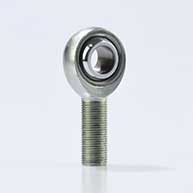
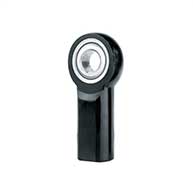
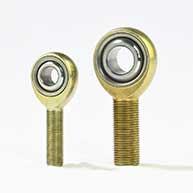
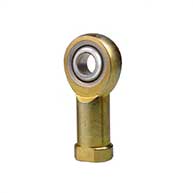
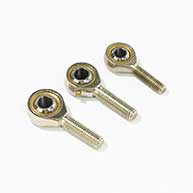
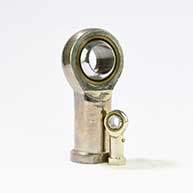
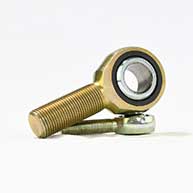
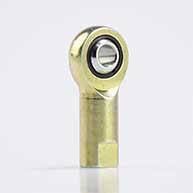
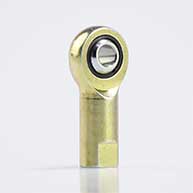
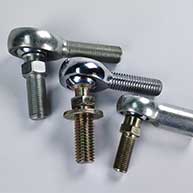
A rod end — also called a heim joint or rose joint — is a threaded spherical bearing that transmits push-pull load while allowing angular misalignment. SYZ manufactures a complete range across chromoly, carbon steel, stainless and 7075 aluminum, in 2-piece and 3-piece designs, PTFE-lined or metal-to-metal, in both inch (UNF) and metric threads, male and female, right- and left-hand. Browse by material below, then drill into each series spec chart.

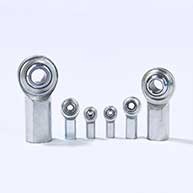
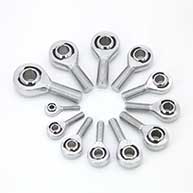
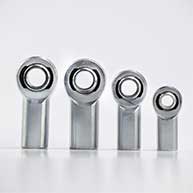
Rod ends and heim joints parent hub group shot
4 Materials
Material Families
Inch + Metric
Thread Standards
PTFE / M2M
Liner Options
FK · QA1 · Aurora
Cross-Reference
Material Certs Available
Sample to Full-Container
Heat-Treated & Lot-Verified
FK · QA1 · Aurora Cross-Ref
Direct Factory Sourcing

Overview

What Is a Rod End (Heim Joint)?

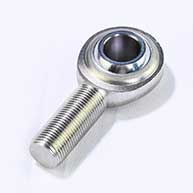
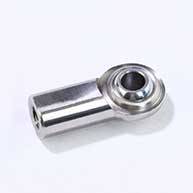
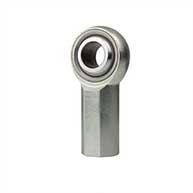
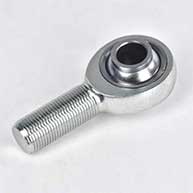
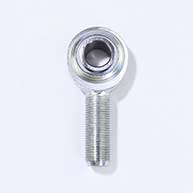
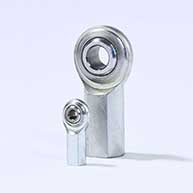
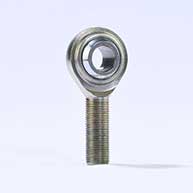
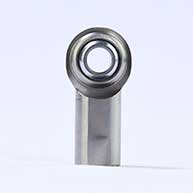
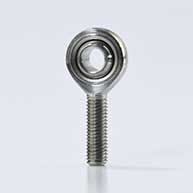
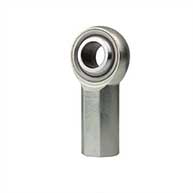
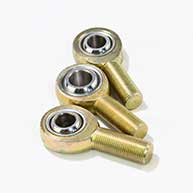
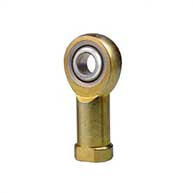
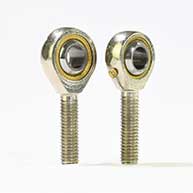
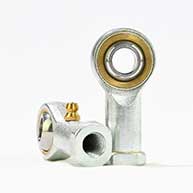
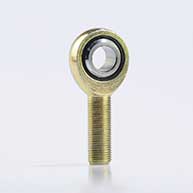
A rod end is a mechanical articulating joint used at the end of control rods, linkages and steering systems. A spherical ball is swaged into a housing that carries either an integral threaded shank (male) or a threaded bore (female). The ball swivels to absorb angular misalignment while load transfers along the rod axis.

How a rod end actually works: The spherical ball swivels inside the housing race to absorb angular misalignment (the rod end “tilts”) while transmitting tension or compression along the rod axis. Two things set its operational limits: the race/liner (how the ball slides: greased metal, self-lubricating PTFE, nylon or bronze) and the housing geometry (how far it tilts before the shank bottoms out against the housing, i.e. the misalignment angle). Most field failures trace to under-sizing for load, picking the wrong liner for the environment, or exceeding the misalignment angle.

Terminology Synonyms
Called rod end in engineering specs, heim joint in generic North American terms, and rose joint in the UK/Commonwealth. All refer to the same device.
Performance Factors
Articulating limits are governed by static radial load capacity, maximum misalignment angle, liner type (friction/maintenance needs), and thread specifications.
Limits & Articulation
The race material and housing clearance envelope define the load limits and tilt bounds. Select these based on environmental dust, moisture, and motion frequency.

Material Families

Select by Material

SYZ rod ends span four core material families. Pick the family by your dominant requirement, then explore its landing page for series details.

MaterialStrength / Load MarginWeightCorrosion ResistanceBest For
Chromoly (4130)HighestModerateNeeds plating (zinc/black oxide)Off-road, motorsport, 4-link, high-shock steering
Carbon steelHighModerateZinc platedIndustrial machinery, agriculture, general linkage
Stainless (304 body / 440C ball)Moderate-highModerateHighestMarine, washdown, food, chemical, outdoor
7075-T6 aluminumModerate (weight-first)LowestAnodized (moderate)Racing, robotics, UAV, weight-critical linkage
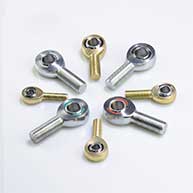
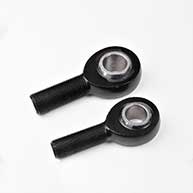
Chromoly Steel
Motorsport

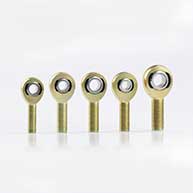
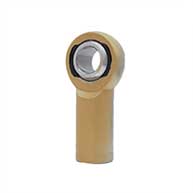
4130 chromoly bodies, heat-treated for ultimate strength and fatigue resistance. Ideal for competition suspension, steering and high-shock loading.

Body: 4130 chromoly
Race: Alloy steel / nylon-PTFE

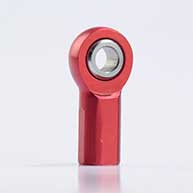
7075 Aluminum
Lightweight

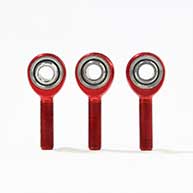
Lightweight 7075-T6 aerospace aluminum bodies, color anodized. Cuts weight to 1/3 of steel for racing, robotics, and UAV control links.

Body: 7075-T6 aluminum
Race: Steel / nylon-PTFE

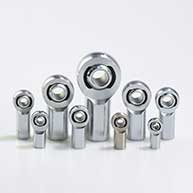
Carbon Steel
Industrial

Economical to heavy industrial carbon steel bodies. Ideal for general linkages, agriculture, conveyor systems, and industrial machinery.

Body: Carbon steel
Race: Steel / bronze / nylon-PTFE

Stainless Steel
Washdown

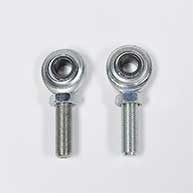
304/316/17-4 PH stainless steel housings with 440C balls, plus bronze-race and custom specialties. Built for marine, food-grade and washdown environments.

Body: 304 / 316 stainless
Race: Stainless / PTFE

Chromoly (4130): Best for high-impact, shock, or high-cycle loads (steering, competition suspension) where ultimate fatigue life is demanded.
Carbon Steel: Reliable and economical selection for moderate loads in general linkage, machinery, and agricultural mechanisms.
Stainless Steel: Essential choice for marine corrosion resistance, food-grade washdown systems, and chemical exposure.
7075-T6 Aluminum: Reduces unsprung mass for racing, drones, and robotics where moving weight reduction is paramount.

Structure & Liners

2-Piece vs 3-Piece Structure

Choose the configuration that matches your tolerance and maintenance budget. Every series offers male (external threads) and female (internal threads) in right- and left-hand configurations.

2-Piece Construction

The spherical ball is swaged directly into the housing body. This is a simpler, highly cost-effective design suitable for general industrial, agricultural, and light duty linkage.

Examples: XM/XF, CM, AM/AF, SCM, EXM, PM/PF, PCM

3-Piece Construction

A separate insert race retains the spherical ball within the housing. This provides tighter ball-to-race tolerance and higher radial load capacities per bore diameter, with optional self-lubricating PTFE liners.

Examples: JMX/JFX, JM/JF, ALJM Family

Liner and Lubrication Selection

Liner TypeLubrication NeedsBest ForExample Series
PTFE-linedSelf-lubricating, maintenance-freeHigh-cycle, sealed assemblies, clean environmentsJMX-T, CM-T, SCM-T
Metal-to-metal (alloy/steel race)Requires periodic grease purgesHigh static/impact loads, dusty or contaminated settingsCOM, JM, JMX (non-T)
Molded reinforced nylon + PTFESelf-lubricating, maintenance-freeModerate-load, low friction budget linkagesXM/XF, AM/AF, EXM, MXM
Sintered bronze, oil-impregnatedSelf-lubricatingGeneral machinery and light industrial settingsVM/VF, SA-TK
Polyurethane / Delrin (rebuildable)Self-lubricatingOff-road articulation joints requiring shock absorptionRebuildable Flex Joint

Selection Checklist

How to Select in 5 Steps

Ensure reliability in your linkage assembly by reviewing this fundamental checklist before placing your order.

01

Load Rating

Estimate max static radial load (dead + dynamic + shock). Select a housing rating with safety margin (≥1.5× typical; 2–3× for severe impact loads).

02

Thread Fit

Match thread pitch and standard. Inch uses UNF (fine threads); metric uses ISO. Confirm RH vs LH (left-hand) for adjustability turnbuckles.

03

Bore Alignment

Select bore size matching your mounting bolt. Pin size ranges from 3/16″ to 2″ and M3 to M30+ across the SYZ catalog.

04

Body Material

Corrosion-prone → stainless; rotating mass/weight → 7075 aluminum; heavy shock and suspension → 4130 chromoly; economic → carbon steel.

05

Liner Compound

Greaseable and accessible link → metal-to-metal; sealed/maintenance-free → PTFE; high-articulation off-road → polyurethane rebuildable flex joint.

Sizing Assistance

Our engineers can cross-reference parts or run calculations. Get in touch with our team directly for custom sizing.

Common design mistakes: Specifying the rod end by thread size alone while ignoring the radial load capacity; selecting metal-to-metal joints where greasing accessibility is blocked; mounting unprotected carbon steel outdoors; and exceeding the maximum misalignment angle (which bends shanks and cracks housings).

Industries & Equipment

Where SYZ Rod Ends Perform

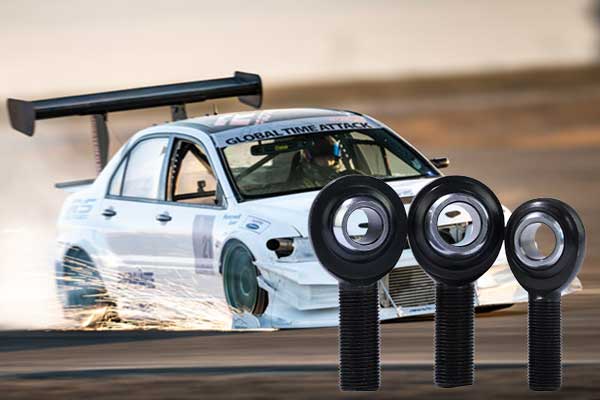
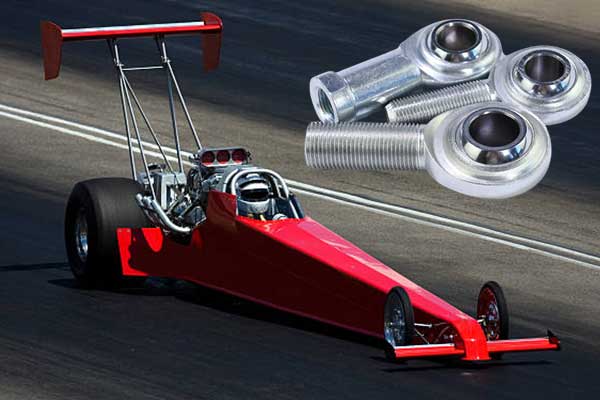
Off-Road & Motorsport

Backbone joints for competition suspension and steering. 4-link systems, panhard bars, sway-bar links, steering columns.

Recommended: Chromoly 3-piece JMX(-T) or high-misalignment PCM.

Industrial Automation

Linkages for packaging machines, conveyors, pneumatic/hydraulic cylinders, actuators, and pick-and-place systems.

Recommended: Carbon steel CM, JM or SCM stainless series.

Agriculture & Heavy Duty

Severe-duty agricultural implements, harvester/baler stroke links, tractor hitch connections, and heavy cylinder mounting.

Recommended: Greaseable COM or carbon steel JM/JF series.

Marine & Corrosive

Rudder steering linkages, throttle linkages, hatch lifters, deck hardware, and tilt/trim actuators exposed to saltwater or washdown chemicals.

Recommended: Stainless SCM-T/SCF-T or COM-SS spherical bearings.

Aerospace & Robotics

Unmanned aerial vehicles (UAVs), robotics, custom motion simulators, and weight-critical assemblies requiring high articulation.

Recommended: 7075-T6 aluminum ALJM or AM/AF series.

Our Strengths

Why Choose SYZ as Your Supplier

Factory-Direct Pricing
Direct manufacturer integration eliminates distributor margins and markup, saving cost on high-volume production schedules.
Specialist Technical Focus
Spherical plain bearings and rod ends are our core expertise, ensuring deep metallurgical control and batch-verified consistency.
Complete Product Matrix
One source for 57 spec series, 1,200+ distinct part numbers, spanning standard, metric, and specialized structural designs.
Authoritative Cross-Referencing
Dynamic matching capability to identify replacement parts matching FK, QA1, Aurora, Alinabal, and Midwest Control specifications.
Prototype to Production Scaling
Sample orders are welcomed to verify assembly clearances, scaling seamlessly to full container shipping for high-volume OEM requirements.

FAQ

Common Questions

What is the difference between a rod end and a spherical bearing?
A rod end is a complete assembly — a spherical bearing inside a housing with an integral threaded shank or bore, ready to thread into a linkage. A spherical plain bearing is just the ball-in-ring element and must be pressed into a housing first. SYZ manufactures both.
What does “PTFE-lined” mean?
A PTFE liner is bonded between ball and race to eliminate metal-to-metal contact, giving self-lubricating, maintenance-free, low-friction operation. It is the default where the joint is sealed, hard to grease, or must run clean.
Should I choose a male or female rod end?
Male rod ends thread into a tapped hole, tube adapter or turnbuckle and are most common. Female rod ends accept a threaded stud, bolt or male rod end. Every SYZ series offers both.
What thread standard do SYZ rod ends use?
Inch rod ends use UNF fine threads for vibration resistance; metric rod ends use ISO metric threads. Left-hand variants are available for turnbuckle and adjuster assemblies.
How do I match an SYZ rod end to an FK, QA1 or Aurora part?
Each series spec page has a cross-search tool listing the competitor brands SYZ cross-references for that series, such as FK, QA1, Aurora, Alinabal and Midwest Control. Search by competitor part number to find the SYZ equivalent.
Do you offer custom rod ends?
Yes. SYZ can manufacture non-standard threads, special materials, custom housing dimensions and liners. Send a drawing or competitor part number for review.
Can rod ends be used in continuous rotation?
No. Rod ends are designed for oscillating and angular movement and static positioning. Continuous RPM overheats and wears the bearing; use a ball or roller bearing instead.
What is misalignment angle?
It is the maximum angular deflection before the shank or housing bottoms out. SYZ high-misalignment series (PCM, PCYM, HJMX) and misalignment spacers extend the angle. Exceeding it bends the shank or cracks the housing.

Factory Direct

Request a Quote

Tell us your series, part numbers and quantities. We respond within 24 hours with pricing and lead time.

We respond within 24 hours · Factory direct · No spam, ever

Request a Quote

Please submit the form or email [email protected]

🍪
We Use Cookies