
Spacers Buyers’ Guide
Spacers are precision components used between rod ends, spherical joints, mounting tabs and fasteners to establish the required width, clearance and misalignment space. This guide covers what spacers do, the material and finish choices, and how to select across the SYZ spacer families.
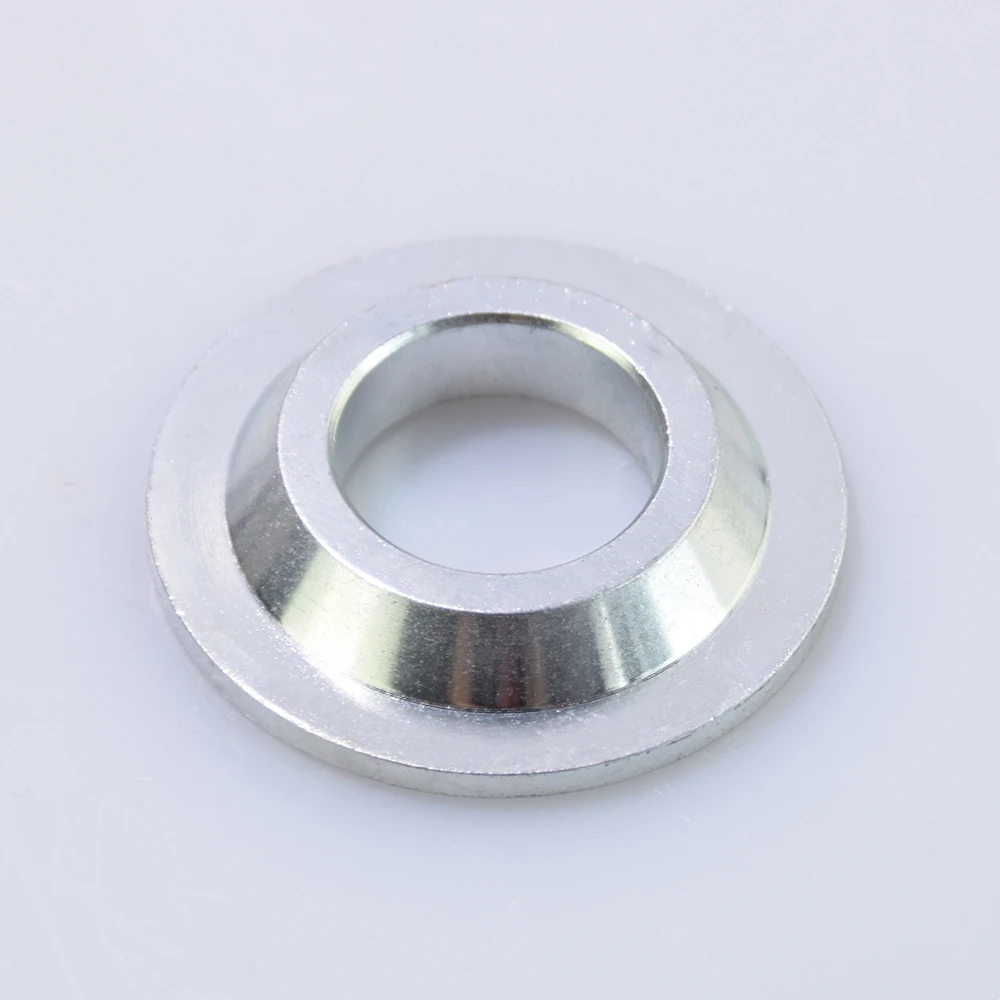
What Are Spacers?
DefinitionSpacers are precision-machined components placed between rod ends, spherical joints, mounting tabs and fasteners to establish the required width, clearance and misalignment space. They position the spherical joint inside a bracket stack without changing the rod-end body — and they keep the assembly aligned and free to articulate through its working travel.
Beyond alignment, spacers distribute clamp load evenly, stop damaging metal-to-metal contact and adapt bore to bolt. SYZ machines spacer families in stainless and zinc-plated carbon steel — high-misalignment, cone and mounting styles — plus custom spacers to drawing at ±0.01 mm CNC tolerance.
- Also called
- Standoffs · reducers · bushing spacers
- Core function
- Set width, clearance and alignment
- Tolerance
- CNC machined to ±0.01 mm
- Materials
- Stainless · zinc-plated carbon steel
Anatomy: What a Spacer Does
StructureA spacer is defined by four dimensional decisions — each one a mechanical function.
Bore
The bore accepts the bolt or stud and adapts the joint’s ball bore to the fastener — the reducer function.
Width
Width sets the installed gap between tabs or faces — establishing clearance and centering the joint in the stack.
Shoulder / Step
Shouldered and cone geometries move pivot planes, seat into tapers or register against faces — the geometry that extends articulation or locates a bearing.
Material & Finish
Stainless or zinc-plated carbon steel decides how the spacer survives its environment while carrying the clamp load.
Rod-End Spacers
High-misalignment (SG/HMS), cone (SCNS/CNS) and mounting (SCW/CW) spacers purpose-built for spherical rod ends — extending articulation angle, adapting bores and centering joints.
The right choice when the spacer’s job is defined by a rod end or spherical bearing.
General Mounting Spacers
Straight spacers and standoffs for control-arm, sway-bar, radius-rod and fabricated chassis assemblies — spacing hardware where no spherical joint is involved.
Machined to your dimensions in stainless or plated carbon steel, at production quantities or one-offs.
What Spacers Do in the Assembly
FunctionFour distinct technical jobs — knowing which one you need decides the family.
Maintain accurate gaps
Consistent spacing between mechanical parts or layers — the spacer is the dimensional reference that keeps the assembly square through its life.
Distribute load evenly
A spacer across a joint spreads clamp load instead of concentrating it on a thin tab — preventing local yielding and looseness.
Preserve articulation
The right width and shoulder geometry keep the joint’s full misalignment available — the difference between free travel and binding at full droop.
Isolate contact
Spacers stop metal-to-metal contact where sliding or fretting would damage the parts.
Where spacers fail in the field
- Wrong width stack-up — the joint side-loads or loses its working angle.
- Plated steel in corrosive service instead of stainless.
- Soft or under-hardened spacers crushing under clamp load.
- Skipping the travel check — binding discovered only at full droop.
Choose the Material
MaterialsTwo material tracks cover nearly every spacer application.
Zinc-Plated Carbon Steel
Standard dutyThe economical standard — CNC-machined, zinc-plated for corrosion protection in protected environments.
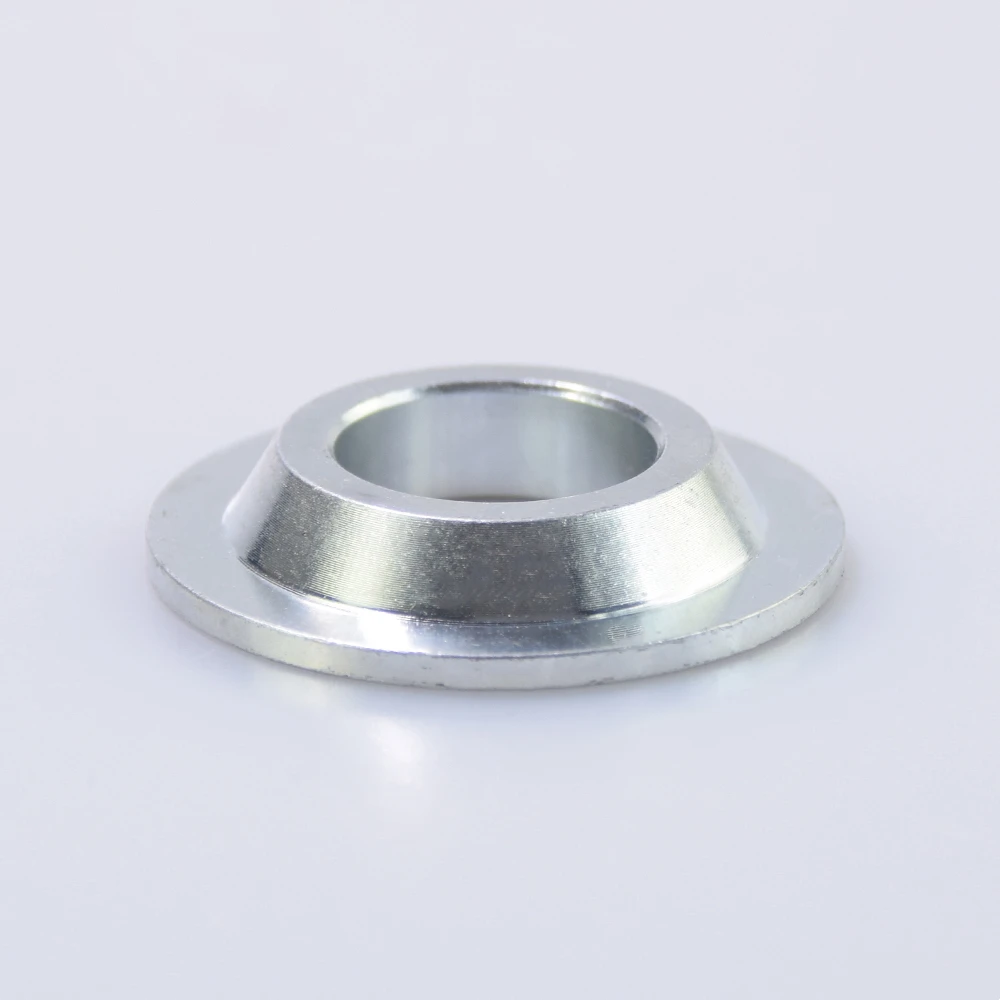
Stainless Steel
Corrosion serviceStainless spacers for marine, salted-road and washdown environments — no plating to wear through.
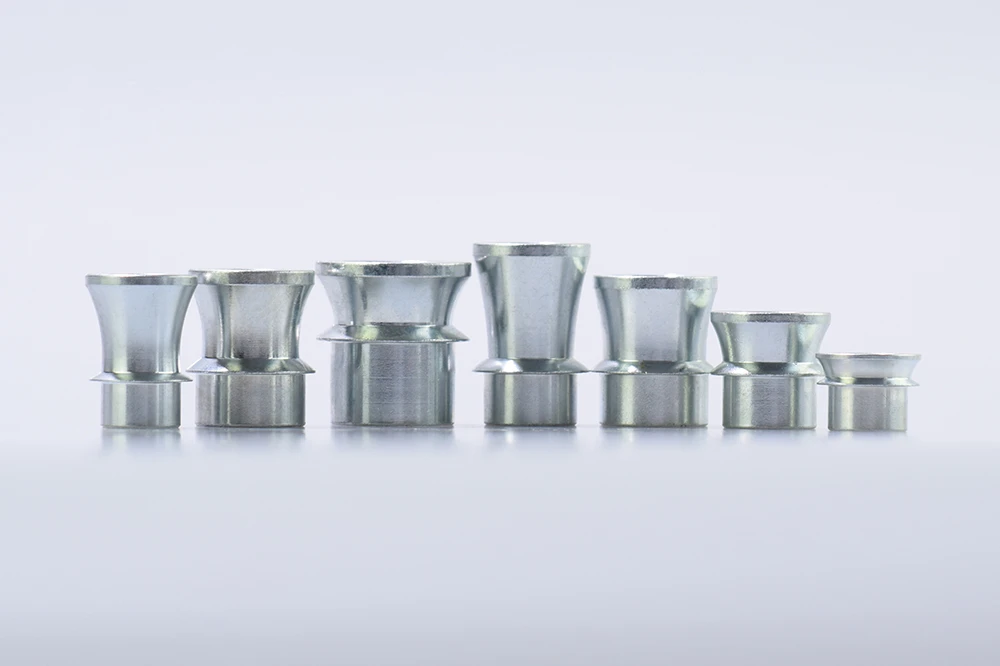
Joint-Specific Geometries
Spherical jointsShouldered and cone geometries purpose-built for rod ends and spherical bearings — articulation and adaptation, not just spacing.
Materials and Finishes
Surface treatmentFinish follows material — two standards plus custom work.
| Treatment | Applied to | Series examples | What it does |
|---|---|---|---|
| Zinc plating | Carbon steel spacers | Standard families | Sacrificial corrosion protection. |
| Stainless, bare | Stainless spacers | Corrosion-prone builds | Alloy is the corrosion strategy — no plating to damage. |
| Custom finish | Special orders | To drawing | Special platings and finishes for production programs. |
Standard configurations live in the rod end spacer families; custom spacers are machined to drawing — send dimensions for review.
Where Spacers Perform
ApplicationsSpacers are everywhere a joint meets a bracket — these are the recurring patterns.
Rod-End Misalignment & Clearance
Positioning a rod end between mounting tabs while preserving its angular travel.
SG/HMSSCW/CWSuspension & Chassis Mounting
Control-arm, sway-bar, radius-rod and fabricated chassis assemblies.
ZincStainlessBearing & Joint Mounting
Adapting spherical bearings into stepped, tapered or wide mounts.
ConesCustomGeneral Machinery
Accurate gaps and load distribution across equipment and fixtures.
ZincCustomHow to Choose: 5 Steps, Then the Family Table
Selection referenceDefine the Function
Pure spacing → straight spacers. Joint articulation → high-misalignment. Tapered mount → cone.
Set the Dimensions
Bore, width and OD — plus shoulder or taper geometry where the mount demands it.
Pick the Material
Zinc-plated carbon steel for standard duty; stainless for corrosion-prone environments.
Check the Clamp Load
Confirm the spacer carries the clamp load without crushing — material hardness matters.
Verify Through Travel
Recheck alignment and clearance through the full working travel with the stack installed.
| Family | Type | Material | Best for | Where |
|---|---|---|---|---|
| SYZ spacer families | ||||
| SG / HMS | High-misalignment rod-end spacers | Stainless / carbon | Articulation links | View |
| SCNS / CNS | Cone spacers | Zinc-plated carbon steel | Tapered & stepped mounts | View |
| SCW / CW | Mounting spacers | Stainless / carbon steel | Width & bore adaptation | View |
| Custom spacers | Machined to drawing | Stainless / plated steel | Everything else | View |
Joint-specific hardware? The rod end spacer families cover spherical-joint spacers; uniball cups cover weld-in bearing housings.
Get Selection HelpSpacer Buyers’ Questions
FAQQ1What is the difference between spacers and rod end spacers?
Q2Which material should I choose?
Q3Can I get custom spacer dimensions?
Q4How do spacers affect articulation?
Q5What tolerance are spacers machined to?
Selecting Spacers?
Send us the bore, width and working environment — or the drawing for custom spacers. SYZ engineers reply with the right configuration at factory-direct pricing.
For the full SG/HMS, SCNS/CNS and SCW/CW family breakdown, see the Rod End Spacers Buyers’ Guide.