
Rod End Spacers Buyers’ Guide
A rod end spacer locates the joint in its mount, adapts the bore to your bolt and — in high-misalignment form — extends how far the joint can travel before it binds. This guide covers the three SYZ families (SG/HMS, SCNS/CNS, SCW/CW) and how to choose them.
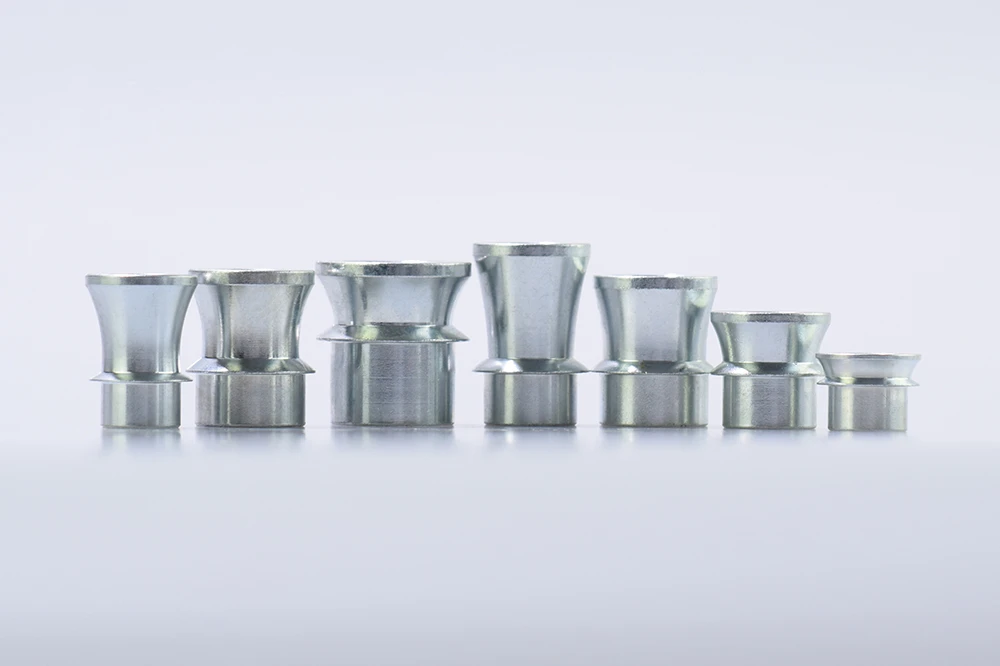
What Are Rod End Spacers?
DefinitionA rod end spacer sits between the spherical ball bore and your mounting brackets, and does two jobs: it locates and centers the bearing inside the bracket so it runs straight, and — in high-misalignment form — it increases the tilt angle before the rod housing binds against the tabs. On a suspension link that is actively cycling, the second job is the one that keeps parts from breaking.
Spacers (also called reducers or standoffs) also adapt the rod-end bore to your bolt size — so one joint serves multiple bolt diameters without changing the body. SYZ machines three families: high-misalignment SG (stainless) / HMS (carbon steel), cone spacers SCNS/CNS and mounting spacers SCW/CW — 36 standard configurations, stainless or zinc-plated carbon steel, plus custom materials and finishes to drawing.
- Also called
- Reducers · standoffs · misalignment spacers
- Core function
- Locate, adapt and extend joint travel
- Families
- SG/HMS · SCNS/CNS · SCW/CW
- Configurations
- 36 standard, custom to drawing
Anatomy: What a Spacer Actually Does
StructureSmall part, big impact — each spacer family solves a distinct mechanical problem.
Bore Adaptation
The spacer’s bore adapts the rod-end ball bore to your bolt diameter — one joint, multiple bolt sizes, with the spacer carrying the compression between the tabs.
Width & Location
Spacer width sets the installed width of the joint, centering the bearing between the tabs so it runs straight instead of side-loaded.
High-Misalignment Geometry
SG/HMS spacers have a reduced-diameter shoulder that protrudes into the tab holes — moving the pivot plane outward and raising the working tilt angle to 44°–66° before the housing binds.
Cone Geometry (SCNS/CNS)
Cone spacers combine bore adaptation with a tapered seat, commonly used to adapt spherical bearings into tapered or stepped mounts.
High-Misalignment (SG / HMS)
Under extreme articulation — full droop or full compression — standard hardware lets the housing bind against the brackets, bending the shank or cracking the head. High-misalignment spacers move the pivot plane outward and fix it.
SG in stainless for corrosion-prone builds; HMS in carbon steel for standard duty. Working angles 44°–66° by size.
Mounting & Cone (SCW/CW, SCNS/CNS)
Mounting spacers (SCW stainless / CW carbon) set width and adapt bore on standard mounts. Cone spacers (SCNS/CNS) add a tapered seat for stepped or tapered mounting scenarios.
Choose these when the joint’s travel fits standard hardware and the job is centering, spacing and bore adaptation.
What Spacers Do in the Assembly
FunctionBeyond alignment and spacing, spacers do several distinct technical jobs — knowing which one you need decides the family.
Maintain accurate gaps
Consistent spacing between mechanical parts or layers — the spacer is the dimensional reference that keeps the assembly square.
Distribute load evenly
A spacer across the joint spreads the clamp load and stops metal-to-metal contact where it would do damage.
Extend articulation
High-misalignment shoulders raise the working angle before the housing contacts the tabs — the difference between a working off-road link and a broken one.
Adapt bore to bolt
Reducers let a single rod-end bore serve a range of bolt sizes — inventory efficiency for OEM and repair builds.
Where spacers fail in the field
- Standard spacers on full-articulation links — the housing binds and the shank bends.
- Wrong width stack-up, side-loading the spherical bearing.
- Carbon steel spacers in corrosive climates instead of stainless.
- Skipping the stack-up check — alignment lost through full travel.
Choose the Material
MaterialsTwo material tracks — stainless for corrosion-prone builds, zinc-plated carbon steel for standard duty.
SG — Stainless
High-misalignment, corrosionStainless high-misalignment spacers — the corrosion-proof choice for off-road, marine and salted-road builds that also need the extended angle.
HMS — Carbon Steel
High-misalignment, standardZinc-plated carbon steel high-misalignment spacers with the same geometry as SG — the economical standard for protected builds.
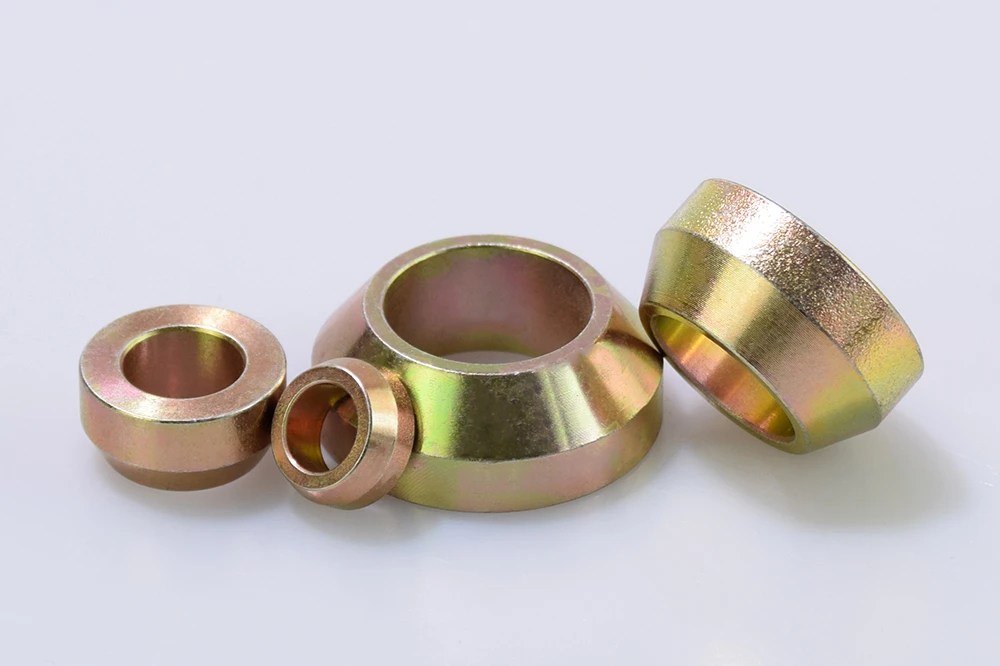
SCNS / CNS — Cone
Tapered adaptationCone spacers adapt spherical bearings into tapered or stepped mounts while spacing the joint.
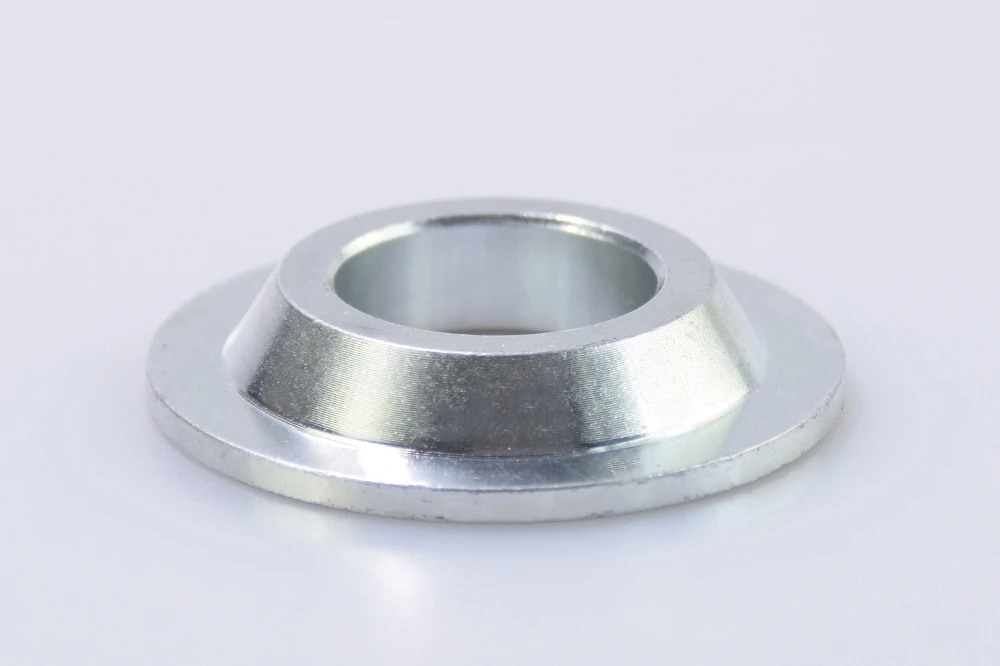
SCW / CW — Mounting
Width & bore adaptationStraight mounting spacers in stainless (SCW) and zinc-plated carbon steel (CW) for standard width and bore adaptation.
Materials and Finishes
Surface treatmentFinish follows material — two tracks across all three families.
| Treatment | Applied to | Series examples | What it does |
|---|---|---|---|
| Stainless steel | SG, SCW bodies | Corrosion-prone builds | No plating — alloy is the corrosion strategy; ideal for salted roads and marine. |
| Zinc-plated carbon steel | HMS, CW, SCNS/CNS bodies | Standard builds | Sacrificial plating on the economical material track. |
| Custom materials/finishes | All families | To drawing | Special materials and finishes machined to drawing for production programs. |
Bore, width and angle charts for every part are on the family spec pages — SG/HMS, SCNS/CNS and SCW/CW.
Where Rod End Spacers Perform
ApplicationsWherever a spherical joint meets a bracket, spacers decide whether it works or binds.
Off-Road Suspension Links
Full-articulation control arms and links — high-misalignment spacers are mandatory hardware at every heim.
SGHMSSteering Systems
Heim-joint steering on drilled arms — spacers preserve steering travel.
SGHMSBracket & Mount Spacing
Setting joint width and adapting bore to bolt on industrial mounts.
SCW/CWSCNS/CNSMarine & Corrosive Builds
Stainless spacers wherever roads are salted or the air is salty.
SGSCWHow to Choose: 5 Steps, Then the Family Table
Selection referenceMeasure the Articulation
Cycle the assembly to full droop and compression — if the housing can contact the tabs, you need high-misalignment SG/HMS.
Confirm Bolt & Bore
Match the spacer bore to your bolt and the OD to the ball bore — the reducer logic that adapts joint to bolt.
Set the Width Stack
Add spacer widths so the joint is centered — no side load, no lost angle.
Pick the Material
Stainless for corrosive exposure; zinc-plated carbon steel for standard duty.
Verify Through Travel
Recheck alignment and clearance through the full working travel with the stack installed.
| Family | Type | Material | Best for | Specs |
|---|---|---|---|---|
| Spacer families | ||||
| SG / HMS | High-misalignment | Stainless / carbon steel | 44°–66° articulation links | View |
| SCNS / CNS | Cone spacers | Zinc-plated carbon steel | Tapered & stepped mounts | View |
| SCW / CW | Mounting spacers | Stainless / carbon steel | Width & bore adaptation | View |
Which rod ends do these fit? Any spherical ball bore — see the rod end range. Building links? See linkage rods.
Get Selection HelpRod End Spacer Buyers’ Questions
FAQQ1Why do heim joints need high-misalignment spacers?
Q2SG or HMS — which one?
Q3What are cone spacers for?
Q4Do spacers change the bolt size?
Q5What sizes are covered?
Selecting Rod End Spacers?
Send us your bolt size, ball bore and articulation angle — SYZ engineers reply with the right family and configuration at factory-direct pricing.
Need a general mounting or bore-reducer spacer instead? See the Spacers Buyers’ Guide.