
Small Ball Joints Buyers’ Guide
Small ball joints are compact ball-stud-and-socket joints for light control and positioning linkage — simpler and smaller than a rod end. This guide covers how they work, the DIN 71802 / axial / staked / quick-release styles, materials and finishes, and how to choose across SYZ’s five series.
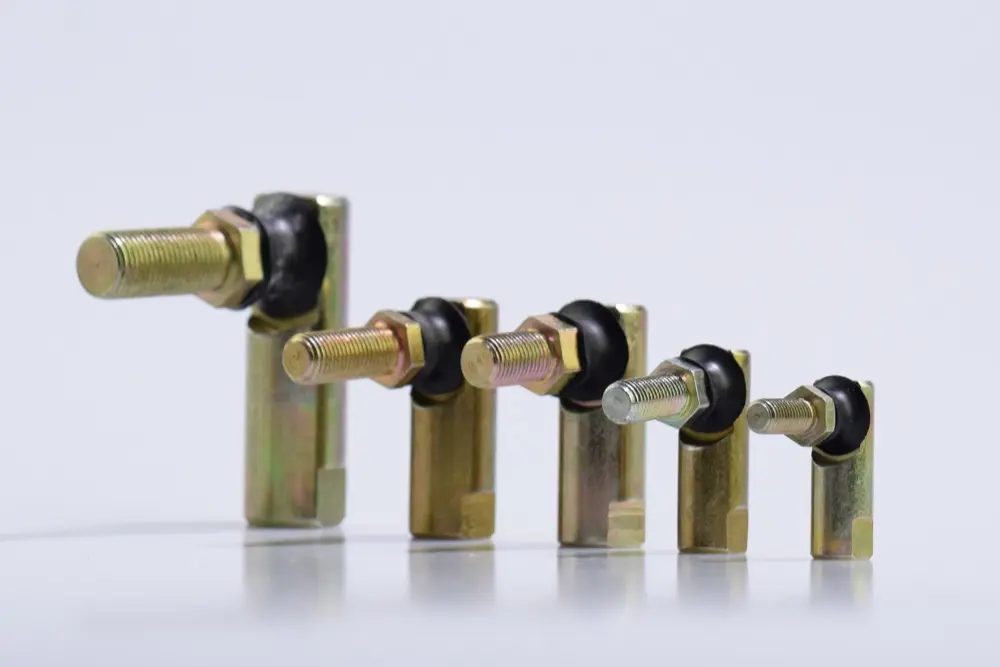
What Are Small Ball Joints?
DefinitionSmall ball joints are smaller, lighter articulating joints that use a ball stud rotating in a socket — distinct from a rod end, which uses a spherical bearing inside a threaded housing. The ball-stud layout is simpler and more compact, made for low-to-moderate-load control and positioning linkage.
These are light industrial and equipment joints — throttle linkage, control rods, mower steering, actuators — not automotive suspension ball joints. For structural or suspension loads, confirm the required load rating and step up to a rod end.
- Also called
- Ball stud joint · mini ball joint
- Core function
- Compact push-pull + swivel on control linkage
- Thread range
- 10-32 to 1/2-20 (inch) · M5–M16 (metric)
- Standards
- DIN 71802 (CS) · GN 71802.1 (AIM)
Anatomy of a Small Ball Joint
StructureThe construction is deliberately simple — four elements decide how the joint behaves and how it is serviced.
Ball Stud
A hardened steel ball on a threaded shank (1045-class, lubricated ball seat). The ball is the swiveling element; the thread anchors the joint into the mating part.
Socket / Housing
The stamped or machined housing that captures the ball — carbon steel, tensile class 5 on the DIN 71802 CS series, zinc plated and passivated.
Retention System
How the ball stays in the socket: staked construction (ES), spring clip (CS), or a stainless quick-release spring (QD/QI). This decides whether the joint is permanent or serviceable.
Sealing
A rubber grommet shell (ES) or optional sealing cap (CS) keeps debris out of the ball seat — the difference between a joint that lasts outdoors and one that doesn’t.
Staked / Fixed
The socket is staked or clipped around the ball for a permanent, secure joint. ES adds a rubber grommet shell that seals against debris; CS uses a spring-steel clip with optional sealing cap.
Choose these when the joint is assembled once and expected to stay in service without disconnection.
Quick Disconnect
A stainless spring lets the socket release from the ball and snap back on — no hardware disassembly. QD carries the spring on the inner side, QI on the outer layout.
Choose these for assemblies that are repeatedly disconnected: deck linkages, removable panels, service fixtures.
What a Small Ball Joint Does in a Mechanism
FunctionFour engineering jobs define these joints — each maps to a line on the selection path.
Transmit push-pull control force
AIM is optimized for axial force transfer along the rod centerline with minimal power loss; CS’s 90-degree angled layout converts direction in tight assemblies. Size by the published pull-out force range (30–100 N on AIM).
Compensate small misalignment
The ball pivots within a defined conical angle and rotates 360° in the socket, absorbing small geometry errors in throttle, mower-steering and actuator linkage — not suspension-range articulation.
Release and re-connect fast
QD/QI quick-disconnect designs let operators remove a linkage for service or seasonal changeover and snap it back — the reason they dominate deck and blade-engagement linkages.
Keep dirt out of the seat
The ES grommet and the CS sealing cap protect the lubricated ball seat outdoors — in lawn, garden and agricultural equipment this is what keeps the joint smooth over its life.
Where small ball joints fail in the field
- Using them for suspension or structural loads beyond their pull-out rating.
- Choosing fixed styles where the linkage must be disconnected for service.
- Running unsealed joints in debris-heavy outdoor equipment.
- Mismatching thread hand or size with the mating rod or bracket.
Choose Construction and Material
MaterialsAll five series share the same material logic: hardened steel ball, carbon steel socket, zinc-plated finish — with stainless options where corrosion or cleanliness demands it.
Standard Carbon Steel
The default buildHousing 1045 (ES/QD/QI) or 1020 (CS) carbon steel with a 1045 hardened ball stud, silver or yellow zinc plated. The economical standard for OEM and replacement linkage.
Grommet-Sealed (ES)
Debris protectionThe ES rubber grommet shell seals the ball seat against grass, dust and washdown — the series of choice for lawn, garden and agricultural equipment.
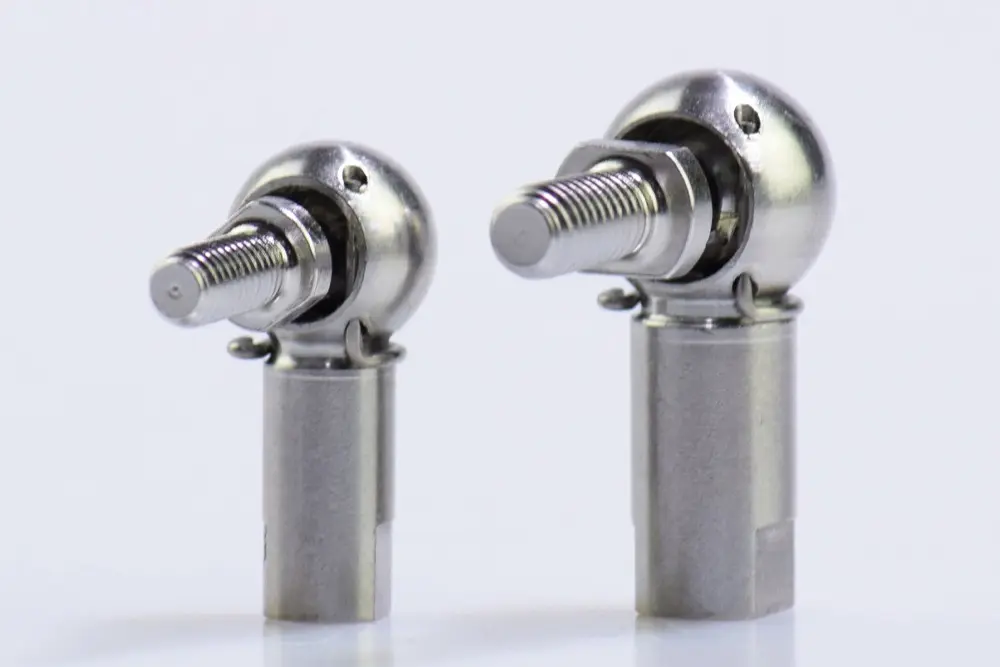
Stainless Option
Corrosion-sensitive serviceAdd S to the prefix (e.g., SCSM10) for stainless construction on CS and QI series — for washdown, chemical exposure or food-adjacent equipment.
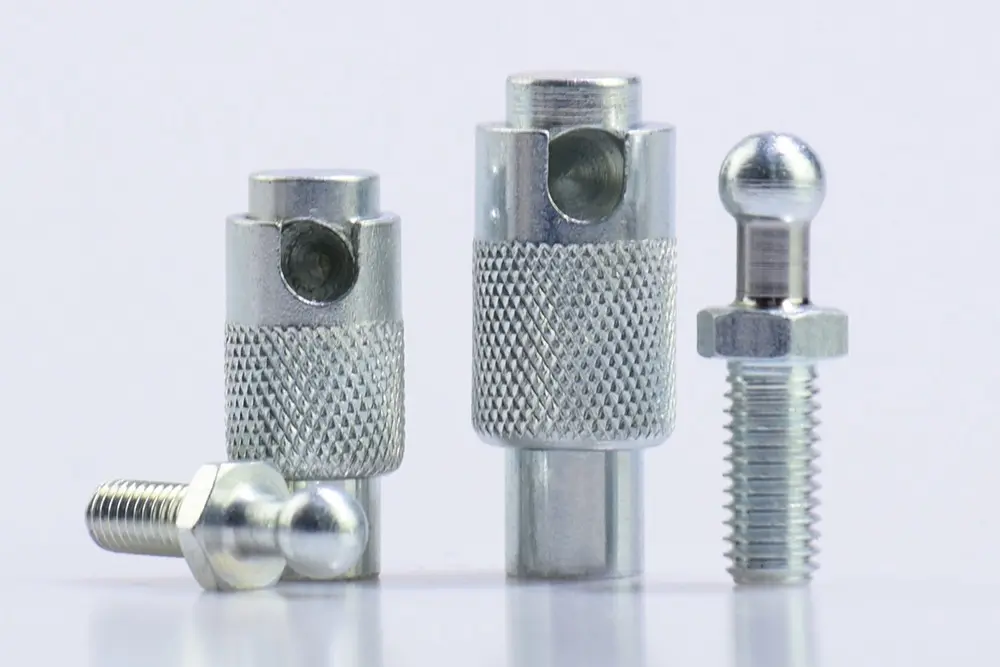
Aluminum Option (QD)
Weight-critical buildsThe QD series adds an aluminum-body option (prefix A, e.g., AQD250) where weight matters on moving linkage.
Finishes: What Protects Each Part
Surface treatmentSmall ball joints are zinc-plated across the range; the variations are in passivation and material substitution.
| Treatment | Applied to | Series examples | What it does |
|---|---|---|---|
| Zinc plating, colorless passivate | Sockets and shells | CS, AIM, ES, QD, QI | Sacrificial corrosion protection with a clean, OEM-style appearance. |
| Silver / yellow zinc | Housing and stud | ES, QD, QI | Choice of finish tone for OEM matching; both are sacrificial protection. |
| Lubricated ball seat | Ball stud | All series | Factory lubrication for smooth swivel and wear resistance over life. |
| Stainless substitution | Whole joint | CS (S prefix), QI (S prefix) | Material upgrade replacing plating when corrosion requirements are higher. |
Finish and material options vary by series — confirm on each series spec page before ordering.
Where Small Ball Joints Perform
ApplicationsAnywhere compact, light-load linkage needs a swivel — these are the patterns the five series are built around.
Throttle & Control Linkage
Engine and machine control rods where a compact swivel must transmit push-pull force in tight packaging.
CSAIMQDLawn & Garden Equipment
Mower steering and deck engagement — grommet sealing and quick disconnect earn their keep outdoors.
ESQDQIActuators & Positioning
Linear actuator links and positioning mechanisms using axial pull-pull transfer.
AIMCSAgricultural & Construction
Light control and sensor linkages on machinery — zinc-plated, sealed, OEM-grade.
ESCSMotorsport Accessories
Non-structural control circuits — throttle, shifter and release linkages around the vehicle.
QDQIHow to Choose: 5 Steps, Then the Series Table
Selection referenceLoad & Pull-Out Force
Confirm the working force against the published pull-out range (AIM: 30–100 N). For structural or suspension loads, move to a rod end instead.
Geometry
Straight-line axial transfer → AIM. A direction change in tight space → CS angled (DIN 71802).
Thread & Size
Match thread to the mating part: inch 10-32 to 1/2-20 (ES/QD/QI) or metric M5–M16 (CS/AIM).
Retention Style
Permanent assembly → staked ES / clip CS. Repeated disconnection → quick release QD/QI.
Environment
Outdoor debris → ES grommet or CS sealing cap; washdown/corrosive → stainless S-prefix versions.
| Series | Style | Standard | Retention / Seal | Specs |
|---|---|---|---|---|
| Inch series | ||||
| ES | Grommet style, staked | — | Rubber grommet shell, sealed | View |
| QD | Quick disconnect | — | Inner spring, stainless | View |
| QI | Quick disconnect | — | Outer spring, stainless | View |
| Metric series | ||||
| CS | Angled ball joint | DIN 71802 | Spring clip; sealing cap optional | View |
| AIM | Axial ball joint | GN 71802.1 equiv. | Swaged axial socket | View |
Need more articulation or load? Step up to the rod end range, or build the complete circuit with ball joint linkages. Cross-referencing a competitor part number? Each series spec page includes the cross-search tool.
Get Selection HelpSmall Ball Joint Buyers’ Questions
FAQQ1Small ball joint vs rod end — which do I need?
Q2What is DIN 71802?
Q3What is the difference between QD and QI quick disconnect joints?
Q4Are stainless small ball joints available?
Q5What pull-out forces do AIM axial joints cover?
Q6Can I get left-hand threads?
Selecting Small Ball Joints for Your Build?
Send us your thread, force and environment requirements — or a competitor part number to cross-reference. SYZ engineers reply with the right series and factory-direct pricing from sample to full-container quantities.