
Industrial Weld on Ball Joints Buyers’ Guide
Industrial weld-on ball joints are heavy-duty spherical joints built to be welded into machine structures — a hardened ball stud in a weldable carbon steel housing, published with retainer strength and push-out data. This guide covers construction, the shouldered vs not-shouldered choice, and how to select across SYZ’s 29 sizes.
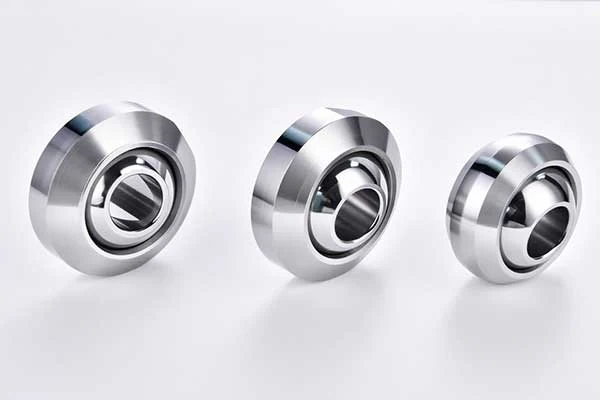
What Are Weld on Ball Joints?
DefinitionA weld-on ball joint is a heavy-duty spherical joint with a weldable housing: the carbon steel retainer is welded into a machine structure, lever or mounting bracket, and the hardened ball stud pivots inside it. Unlike a rod end, there is no threaded housing — the joint becomes a fixed pivot welded into the parent structure.
SYZ supplies them in shouldered and not-shouldered styles across 29 pin sizes, with ultimate retainer strength and ball push-out force published on every part — the numbers you need when the joint is a structural pivot on industrial and agricultural equipment.
- Also called
- Weldable ball joint · weld-in ball socket
- Core function
- Fixed weld-in pivot with angular movement
- Strength data
- Published per part: retainer + push-out
- Styles
- Shouldered · Not-shouldered
Anatomy of a Weld on Ball Joint
StructureConstruction is simple and robust — three elements decide fit and strength.
Weldable Retainer
The carbon steel housing that is welded into the parent structure. Its OD (B), width (D) and angle define the weld package and the joint’s working envelope.
Hardened Ball Stud
The pin that pivots in the retainer — sized 0.5″ to 1.12″+ across the range. Pin size and ball width (C) carry the working load.
Shoulder (on shouldered styles)
A machined shoulder locates the joint against the mounting surface and sets the standoff. Not-shouldered styles weld flush for simpler fixturing.
Shouldered
The shoulder registers the joint against the mating surface, controlling penetration depth and alignment during welding — useful where the pivot position is dimension-critical.
Choose this when the joint must sit at an exact height or face a machined register.
Not-Shouldered
A straight retainer that welds in flush — the simplest, most flexible package for fixtures and structures where the welder sets the position.
Strength data spans 20,000 to 78,900 lb ultimate retainer strength across the group, with matching push-out figures.
What a Weld on Ball Joint Does in a Machine
FunctionFour engineering jobs define these joints — each maps to a selection decision.
Provide a structural weld-in pivot
The retainer becomes part of the machine structure once welded — choose retainer OD and width for the weld package and the load path, not the pin alone.
Carry load with published margins
Every part lists ultimate retainer strength (20,000–162,000 lb) and ball push-out force (14,600–68,600 lb). Size against the worst-case machine load with margin.
Articulate under vibration
The hardened ball pivots through the published working angles (A/B) — enough for linkage and lever motions on industrial and agricultural equipment.
Survive welded-in service
Carbon steel construction is welder-friendly; weld, cool, then finish the assembly. The joint is not serviceable after welding — select ratings accordingly.
Where weld-on ball joints fail in the field
- Welding without fixture control, putting the pivot out of position.
- Sizing by pin diameter while ignoring retainer strength data.
- Under-specified push-out rating on impact-loaded levers.
- Expecting serviceability — a welded joint is permanent; use a rod end if it must be replaceable.
Materials and Strength Classes
MaterialsThe range is deliberately focused: carbon steel housing with a hardened ball, in strength classes that scale with pin size.
Standard Range
20,000 lb classThe compact class — 0.5″ to 1″ pins with 20,000 lb ultimate retainer strength and 14,600 lb push-out. The general-purpose choice for equipment linkages.
Mid Range
32,800–45,000 lb classLarger retainers with 1.38″ ball widths raise capacity to the 32,800–45,000 lb class for heavier levers and linkages.
Heavy Range
52,000–78,900 lb classThe top of the range: 1.75″ ball widths and 162,000 lb ultimate retainer strength on the largest 1.5–2.0″ pins, for severe-duty structural pivots.
Materials and Finishes
Surface treatmentThe catalog is built around welded-in carbon steel construction; surface engineering happens at the assembly level.
| Treatment | Applied to | Series examples | What it does |
|---|---|---|---|
| Carbon steel housing | Retainer (weldable) | All 29 sizes | Welder-friendly carbon steel — the material is the point, since the retainer is welded into the structure. |
| Hardened ball stud | Pin | All 29 sizes | Heat-treated pin for wear resistance under oscillating load. |
| Post-weld finishing | Assembly level | Fabricator scope | Paint, powder coat or plating applied after welding protects the finished structure. |
Confirm pin, retainer and strength data for each part on the series spec page. Special sizes and configurations are available on request.
Where Weld on Ball Joints Perform
ApplicationsAnywhere a machine needs a permanent, weld-in pivot with real load data behind it.
Industrial Machinery
Fixed pivots on levers, linkages and machine structures welded directly into the frame.
NS seriesS seriesAgricultural Equipment
Implement and attachment pivots exposed to shock and weather, with published strength margins.
Mid rangeHeavy rangeConstruction & Attachments
Attachment joints on buckets, hitches and tooling where the pivot is part of the welded structure.
Heavy rangeCustom Fabrication
OEM machine builds that need a repeatable, data-backed weld-in joint across production runs.
NS seriesHow to Choose: 5 Steps, Then the Series Table
Selection referenceWorking Load
Compare the machine’s worst-case load with the published ultimate retainer strength and push-out force — keep a clear margin.
Pin Size & Ball Width
Match the pin to the mating linkage and the ball width (C) to the load and wear expectation.
Mounting Style
Shouldered when the pivot position must register against a surface; not-shouldered for flexible weld-in placement.
Weld Package
Confirm retainer OD (B), width (D) and working angles (A/B) against the structure before cutting steel.
Service Expectation
Welded joints are permanent — if the pivot must be replaceable, use a rod end or a clevis instead.
| Style | Pin range | Strength class | Typical use | Specs |
|---|---|---|---|---|
| Not-shouldered — SYZ-HSB-NS | ||||
| NS001–NS005 | 0.5″–0.75″ | 20,000–45,000 lb | General equipment linkages | View |
| NS006–NS011 | 0.75″–1″ | 32,800–52,000 lb | Heavier levers and structures | View |
| NS012–NS025 | 1″–1.12″ | 40,500–162,000 lb | Severe-duty structural pivots | View |
| Shouldered — located weld-in | ||||
| SYZ-HSB-S series | By size | Per part data | Position-critical weld-in pivots | View |
Building a complete linkage instead? Pair weld-in joints with linkage rods, or use rod ends where the pivot must thread in and be adjustable.
Get Selection HelpWeld on Ball Joint Buyers’ Questions
FAQQ1Shouldered or not-shouldered — what is the difference?
Q2What do the strength ratings mean?
Q3Can I replace a weld-on ball joint after installation?
Q4Do the joints need lubrication?
Q5Are custom pin sizes available?
Series landing page: see Weld On Ball Joint for the broader product-family context, then return here for weld-on selection details.
Selecting Weld on Ball Joints for Your Equipment?
Send us your pin size, load data and weld package — SYZ engineers reply with the right part and factory-direct pricing from sample to production quantities.