Skip to content
Manufacturing capability / CNC machining

CNC Turning

Turning is the process our production network is built around. Rod ends, bungs, spacers, sleeves, studs and bearing housings are all bodies of revolution, and almost every one of them starts on a lathe. Our own facility in Ningbo and our affiliated production base in Wuxi both run turning as their primary operation — not as a side capability bolted onto something else.

35CNC lathes at our own Ningbo facility
50CNC precision lathes at our affiliated Wuxi base
±0.01 mmDocumented machining precision at Ningbo
ISO 9001:2015Certificate No. 11425Q49262R0S · Ningbo production address
01 / Process fundamentals

What Is CNC Turning?


CNC turning is a subtractive machining process in which the workpiece rotates while a stationary cutting tool removes material from it. The part spins in a chuck or collet at a controlled spindle speed; the tool advances along programmed paths to cut the outside diameter, face the ends, bore the inside, cut grooves, form chamfers and radii, and cut threads.

This is the defining difference from milling. In turning, the workpiece rotates and the tool is fixed. In milling, the tool rotates and the workpiece is fixed. That single distinction determines what each process is good at: turning naturally produces round features that are concentric with each other, because every cut references the same axis of rotation.

A modern CNC lathe controls at minimum two axes — X for diameter, Z for length — and a turning centre may add driven tooling, a Y axis, or a sub-spindle so that flats, cross-holes and secondary features can be machined without moving the part to a second machine. Fewer setups means fewer opportunities for the part to be re-referenced incorrectly, which is why concentricity on a turned part is usually far easier to hold than on a part that has been transferred between machines.

Typical turned features include outside and inside diameters, faces and shoulders, tapers, internal and external threads, undercuts and relief grooves, knurls, chamfers and radii, and drilled or bored through-holes on the centreline.

02 / Process selection

Turning or Milling?


Drawing questionCNC TurningCNC Milling
What rotatesThe workpieceThe cutting tool
Natural geometryRound, symmetrical about one axisPrismatic, flat faces, pockets, complex 3D
Strongest atConcentricity between diameters, threads, boresFlatness, slots, contours, multi-face features
Typical partsShafts, bushings, spacers, sleeves, studs, bungsBrackets, housings, plates, manifolds
Cost driverCycle time per piece, bar stock diameterNumber of setups, tool changes, 3D toolpaths
Volume behaviourVery efficient at medium and high volume from barSetup cost amortises more slowly
The practical rule: if you can describe the part by sweeping a profile around a centreline, it is a turned part. If it has features that face in several different directions, it is a milled part — or a turned part with a secondary milling operation. Many real components are both; routing is confirmed during drawing review.
03 / Production routes

CNC Turning at SYZ


Our own facility

Ningbo, Zhejiang

Our own facility in Ningbo occupies 2,200 m² with 30 staff and runs 48 machines in total. 35 of those are CNC lathes, supported by one conventional lathe for simple and one-off work, one machining centre, three saws for bar preparation, one grinder and two tapping machines.

±0.01 mmDocumented machining precision
30 daysStandard production lead time
20 daysSample lead time
~50%Current utilisation; ~80% in peak season
Scope boundary: sawing, turning, milling, CNC work, grinding, drilling, tapping, thread rolling, punching, bending, assembly and packing are done here. Forging, heat treatment, welding, laser cutting, shot blasting and surface finishing are routed to qualified external processes.

The Ningbo address is the production address registered on ISO 9001:2015 certificate No. 11425Q49262R0S, valid to 9 September 2028.

Affiliated production base

Wuxi, Jiangsu

For rod end and ball joint volume, turning runs at a closely affiliated production base in Wuxi. It is a separate legal entity with its own equipment, not a second building of ours, and we describe it that way deliberately.

50CNC precision lathes
66Machines across 2 lines
200,000Documented monthly pieces
30 daysProduction lead time · 20 days samples
Raw materialMachiningGrindingThread rollingAssembly

The documented Wuxi process has no outsourced steps. The site has been assessed on-site by SGS under the Alibaba.com Verified Supplier programme, report No. 492475436_P+T, valid to 9 July 2027.

Drawing reviewMaterial + quantityNingbo / Wuxi routeSecondary operations

For custom or drawing-based turned parts, the typical route is Ningbo subject to drawing and capacity review. Rod ends and ball joints at production volume are routed to Wuxi. Parts needing forging, heat treatment, plating, welding or sheet-metal sub-assemblies are coordinated with the qualified route best suited to the order.

04 / Part families

What CNC Turning Is Used to Make


01

Motion and linkage

Rod end bodies, ball studs, tie rod adjusters, tube adapters and weld bungs, misalignment spacers, threaded sleeves, clevis pins and pivot pins.

02

Rotating and transmission

Shafts, stub axles, drive spindles, bushings and bearing sleeves, thrust washers, spacer collars, pulleys and gear blanks before tooth cutting.

03

Fluid and pressure

Hydraulic fittings, valve bodies and seats, cylinder end caps, piston rods, nozzle bodies, hose adapters, plugs and glands.

04

Fasteners and threads

Shoulder bolts, threaded studs, double-ended studs, standoffs, coupling nuts, jack screws, adjuster bodies and custom bolts.

05

Structural hardware

Spacers and standoffs, bushings for suspension and chassis mounts, tube inserts, axle spacers, wheel and hub spacers.

06

Precision components

Sensor housings, connector shells, optical mounts, medical instrument bodies and laboratory fixture components.

Materials across our product lines: carbon steel, 4130 chromoly alloy steel, 6061 aluminium, and 304/316 stainless steel. Material for a custom part is confirmed against the drawing, load, corrosion environment and required documentation.
05 / Product examples

Turned Components From Our Product Lines


Tube adapterAlloy steel weld-in tube adapter bung with turned outside diameter and internal thread
Drawing-based component

Weld-in Tube Adapter, Threaded Alloy Steel Bung

Typical turning work establishes the outside diameter, face, chamfer, bore and internal thread on the same axis for a tube-ready fitting.

Adjuster sleeveSteel rod end threaded adjuster sleeve with left and right hand internal threads
Linkage hardware

Rod End Threaded Adjuster Sleeve

Both ends are typically bored and threaded on the same centreline, with left- and right-hand thread options for adjustment systems.

SpacerSteel heim joint misalignment spacers with turned spherical seat and bore
Suspension hardware

Heim Misalignment Spacers

A turned spherical outer seat and bolt bore are typical features where concentricity controls how the spacer articulates.

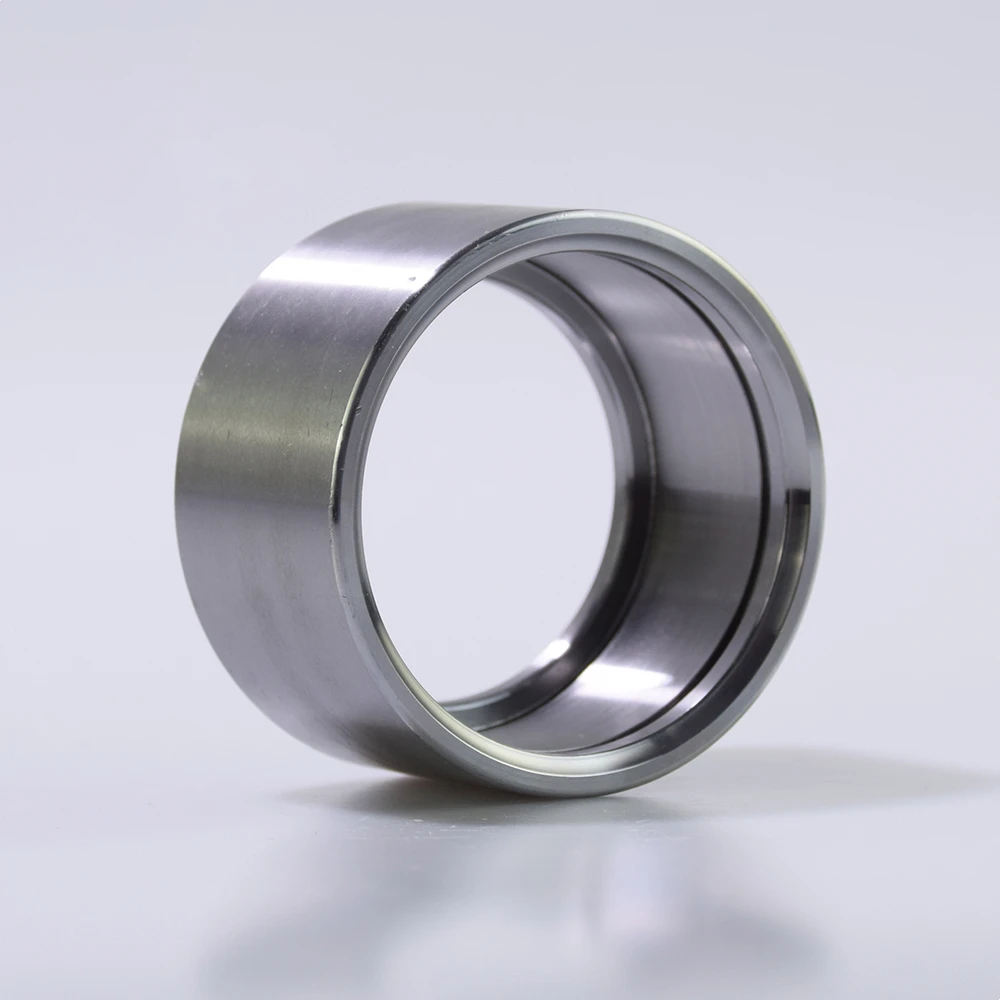
Uniball cupIndustrial uniball cup housing with turned bore and retaining groove
Bearing housing

UBC24 Uniball Cup

The bore, bearing register and retaining groove are typical turned features that share a common axis.

6061 aluminiumMachined 6061 aluminium upper ball joint spacers for suspension adjustment
Custom machined part

Custom Aluminium Upper Ball Joint Spacers

Turning can establish the bore and outside profile; stack height and face relationships are confirmed against the drawing.

Stainless steelStainless steel threaded rod couplers with turned body and internal thread
Threaded coupler

Stainless Steel Threaded Rod Couplers

A turned body and internal thread are typical for a coupler; feed and speed are reviewed for stainless material work-hardening.

06 / Quality control

How Turned Parts Are Controlled


Turning is a stable process, which is exactly why it fails quietly. Tool wear moves a diameter a few hundredths over a production run without anything looking wrong on the machine. Control is therefore about measurement frequency, not about inspecting harder at the end.

01

Incoming material

Material certificates are checked against the order and samples are retained before the bar is released to production.

02

First article

The first part off a new setup is checked against the drawing before the run is released — diameters, lengths, thread fit and customer-specified characteristics.

03

In-process checks

Patrol inspection during the run catches drift from tool wear while it is still correctable, supported by written work instructions at the machine.

04

Final inspection

Depending on the product and order, finished goods go through 100% inspection, sampling or a customer-specified plan.

07 / Design for manufacture

Designing for Turning


What to send with an enquiry

  • A 2D drawing or 3D model with dimensions and tolerances.
  • Material and any required specification or certificate.
  • Thread callouts including hand and class.
  • Surface finish requirements on functional faces.
  • Quantity, target schedule and any required finish or coating.
  • If you have a sample, photographs and key measured dimensions.
01

Tolerance band

Tolerance the features that carry the function and open up the rest. A drawing where every dimension is tight costs more without clarifying what matters.

02

Bar diameter and material removal

The cost floor is set by the largest diameter, not the average. A large flange means the whole length starts as larger bar.

03

Length-to-diameter ratio

Long slender parts deflect away from the tool and may need lighter cuts, steady rests or tailstock support.

04

Deep and small bores

Boring depth beyond about three times the bore diameter gets progressively harder to hold straight and round.

05

Threads and secondary operations

Rolled threads can improve fatigue strength when the material and rolling parameters suit the part. Cross-holes, flats, keyways, heat treatment and plating each add a step.

Common next steps in the production network

100–300 piecesTypical MOQ per item; stock items may be available in smaller quantities.
20-day samplesNingbo route sample timing; production timing is confirmed with the quotation.
20+ countriesInternational customers served through SYZ Machine’s export team.
08 / Buyer questions

CNC Turning FAQ


What tolerance can you hold on a turned part?

Documented machining precision at our own Ningbo facility is ±0.01 mm. What is achievable on your specific part depends on its geometry, material and length-to-diameter ratio. Where a feature needs to be tighter than the turned process will reliably hold, we add a grinding operation rather than promise it off the lathe. Send the drawing and we will confirm feature by feature.

Do you only make catalogue parts, or can you turn to my drawing?

Both. Our catalogue covers standard rod ends, spacers, bungs, sleeves and related hardware, and we also produce drawing-based and sample-based custom turned components. Send a drawing, physical sample or clear application brief and we will review dimensions, tolerances, material, thread direction, quantity and inspection requirements before confirming the route.

What is your MOQ for turned components?

Typically 100–300 pieces per item. Stock catalogue products may be available in smaller quantities. For a first custom order we normally recommend confirming a sample before committing to volume.

How long does a turned sample take?

Sample lead time on the Ningbo route is 20 days, and standard production lead time is 30 days. Timing is confirmed with the quotation, since it depends on material availability and whether the part needs external processes such as heat treatment or plating.

Which materials do you turn?

Materials we regularly turn across our own product lines include carbon steel, 4130 chromoly alloy steel, 6061 aluminium and 304/316 stainless steel. For a custom part, material is confirmed against your drawing and the documentation your programme requires.

Is turning done in your own factory or subcontracted?

Turning is done in-network. Our own facility in Ningbo runs 35 CNC lathes, and our closely affiliated production base in Wuxi runs 50 CNC precision lathes across two production lines with no outsourced steps in its documented process. At Ningbo specifically, forging, heat treatment, welding and surface finishing are routed to qualified external processes rather than performed on site.

Can you provide material certificates and inspection reports?

Yes. Material certificates, dimensional inspection reports, inspection plans and OEM documentation can be supplied according to the product and order. Finished-lot traceability to the raw-material heat number is available on the Wuxi route; the Ningbo route retains material certificates and samples but does not trace lots to heat number.

Can we audit the facility or arrange a third-party inspection?

Client visits and third-party inspections can be arranged for the relevant production site. Both affiliated production bases have been assessed on-site by SGS under the Alibaba.com Verified Supplier programme. Contact us so we can coordinate the site and inspection scope.

Start with the drawing

Have a Turned Part to Quote?


Send the drawing or sample, the material, the quantity and the application. We will confirm whether it runs on the Ningbo or Wuxi route, what secondary operations it needs and what it will take to make it.

Request a Quote

Please submit the form or email [email protected]

🍪
We Use Cookies