Skip to content
Manufacturing capability / CNC machining

CNC Milling

Milling is how we make the parts that turning cannot: brackets, plates, housings and anything with faces pointing in more than one direction. Where our turning capacity concentrates in Ningbo and Wuxi, our milling capacity concentrates at our affiliated production base in Taixing, alongside the laser cutting, forming and welding it is routed with.

8CNC machining centres at our affiliated Taixing base
ISO 9001:2015Certificate No. 11425Q49262R0S · Ningbo production address
SGS-assessedTaixing production base · report No. 482195455_P+T
±0.01 mmDocumented machining precision at our own Ningbo facility
01 / Process fundamentals

What Is CNC Milling?


CNC milling is a subtractive machining process in which a rotating multi-tooth cutter removes material from a workpiece that is held stationary, or indexed, in a fixture. This is the mirror image of turning: in milling, the tool rotates and the workpiece stays fixed; in turning, the workpiece rotates and the tool stays fixed.

That distinction is what gives milling its range. Because the workpiece does not have to spin, it does not have to be round. A milling machine can approach a part from the top, the sides, and — with a fourth axis or a repositioned fixture — from additional faces, cutting flat surfaces, pockets, slots, contoured profiles, and holes wherever the drawing calls for them.

A typical CNC machining centre controls at least three linear axes (X, Y, Z) and holds interchangeable tooling, so a single setup can face a surface, cut a pocket, drill a hole pattern, and tap threads without moving the part, where the machine and tooling support it. Fewer setups mean the features machined in one operation stay dimensionally related to each other; features that require a second setup depend on how accurately the part is re-fixtured. The exact axis configuration and tooling capacity of a specific machine are confirmed against your part’s requirements at drawing review.

Typical milled features include flat and stepped faces, pockets and slots, contoured and 3D surfaces, drilled and tapped hole patterns, bosses and ribs, and mounting flanges with features on more than one face.

02 / Process selection

Milling or Turning? Reading the Drawing Correctly


The two processes are complementary, not competing, and most drawing packages we receive need both somewhere in the routing.

Milling wins when the part is not round. A bracket, a plate, a housing, or anything with faces that point in different directions has no natural axis to spin it on — it has to be held still while the tool moves around it. If you can picture the part sitting flat on a table, it is very likely a milled part.

Turning wins when the part is a body of revolution. A shaft, a bushing, a threaded sleeve, a spacer — anything where every feature is concentric with a single centreline is turned far more efficiently than it is milled, because the rotating workpiece does the positioning work that a mill would otherwise need multiple setups to achieve.

Many real components need both, in sequence. A turned stud that also needs a flat for a wrench, or a cross-hole off the main axis, goes through milling as a secondary operation after turning. A milled bracket that also carries a bored bushing seat goes through turning-style boring on the machining centre itself. Routing that correctly — and in the right order — is part of what we confirm at drawing review, not something left for the shop floor to work out.

Question to ask about the partPoints toward
Can I describe it by sweeping a profile around one centreline?Turning
Does it have flat faces pointing in different directions?Milling
Does it mount to something with a bolt pattern across a flat face?Milling
Is the main feature a bore, an OD, or a thread on one axis?Turning
Does it need pockets, slots, or a contoured profile?Milling
The practical rule: if a part needs flat faces, pockets, slots, or features that face in several directions, milling is usually the natural primary process. If it is a body of revolution, turning is usually more efficient. Many real components need both; routing is confirmed during drawing review.
03 / Production routes

CNC Milling at SYZ


Primary route

Taixing, Jiangsu

Our closely affiliated production base in Taixing is where structural and sheet-metal work is concentrated, and machining centres are the backbone of that capability. The base runs 8 CNC machining centres — 4 units of model VL-12i and 4 units of CNC i5T5.2 — alongside its laser cutting, forming, robotic welding, and coating equipment. This is a separate legal entity with its own equipment, and we describe it that way deliberately rather than calling it “our factory.”

8CNC machining centres
4Production lines
5,313 m²Production area
60 daysStandard lead time · 45 days samples
Site boundary: Taixing is an affiliated production base, not SYZ’s own legal entity. Its CNC milling capacity is coordinated with the laser cutting, forming, robotic welding and coating resources located at the same base.

The base occupies 5,313 m² with 32 staff across 4 production lines and has been assessed on-site by SGS under the Alibaba.com Verified Supplier programme, report No. 482195455_P+T, valid to 17 November 2026.

Secondary route

Ningbo + Wuxi

Our own facility in Ningbo and our affiliated base in Wuxi each additionally run one machining centre. In practice this capacity is typically used for milled features on parts that are primarily turned — a flat for a wrench, a cross-hole, a keyway — since a genuinely milled part generally has more milling volume than one machine per site can absorb alongside its other work. A standalone milled part is more likely routed to Taixing.

2Centres across Ningbo + Wuxi
1 + 1One centre at each site
20 daysSample lead time on Ningbo route
30 daysStandard production on Ningbo route
Typical use: if your part is mostly a turned body with one or two milled features, the likely route keeps it on the turning line and picks up the milling operation there. The exact routing is confirmed at drawing review.

The Ningbo facility is our own production facility. Wuxi is a closely affiliated production base with its own equipment and documented no-outsourcing process. We identify the route used for a specific order instead of presenting all capacity as one undifferentiated shop.

Drawing reviewMaterial + datum schemeTaixing / secondary routeInspection + next process

Beyond our own and affiliated production, we work with around 30 vetted partner factories in the Ningbo and Taizhou area covering specialised processes. We will confirm which route your part takes during drawing review.

04 / Part families

What CNC Milling Is Used to Make


01

Structural and mounting hardware

Brackets, mounting plates, yoke plates, clevis mounts, shackle mounts, U-brackets, torsion arm stops, and weld-prep fixtures with machined mating faces.

02

Housings and enclosures

Bearing housings, sensor enclosures, gearbox and pump housings, connector shells, and instrument bodies with multiple machined faces.

03

Automotive and off-road structural parts

Control arms, suspension links, sway bar mounts, skid plate brackets, and chassis reinforcement plates.

04

Fluid and pneumatic components

Valve bodies, manifold blocks, cylinder mounting blocks, and fitting adapter plates with multiple port faces.

05

Fixtures, jigs, and tooling

Inspection fixtures, weld jigs, drill jigs, and locating plates used in production rather than sold as end products.

06

Industrial automation hardware

Sensor mounting plates, cable management brackets, guarding panel frames, and actuator mounting blocks.

Materials commonly milled across our own product lines: mild and carbon steel, 4130 chromoly alloy steel, 6061 aluminium, and 304/316 stainless steel. Material for a custom part is confirmed against your drawing, the load path, and the finish or coating the assembly needs — we do not assume it from the part’s appearance.
05 / Product examples

Machined Components From Our Own Product Lines


Yoke plateCustom machined steel yoke plate with milled slot and mounting holes
Structural hardware

Custom Yoke Plates

The plate profile, the pin slot, and the mounting hole pattern are all milled from flat stock in one setup, keeping the slot square to the mounting face.

Clevis bracketMild steel clevis link bracket for rod end mounting with milled clevis slot
Rod-end mount

Clevis Link Bracket, Rod End Mount

The clevis ears, the pin bore, and the base mounting face are machined on a machining centre so the slot stays parallel and the bore stays perpendicular to the mounting face.

Shackle mountWeld-on shackle clevis mount bracket with machined pin slot
Weld-on hardware

Custom Weld-On Shackle Clevis Mount

Machined from bar or plate stock before the weld prep face is cut — the slot and pin bore are held to the same datum so the shackle articulates cleanly once welded in place.

U-bracketMachined steel U-bracket clevis with parallel mounting arms
Golf cart application

U-Bracket Clevis, Golf Cart Application

The two parallel arms and their aligned pin holes are milled and drilled together so the bracket accepts the pin without binding.

Torsion stopMachined torsion bar stop block for sprint car suspension
Off-road hardware

Sprint Car Torsion Bar Stop

The mounting face, the stop profile, and the through-bore are machined together so the stop sits flat and square once bolted to the chassis.

Bearing bracketMachined bracket arm hardware for glider bearing mounting
Bearing hardware

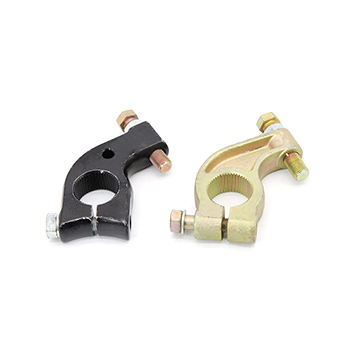
Glider Bearing Arm Bracket Hardware

The arm profile and its bore and mounting-hole pattern are machined in one setup, which is what keeps the bearing bore aligned with the mounting face.

Need a bracket or housing that is not in the catalogue? Send us the drawing.

06 / Quality control

How Milled Parts Are Controlled


Milled parts carry more risk of accumulated error than turned parts, because most of them depend on several faces staying correctly related to each other. Control focuses on the fixture and the first article, not just the finished part.

01

Incoming material

Plate, bar, and billet stock is checked against material certificates before release to production.

02

Process documentation

Our affiliated Taixing base operates under written work instructions, a defined process flow for each part number, a production management system, and a supplier evaluation programme.

03

First article

The first part off a new fixture is checked against the drawing before the run is released, including feature-to-feature relationships that a single-surface check would miss.

04

In-process and final inspection

Depending on the product and the order, finished goods go through 100% inspection, sampling, or a customer-specified plan.

05

Corrective action

A documented corrective and preventive action procedure applies when a quality issue requires it.

07 / Design for manufacture

Designing for Milling: What to Send, and What Drives Cost


What to send with an enquiry

  • A 2D drawing or 3D model with dimensions and tolerances
  • Material and any required certificate
  • Surface finish requirements on functional faces
  • Datum scheme, if it matters for how features relate to each other
  • Quantity and target schedule
  • Finish or coating, if any
01

Number of setups

Every face that needs a separate fixture orientation adds time and reintroduces positional tolerance. Designing a part so more features can be reached from one or two setups is the single biggest lever on cost.

02

Starting stock

Milling removes material from a block, plate, or billet. A large flat part machined from thick plate can cost less than the same shape machined from a solid block.

03

Internal corner radii

A milling cutter has a radius, so a truly sharp internal corner cannot be milled. A practical radius or relief slot is usually cheaper and stronger than demanding an impossible corner.

04

Pocket depth relative to cutter diameter

Deep, narrow pockets need a long, thin cutter that deflects under load. Keeping pocket depth within roughly four times the cutter diameter avoids this where the design permits.

05

Thin walls and ribs

Thin sections deflect away from cutting force, which affects wall flatness and thickness. If a thin wall is functionally necessary, tell us because it changes the cutting strategy.

06

Tolerance and datum scheme

Tolerance the features that carry the function and define how features on different faces relate to each other.

07

Hole patterns and threads

Drilled, bored, and tapped holes are usually done on the same machining centre as the milling when the machine and tooling support it. Grouping them by face reduces tool changes and setups.

After milling

Common next steps in our network for a milled part:

Typical MOQ100–300 pieces per item; stock items may be available in smaller quantities.
45-day samplesTaixing route sample timing; standard production lead time is 60 days.
20+ countriesCustomers are served through SYZ Machine’s export team.
08 / Buyer questions

CNC Milling FAQ


What kinds of parts do you mill, versus turn?

Milling covers anything that is not a body of revolution — brackets, plates, housings, and parts with faces pointing in different directions. If your part is round and every feature shares one centreline, it is almost certainly a turned part instead. Many components need both; we confirm the routing at drawing review.

Do you machine to my drawing, or only from a catalogue?

Both. We produce drawing-based custom machined brackets, plates, and housings, in addition to catalogue hardware. Send a 2D or 3D drawing, or a sample with key dimensions, and we will confirm material, tolerances, datum scheme, and finish before quoting.

What tolerance can you hold on a milled part?

It depends on the feature, the fixture, and how many setups the part needs — a face milled in one setup against a solid datum holds tighter than a feature reached after re-fixturing. Tell us which features carry the function and we will confirm what is achievable feature by feature rather than quote a single blanket number.

Is milling done in-house or subcontracted?

Milling capacity is concentrated at our closely affiliated production base in Taixing, which runs 8 CNC machining centres alongside laser cutting, forming, and welding. Our own facility in Ningbo and our affiliated Wuxi base each additionally run one machining centre for milled features on parts that are primarily turned. We are specific about which route a part takes rather than describing everything as one undifferentiated shop.

What is your MOQ and lead time for machined brackets?

Typical MOQ is 100–300 pieces per item. Standard lead time on the Taixing route is 60 days with a 45-day sample lead time — longer than turned parts, reflecting the multi-process, structural nature of most milled components. Timing is confirmed with the quotation.

Which materials do you mill?

Materials we regularly mill across our own product lines include mild and carbon steel, 4130 chromoly alloy steel, 6061 aluminium, and 304/316 stainless steel. For a custom part, material is confirmed against your drawing and the finish or coating your programme needs.

Can you supply CMM inspection data for a milled part?

Yes, where your programme requires it. Coordinate measurement is available through our affiliated Wuxi base, which operates a CMM, an optical projector, and a Rockwell hardness tester. Tell us at drawing review if your part needs CMM verification and we will confirm the inspection route and timing.

Can we audit the facility or arrange a third-party inspection?

Yes. Client visits and third-party inspections can be arranged for the relevant production site. Our affiliated Taixing base has been assessed on-site by SGS under the Alibaba.com Verified Supplier programme (report No. 482195455_P+T, valid to 17 November 2026). Contact us so we can coordinate the site and inspection scope.

09 / Start a review

Have a Bracket, Plate, or Housing to Quote?


Send the drawing or sample, the material, the quantity and the application. We will confirm whether it runs on the Taixing route or as a feature operation on a turned part, and what it will take to make it.

Request a Quote

Please submit the form or email [email protected]

🍪
We Use Cookies