
US Output Rebounds, but the Mix Matters More Than the Headline

US industrial production rose faster than expected in September, with manufacturing output rebounding on semiconductors and supplies — a signal that capital investment, not consumer demand, is carrying the current industrial cycle. Around that core data point, this week’s briefing tracks five connected shifts: a 3% rebound in global container rates after a 13-week decline, with Asia–Europe lanes leading and schedule reliability still weak; US–Mexico trade talks stalling as the USMCA review approaches; a widening EU split over the scope of the carbon border adjustment mechanism; heavy equipment order momentum in China and India alongside dealer-network consolidation in North America; and a rare-earths supply story moving from policy rhetoric to project timelines in Malawi, the US and Australia. For component buyers and engineers, the common thread is planning risk: freight costs are turning, trade rules are in flux, and the materials and power inputs behind automation and electrification are being re-sourced at project level rather than announced at strategy level.
Port Congestion Absorbs 12% of Global Container Capacity
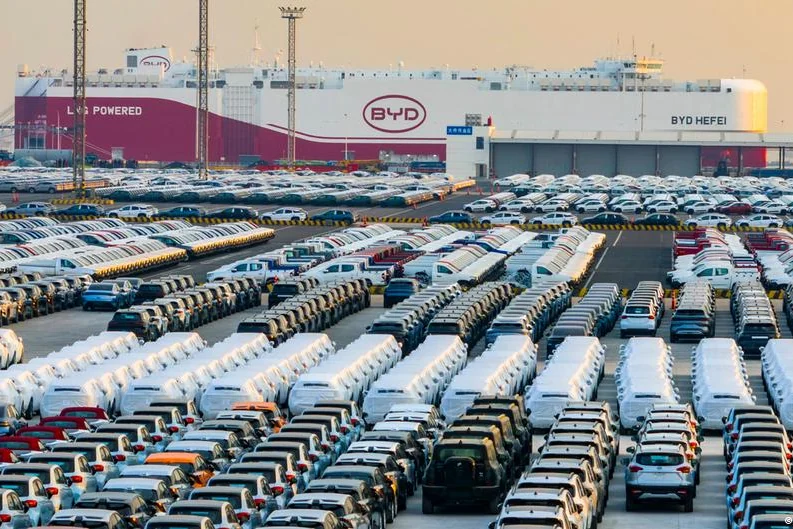
Global container capacity is being squeezed by congestion that now absorbs roughly 12% of the world fleet, extending peak season well past its usual window. At the same time, three regulatory tracks are converging on industrial trade: the EU’s carbon border mechanism is being priced into steel, the USMCA review has pushed trade uncertainty to multi-decade highs, and right-to-repair rules are advancing through courts and legislatures. On the demand side, the picture is uneven — Volvo CE reported a 14% second-quarter sales decline, US August industrial output came in flat, and several European economies posted weaker production, while AI-driven infrastructure spending and data-centre power demand keep setting records. Materials markets are mixed: rare earths remain a processing bottleneck outside China, but European steel pricing is firming. This week’s briefing covers freight capacity, trade policy, industrial demand signals, materials, automation standards, and the emerging right-to-repair regime.
Manufacturing Momentum Meets an Inflation Problem

September’s global manufacturing PMI reached its highest level since February 2022, with India posting a seven-month high and U.S. factory activity expanding for a ninth straight month — but the same surveys show input prices accelerating, and diesel, freight and rare-earth costs are all moving in the wrong direction for buyers. Roughly 12% of the world’s container ship capacity is tied up in port congestion that could persist into 2027, Asia–Europe rates have now fallen for twelve consecutive weeks even as U.S. rates hit a post-Hormuz peak, and Saudi planning for a Red Sea offensive keeps the Bab el-Mandeb corridor in play. In materials, Lynas agreed to buy Meteoric Resources for $672 million to enter Brazil’s rare-earth sector, Rio Tinto expanded low-carbon aluminium billet supply, and aluminium prices touched a twelve-week low on dollar strength. Trade policy stayed active: the U.S.–China Section 301 pause was extended, USMCA talks edged forward, and CBAM compliance costs are spreading beyond steel into more export categories. This week’s briefing covers what changed, what is driving it, and what it means for the people who specify, buy, and move industrial components.