
Executive Summary
September's global manufacturing PMI reached its highest level since February 2022, with India posting a seven-month high and U.S. factory activity expanding for a ninth straight month — but the same surveys show input prices accelerating, and diesel, freight and rare-earth costs are all moving in the wrong direction for buyers. Roughly 12% of the world's container ship capacity is tied up in port congestion that could persist into 2027, Asia–Europe rates have now fallen for twelve consecutive weeks even as U.S. rates hit a post-Hormuz peak, and Saudi planning for a Red Sea offensive keeps the Bab el-Mandeb corridor in play. In materials, Lynas agreed to buy Meteoric Resources for $672 million to enter Brazil's rare-earth sector, Rio Tinto expanded low-carbon aluminium billet supply, and aluminium prices touched a twelve-week low on dollar strength. Trade policy stayed active: the U.S.–China Section 301 pause was extended, USMCA talks edged forward, and CBAM compliance costs are spreading beyond steel into more export categories. This week's briefing covers what changed, what is driving it, and what it means for the people who specify, buy, and move industrial components.
Manufacturing Momentum Meets an Inflation Problem

September’s global manufacturing PMI hit its highest reading since February 2022, according to S&P Global, and the U.S. ISM Manufacturing PMI held at 54.5 — a ninth consecutive month of expansion, with new orders and employment accelerating while production moderated. India’s HSBC manufacturing PMI rose to 55.1, a seven-month high, on stronger sales, production, hiring, and demand optimism. Canada was the outlier: its September PMI fell to the weakest level since March, with input inflation at a more than four-year high.
The common thread across the surveys is price pressure. FreightWaves reported that supply executives flagged rising costs as a primary concern, and the ISM prices gauge surged even as the headline index stayed steady. That combination — solid order books paired with accelerating input costs — is the defining tension for component buyers heading into the fourth quarter. It suggests demand is real enough to support volumes, but that margin protection will depend on how quickly cost increases can be passed through or designed out.
For engineers and procurement teams, the practical read is that this is not a demand problem. It is a cost-visibility problem. When order books are full and prices are rising simultaneously, the value of locking in supply agreements, qualifying alternate sources, and tracking index-linked contracts goes up sharply.
Freight: Congestion Eats Capacity While Rates Diverge
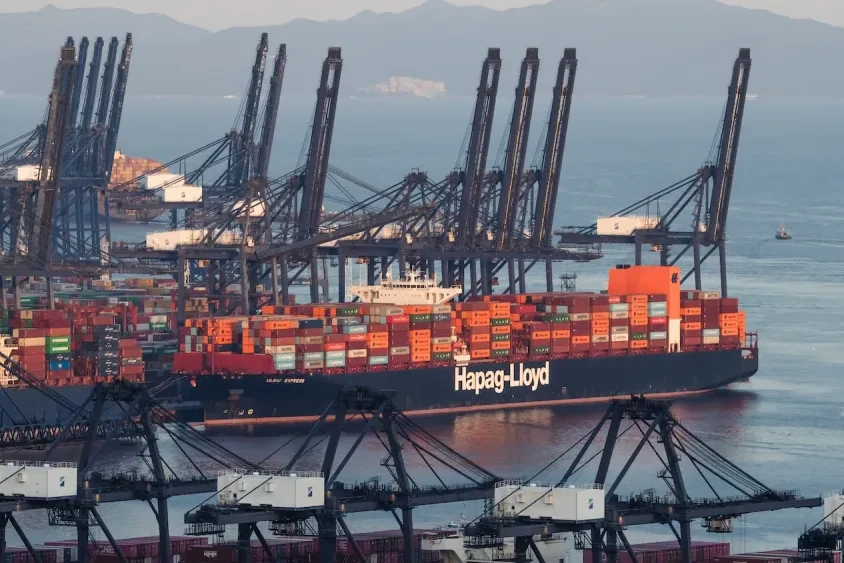
Roughly 12% of global container ship capacity is currently tied up in port congestion, according to gCaptain — not because the world is short of ships, but because a growing share of them are waiting. Asian port congestion in particular could disrupt supply chains well into 2027, with vessel reliability in Asia already falling as the backlog bites.
Rates are telling two different stories. Asia–Europe container rates have now fallen for twelve consecutive weeks, per DCA Market Intelligence, while U.S. container freight rates have reached a post-Hormuz peak, according to Xeneta. Hapag-Lloyd lifted its full-year earnings outlook on strong demand and elevated spot rates, though its proposed acquisition of ZIM has been sent back to Israeli regulators for a more detailed merger proposal.
The divergence matters because it shows how unevenly the Red Sea disruption is being absorbed. Carriers rerouting around the Cape of Good Hope add transit time and fuel cost to Asia–Europe lanes, yet that market is now oversupplied enough to push rates down. U.S. importers, by contrast, are still paying peak-level rates. For industrial shippers, this is a moment to scrutinize lane-by-lane economics rather than assume a single global freight trend.
The underlying risk has not gone away. Saudi Arabia is planning an offensive against Houthi militants in Yemen, with options including a coastal push to secure the Red Sea shipping route, according to Reuters reporting carried by Al-Monitor and others. Italy’s defence minister said EU naval contributions to the Aspides mission remain insufficient. ACLED has warned that Houthi gains around Bab al-Mandab raise risks to both shipping and global oil markets. Any escalation would reset the freight calculus again — and quickly.
Red Sea Risk and the Diesel Question

The energy dimension of the Red Sea situation is already visible in fuel markets. The G7 has moved to release 100 million barrels of oil and diesel amid soaring prices linked to the Iran conflict and Russia’s war in Ukraine. In the U.S., the White House is considering expanding sales of red-dyed diesel — the tax-exempt fuel typically reserved for farming and construction equipment — as diesel prices reach record levels, according to FOX 4 News.
Diesel is the operating cost that sits underneath nearly every piece of off-highway equipment, from excavators to haul trucks to agricultural tractors. Record pump prices feed directly into contractor operating budgets and, eventually, into equipment purchasing decisions. A policy shift on red-dyed diesel would not change the physics of supply, but it would change the effective cost of running diesel-powered fleets — and it would sharpen the already-active comparison between diesel, hybrid, and electric drivetrains in construction and agricultural machinery.
That comparison got a concrete data point this week: Swedish heavy equipment maker HUDDIG upgraded the battery on its 1370 hybrid wheel loader from 44 kWh to 61 kWh, a 40% increase for the new model year. It is a single product update, but it illustrates the direction of travel in off-highway electrification — incremental range and duty-cycle improvements rather than wholesale replacement of diesel platforms.
Rare Earths: Lynas Moves Into Brazil as the West Rebuilds Supply

Australia’s Lynas Rare Earths agreed to acquire Meteoric Resources in a $672 million deal, giving Lynas a foothold in Brazil’s emerging rare-earth industry. The transaction lands in the middle of a broader race to rebuild rare-earth production outside China, and it drew immediate analyst attention: J.P. Morgan and Goldman Sachs both maintained Buy ratings on Lynas, though the stock fell as the deal introduced near-term uncertainty about integration and capital allocation.
The strategic logic is straightforward. North American rare-earth prices have hit new highs on U.S. stockpiling and tight Chinese exports, according to S&P Global. Brazil is positioning itself as a third pole: President Lula has courted Chinese investment while a domestic rival pitches rare-earth projects to the Trump administration, and the Lynas–Meteoric deal is being read in the region as a validation of Brazil’s resource base. Separately, a scoping study advanced the case for what would be the EU’s first rare-earth, zircon, and titanium mine.
For component buyers, rare earths are not an abstraction. They are the magnets inside motors, actuators, sensors, and the growing population of electrified drivetrain components. A more diversified supply base is structurally positive, but it will take years to build. In the interim, price volatility and allocation risk remain real for anyone specifying rare-earth-dependent components.
Metals and Materials: Aluminium Softens, Low-Carbon Supply Expands

Aluminium prices fell to a twelve-week low, pressured by a stronger U.S. dollar, according to mining.com. The dollar index hit new 2026 highs above 102.20 — its highest level since April 2025 — which mechanically weighs on dollar-denominated commodities and on emerging-market currencies. The Indian rupee sank to 96.31 against the dollar, its biggest fall in over two months, and emerging-market currencies broadly slipped as U.S. yields reached levels last seen in 2002.
At the same time, low-carbon aluminium supply is expanding. Rio Tinto and RevoCast announced an expansion of low-carbon aluminium billet supply, a signal that the decarbonization premium in metals is moving from pilot projects toward contracted volume. For manufacturers facing CBAM reporting obligations in Europe, the availability of verified low-carbon billet is not just a sustainability talking point — it is a compliance input.
Steel buyers should also note that U.S. rebar purchasers’ price-fixing claims survived a motion to dismiss, keeping antitrust scrutiny of steel pricing alive. And Ryerson, a major value-added processor and distributor of industrial metals, has scheduled its third-quarter earnings call for October 29 — a useful checkpoint on real metals demand versus the PMI narrative.
Trade Policy: Section 301 Pause Extended, USMCA Inches Forward, CBAM Widens

The U.S. and China extended their current pause on Section 301 tariffs, according to RV PRO — a continuation of the status quo rather than a resolution. The pause keeps a ceiling on tariff costs for a wide range of industrial inputs, but it does not remove the underlying exposure. Notably, U.S. soybean farmers were excluded from the China tariff framework, which covers corn and beef, prompting complaints of a “missed opportunity” from agricultural groups.
USMCA talks continue to grind forward. Mexico’s Economy Secretary Ebrard struck an optimistic tone in Milwaukee, saying the parties are “closer every day,” and North American agriculture leaders have publicly backed the agreement and long-term trade stability. A labor dispute at an Akwel auto parts facility in Juárez was resolved under the USMCA rapid response mechanism — a reminder that the agreement’s labor provisions remain an active enforcement channel for automotive suppliers.
On the carbon side, the EU’s CBAM is reshaping export competitiveness beyond its initial iron and steel focus. Indian exporters are being urged to strategize for compliance that extends to more product categories, and the European Automobile Manufacturers’ Association is pushing to reduce the administrative burden of CBAM reporting for manufacturers. For any supplier shipping into the EU, carbon intensity is becoming a documented commercial attribute, not an environmental footnote.
Enforcement is also tightening elsewhere. U.S. Customs and Border Protection affirmed a duty-evasion finding against an importer of freight rail couplers from China and Mexico under the Enforce and Protect Act — a signal that trade remedies in the rail and heavy equipment supply chain are being actively policed.
Regional Shifts: India Accelerates, Mexico Stalls, Vietnam Attracts

India’s manufacturing expansion is the standout regional story. The September PMI of 55.1 was driven by demand, production, and hiring, and the country is attracting attention as a destination for manufacturing capacity relocating from China — including Japanese firms. But the growth model is being debated: Bloomberg has argued India’s manufacturing future will not simply replicate the China model, and analysts continue to question the credibility of India’s manufacturing GVA estimates. Manufacturing startups in the country also face a capacity-versus-demand funding dilemma, with investors increasingly focused on physical capabilities like power electronics, storage components, and grid equipment.
Mexico tells a more cautious story. Manufacturing confidence stalled at 48 points, below the expansion threshold, even as LEGO committed $400 million to expand its Mexican manufacturing operation and a Houston-area rail-served logistics park attracted new investment. Brazil’s industrial production retreated. And in Southeast Asia, Pandora opened a $150 million factory in Vietnam as part of a broader Asia manufacturing push — another data point in the region’s role as a China-plus-one destination.
In Europe, Eaton completed an expansion of its Austrian manufacturing facility in under ten months, combining fully automated production with digital integration and end-to-end product traceability. It is a useful example of the kind of capacity being added in Europe: not just more floor space, but more instrumented floor space.
Automation and the Aftermarket: Repair Costs and Robotics Capacity

Two quieter but consequential trends deserve attention. First, high-tech vehicles are driving up auto repair costs for shops and consumers, according to CNBC — ADAS calibration equipment, computers, and software subscriptions now inflate the cost of even a windshield replacement or an oil change. The same dynamic is spreading into industrial and off-highway equipment, where diagnostics, calibration, and software access increasingly determine who can service a machine and at what price. Right-to-repair debates, already active in Texas and elsewhere, sit directly on top of this trend.
Second, Amazon plans to double its number of robotics manufacturing facilities, with a new investment in Indiana, according to the National Association of Manufacturers and Advanced Manufacturing. That is a demand signal for the components that go into warehouse automation — bearings, actuators, sensors, motion control — and it reinforces the automation capex cycle that shows up in the angular contact bearings market forecast, where semiconductor capacity expansion and industrial automation are cited as growth drivers.
Additive manufacturing is maturing in parallel. New ANSI and America Makes resources are helping manufacturers and regulators navigate AM standards for safe, consistent 3D-printed parts, and AlSi12 powder for additive manufacturing is forecast to grow at an 8.2% CAGR through 2035 on aerospace lightweighting demand. Standards infrastructure is the unglamorous prerequisite for AM moving from prototypes into certified production parts.
What to Watch

The week’s data paints a picture of a manufacturing recovery that is real but cost-constrained. Watch three things: whether input-price acceleration in the PMI surveys translates into sustained producer price increases or proves transient; whether Red Sea developments force another round of freight rerouting and rate spikes; and whether rare-earth and low-carbon metals supply announcements convert into contracted volumes fast enough to matter for 2027 sourcing plans. For now, the demand side is holding. The cost side is where the risk sits.
- S&P Global – Global Manufacturing PMI hits highest since February 2022 but price growth also accelerates
- FreightWaves – September's 54.5 manufacturing PMI comes with inflation concerns
- BusinessLine – India manufacturing PMI rises to 7-month high of 55.1 in September
- gCaptain – Port Congestion Ties Up 12% of Global Container Shipping Capacity
- DCA Market Intelligence – Asia-Europe container rates fall for twelfth week
- Al-Monitor – Saudis plan assault on Houthis to break Red Sea chokehold
- Al Jazeera – G7 to release 100 million barrels of oil and diesel, will it curb prices?
- FOX 4 News – Trump eyes red-dyed diesel as fuel prices soar: What is it?
- Electrek – Huddig hybrid loader gets a big battery boost
- Reuters – Australia's Lynas Rare Earths to buy Meteoric Resources for $672 million
- S&P Global – North American rare earths at new highs on US stockpiling, tight Chinese exports
- mining.com – Aluminum price falls to a 12-week low on stronger dollar
- Yieh Corp – Rio Tinto, RevoCast expand low-carbon aluminum billet supply
- RV PRO – US & China Extend Current Pause on Section 301 Tariffs
- Mexico News Daily – Ebrard, in Milwaukee, strikes optimistic note on USMCA talks — 'closer every day'
- The Times of India – CBAM can help India build a greener, competitive export sector
- CNBC – High-tech vehicles are driving up auto repair costs for shops and consumers
- National Association of Manufacturers – Amazon to Double Number of Robotics Manufacturing Facilities