
Spherical Plain Bearings Buyers’ Guide
A spherical plain bearing is the articulating ball-in-race element at the heart of every rod end — supplied on its own, ready to be press-fit into your housing, clevis or machined pocket. This guide explains how it works, how the race and liner choices change behavior, and how to choose the right series from SYZ’s 10-series range.
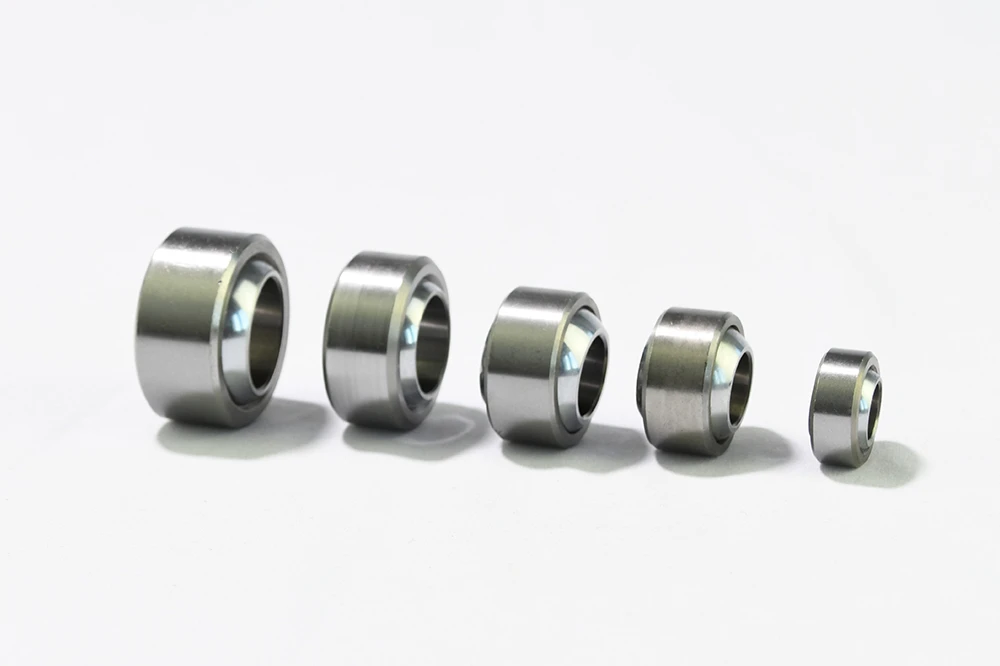
What Is a Spherical Plain Bearing?
DefinitionA spherical plain bearing is a precision-ground ball rotating inside a matched spherical outer race — the bearing element only, with no threaded shank or bore. It handles oscillating movement, misalignment and heavy radial load, and it is what you reach for when the bearing has to be press-fit into a parent component: a hydraulic cylinder end, a machinery housing, a clevis, or a pocket you machined yourself.
Versus a rod end: a rod end is this bearing plus an integral threaded housing, so it screws straight into a linkage. A spherical bearing is the element on its own and needs a separate housing or mount — which also means it can be replaced independently of the linkage around it. The same part is also called a spherical bushing or spherical uniball bearing depending on the industry; for weld-in housings, see uniball cups.
- Also called
- Spherical bushing · uniball bearing
- Core function
- Oscillating articulation under radial load
- Bore range
- 0.165″–5.984″ · 3–30 mm+
- Race systems
- Metal-to-metal · PTFE-lined
Anatomy of a Spherical Plain Bearing
StructureEvery spherical plain bearing is three functional elements. Each one maps to a selection criterion later in this guide.
Inner Ring (Ball)
The precision-ground spherical inner ring, hardened bearing steel — chrome steel (52100-class) in standard series, stainless in the corrosion family. It carries the oscillating motion.
Outer Race
The matched spherical outer race that cradles the ball and defines the misalignment envelope. GEZ uses fractured-race construction — the outer race is split so the bearing can be assembled and closed around the ball — with protective-coated 52100 ball and race; 2RS seals optional.
Race Interface / Liner
The sliding system between ball and race: metal-to-metal contact (greaseable, highest load) or a bonded PTFE liner (self-lubricating, maintenance-free). This choice sets friction, service life and maintenance.
Press-Fit OD
The outside diameter that presses into your housing. Bore, OD and width must match the housing pocket and the load path together — not just the nominal bore callout.
Metal-to-Metal
Ball runs directly on a hardened alloy race. Carries the highest static loads, tolerates heat and contamination better, and handles shock loading.
Wants periodic grease on accessible points; the standard for hydraulic cylinders, heavy machinery and high-impact pivots.
PTFE-Lined
A bonded PTFE liner between ball and race eliminates metal-to-metal contact — low friction, no greasing, quiet running.
Trades some peak load and temperature for maintenance-free service. The default for sealed assemblies, clean environments and hard-to-reach pivots.
What a Spherical Bearing Does in a Machine
FunctionFrom the engineering side, the bearing has to do four jobs at once — and each job maps to a selection criterion.
Carry radial load
Selection starts from the maximum static radial load with a safety margin — the range runs up to 1,146,400 lb (GEZ152ES) across the catalog. Match the bearing’s static rating to dead load, dynamic load and shock combined.
Allow misalignment
The spherical interface lets the shaft tilt as the assembly flexes. Working misalignment ranges from 1° on tight precision series up to 24° on the high-misalignment YPB-T — exceeding it edges the race and shortens life.
Survive its environment
Contamination, washdown and corrosion decide the material and liner: chrome steel with grease for protected machinery, stainless COM-SS for washdown and chemical service, sealed PTFE-lined series for dirty or inaccessible pivots.
Press in and stay put
The OD is a press-fit into the housing; correct interference fit, housing bore tolerance and — where fitted — snap-ring or staking retention keep the OD from spinning under oscillating load.
Where spherical bearings fail in the field
- Sizing by bore alone while ignoring static radial load and shock.
- Running metal-to-metal bearings where greasing access is blocked.
- Exceeding the working misalignment angle, edge-loading the race.
- Incorrect housing press fit letting the OD spin or creep.
Choose the Material and Liner Together
MaterialsSYZ spherical bearings span chrome steel, alloy steel and stainless, in metal-to-metal and PTFE-lined race systems. Pick the combination by load, environment and maintenance access.
COM / COMA-M
Commercial metal-to-metalThe commercial workhorse in inch (COM) and metric (COMA-M): chrome steel ball, alloy race, metal-to-metal contact with grease provision. Highest load per dollar for general machinery and cylinder rod ends.
COM-SS
Stainless · corrosion firstStainless construction for marine, washdown, food and chemical environments where a plated carbon bearing would corrode. Pair with the matching stainless rod-end family for full washdown linkages.
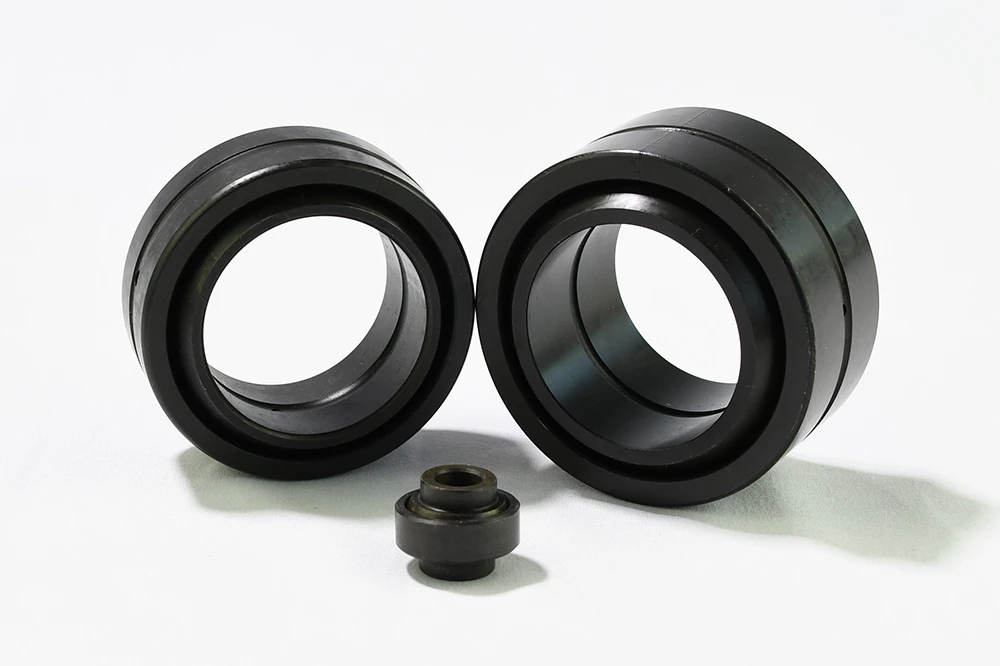
GEZ
Fractured race · heavy loadThe fractured-race industrial series: the split outer race assembles around a larger ball, raising static load capacity dramatically — up to 1,146,400 lb in GEZ152ES. Built for shock loads and severe duty.
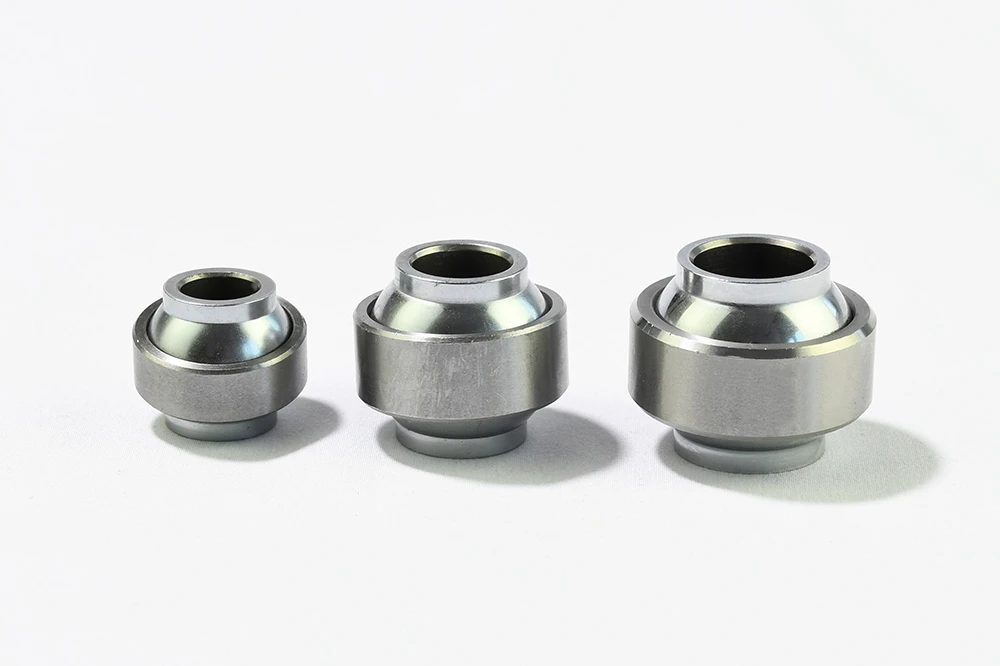
SLB · WPB-T/TG · YPB-T · GEC/GEGC
PTFE-lined & specialtyThe self-lubricating and specialty group: SLB load-slot series, wide-series WPB-T/TG for wide brackets, high-misalignment YPB-T (up to 24°) and precision metric GEC/GEGC. Maintenance-free running for sealed and welded assemblies.
Finishes and Materials: What Protects Each Part
Surface treatmentRace systems do the tribological work; the material and any finish decide how the bearing survives its environment.
| Treatment | Applied to | Series examples | What it does |
|---|---|---|---|
| Chrome steel (52100-class) | Inner ring, standard series | COM(-T), SLB, WPB-T | Hardened, precision-ground bearing steel — the default for protected machinery. |
| Alloy steel race | Outer race, high-load series | COM, COMA-M, GEZ | Heat-treated alloy race for the highest static load and shock tolerance. |
| Stainless 300-series | Inner ring + race | COM-SS | No plating — corrosion resistance comes from the alloy for marine and washdown service. |
| PTFE liner | Race interface | COM-T, SLB, WPB-T, YPB-T, GEC | Bonded self-lubricating liner — eliminates metal-to-metal contact and greasing. |
| Phosphate / oil preservation | Storage protection | All series as supplied | Preservative for transit and storage; run metal-to-metal bearings on grease in service. |
Liner and material options vary by series — always confirm on the series spec page before ordering. Custom materials and specials are available on request.
Where Spherical Bearings Perform
ApplicationsThe bearing element shows up anywhere a press-fit pivot must articulate under load. These are the patterns SYZ spherical bearings are built around.
Hydraulic Cylinders
Rod-end and base mounts on cylinders — high static load, oscillating stroke, greaseable metal-to-metal service.
COMCOMA-MGEZIndustrial Machinery
Conveyors, presses, packaging and processing machines where pivots are pressed into machined housings.
COMSLBGECAgriculture & Heavy Equipment
Implement, harvester and hitch pivots under shock and contamination — fractured-race and greaseable series.
GEZCOMFabricated Suspension
Weld-in uniball pivots with uniball cups: control arms, knuckles and chassis mounts in off-road and motorsport builds.
WPB-TYPB-TCOM-SSMarine & Washdown
Steering and trim pivots exposed to saltwater and chemicals — stainless construction without plating.
COM-SSRobotics & Automation
Compact, maintenance-free pivots for sealed assemblies and limited-service locations.
SLBGEC/GEGCHow to Choose: 5 Steps, Then the Series Table
Selection referenceLoad Rating
Total the static radial load — dead + dynamic + shock — and choose a bearing rating above it with margin. The GEZ series covers the heaviest shock loads.
Misalignment Angle
Measure the tilt the assembly actually sees. Precision series run ~1°; wide and high-misalignment series reach up to 24° (YPB-T).
Bore, OD & Housing
Match shaft bore, press-fit OD and housing width together. For weld-in housings, pair the bearing with a uniball cup.
Race System
Greaseable metal-to-metal for highest load and heat; PTFE-lined for maintenance-free, sealed or clean service.
Material & Environment
Chrome steel for protected machinery; stainless for washdown, marine and chemical exposure.
| Series | Type | Liner / Race | Thread / Size | Specs |
|---|---|---|---|---|
| Metal-to-Metal — highest load | ||||
| COM(-T) | Commercial inch | Metal-to-metal; PTFE-lined on -T | Bore 0.165″–2.000″ | View |
| COMA-M(T) | Commercial metric | Metal-to-metal | Bore 3–30 mm | View |
| GEZ | Fractured race, heavy load | Metal-to-metal | Up to 1,146,403 lb static | View |
| PTFE-lined & specialty | ||||
| SLB | Self-lubricating, load slot | PTFE lined | Maintenance-free pivots | View |
| WPB-T / WPB-TG | Wide series | PTFE lined | Wide bracket mounts | View |
| YPB-T | High misalignment | PTFE lined | Up to 24° articulation | View |
| GEC / GEGC | Precision metric | Self-lubricating | Bore 4–30 mm | View |
| Stainless — corrosion service | ||||
| COM-SS | Stainless inch | Stainless construction | Washdown & marine | View |
Pairing with a weld-in housing? Our uniball cups carry a snap-ring groove matched to these bearings. For rod ends — this bearing plus a threaded housing — start from the rod end range hub.
Get Selection HelpSpherical Bearing Buyers’ Questions
FAQQ1What is the difference between a spherical plain bearing and a rod end?
Q2Metal-to-metal or PTFE-lined — which should I choose?
Q3How much misalignment do spherical bearings allow?
Q4Can I weld near a spherical bearing?
Q5Do you offer stainless spherical bearings?
Q6What load do SYZ spherical bearings cover?
Selecting Spherical Bearings for Your Build?
Send us your bore, load and environment requirements — or a competitor part number to cross-reference. SYZ engineers reply with the right series and factory-direct pricing from sample to full-container quantities.