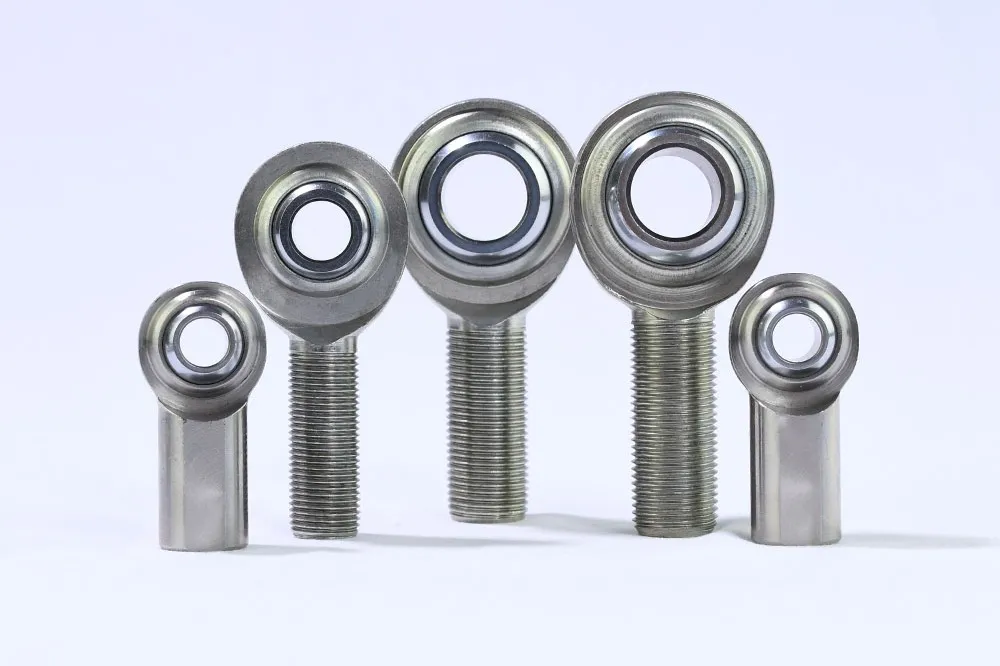
Most rod end selection guides start with bore size and thread pitch. Those matter, but they assume the body material is already settled — and that assumption is where a lot of premature failures start. The wrong body material under the right dimensions still fails: it corrodes in a marine environment, deforms under a shock load it wasn’t rated for, or adds weight a race build can’t afford.
Body material is a different decision from liner material. If you’re choosing between PTFE, bronze mesh, and bronze powder composite races, see 3 Common Materials Used on Heim Joint Liner. This guide covers the body and ball material — the structural question of what the rod end itself is made from, and which SYZ series to spec for each answer.
Why Body Material Is a Structural Decision, Not a Finish Choice
Four variables drive the decision, in roughly this order of importance:
- Load and shock exposure — static industrial load vs. repeated impact (off-road, motorsport, agricultural linkages).
- Environment — dry indoor use vs. saltwater, washdown chemicals, or outdoor weather cycling.
- Weight sensitivity — whether every gram at that pivot point affects lap time, payload, or fuel efficiency.
- Cost and lead time — standard catalog stock vs. a build that justifies a premium or custom alloy.
Below are the five material families used across SYZ’s rod end and heim joint catalog, what each is actually good for, and where each one runs out of headroom.
Carbon Steel: The Standard-Duty Baseline
Carbon steel bodies are the default for general industrial linkages — control mechanisms, garden and light agricultural equipment, and standard-duty mechanisms where the load is predictable and the environment is dry. Typical ultimate tensile strength for the medium-carbon body stock used in these series runs roughly 570–700 MPa, which comfortably covers static and moderate dynamic loads without the cost premium of alloy steel.
Carbon steel isn’t the right call when the application sees repeated shock loading or any real corrosion exposure — that’s where chromoly and stainless take over, respectively.
Recommended Carbon Steel Series
Chromoly Steel (4130): High-Load, High-Impact Performance
4130 chromoly is the step up when the linkage sees real shock loading — motorsports suspension, off-road steering and control arms, and agricultural implements that take repeated impact in the field. It also welds cleanly, which matters when a rod end body needs to be fabricated into a custom weld-in tube end rather than bolted in as a stock part. Properly heat treated, chromoly rod end bodies typically run roughly 900–1080 MPa UTS (commonly specified around Rc 28–32), giving substantially more toughness headroom than carbon steel at a moderate weight and cost increase.
Recommended Chromoly Series
Stainless Steel: Corrosion Resistance for Wet or Chemical Environments
304 stainless bodies with 440C stainless balls are the right call anywhere carbon or chromoly steel would rust — marine steering and rigging, food processing equipment, washdown-cleaned machinery, and outdoor agricultural equipment exposed to fertilizer and moisture. Typical UTS for 304 in this application runs roughly 515–620 MPa — lower than chromoly, so stainless is chosen for corrosion resistance first and load capacity second.
Recommended Stainless Steel Series
Aluminum (7075-T6): Maximum Strength-to-Weight
7075-T6 aircraft aluminum weighs about one-third of an equivalent steel body while still delivering a respectable ~572 MPa UTS — the material of choice when weight at the pivot point directly affects performance: racing suspension, weight-reduction builds, and aerospace-adjacent components. The trade-off is durability in gritty, high-cycle, or heavy-shock environments, where aluminum wears faster than steel — it’s a performance material, not a heavy-duty industrial one.
Recommended Aluminum Series
Titanium: When Weight and Strength Both Matter Most (Custom Only)
Titanium offers the best strength-to-weight ratio of any material here, along with corrosion resistance and stability at temperature extremes that steel and aluminum can’t match — aerospace-grade alloys such as Ti-6Al-4V typically exceed 950 MPa UTS after heat treatment while weighing roughly half of steel. That performance comes at a cost premium that only makes sense when weight and reliability outweigh price: aerospace hardware, top-tier motorsport (including F1-level programs), and medical-device applications.
Titanium is not a standard catalog rod end body at SYZ — it’s produced as a custom CNC-machined part, alongside other premium alloy options such as 17-4 PH stainless, rather than as a stocked inch or metric series. If your project needs titanium (or 17-4 PH) hardware, the process runs through spec review, material/heat-treat verification, and a sample before volume production.
Recommended Custom Links
Material Comparison at a Glance
The table below summarizes the key differences in properties and typical applications among the primary materials used for rod end bodies:
| Material | Typical UTS | Weight vs. Steel | Corrosion Resistance | Relative Cost | Best For |
|---|---|---|---|---|---|
| Carbon Steel | 570–700 MPa | Baseline | Low (plated only) | $ | Standard industrial linkages |
| Chromoly Steel (4130) | 900–1080 MPa | Baseline | Low–moderate (plated) | $$ | Motorsports, off-road, agricultural shock loads |
| Stainless Steel (304) | 515–620 MPa | Slightly higher | Excellent Winner | $$ | Marine, food processing, chemical exposure |
| Aluminum (7075-T6) | ~572 MPa | ~1/3 of steel Winner | Good (anodized) | $$$ | Weight-critical racing and performance builds |
| Titanium (custom) | 950+ MPa | ~1/2 of steel | Excellent | $$$$ | Aerospace, F1-level motorsport, medical devices |
How to Decide: A Quick Framework
Work through these questions in order — the first one that applies usually settles the material selection:
- Is saltwater, washdown chemicals, or continuous moisture involved? → Stainless Steel is the correct selection.
- Is the application weight-critical (racing, aerospace, payload-limited builds)? → Aluminum, or custom Titanium if budget allows.
- Does the linkage see repeated shock or impact loading (off-road, motorsport suspension, ag implements)? → Chromoly Steel (4130).
- Is this a standard-duty, cost-driven industrial or garden linkage with no unusual load or corrosion exposure? → Carbon Steel.
- Do you need aerospace- or motorsport-grade strength-to-weight beyond what catalog chromoly or aluminum can deliver? → Custom Titanium or 17-4 PH stainless.
FAQ
What’s the real difference between carbon steel and chromoly rod ends?
Both are steel, but chromoly (4130) is alloyed and heat-treated for significantly higher toughness and impact resistance — roughly 900–1080 MPa UTS versus 570–700 MPa for carbon steel. Chromoly also welds more reliably, which matters for custom fabrication. Carbon steel is the more economical choice when the application doesn’t see shock loading.
Can I get a stainless steel rod end in metric sizes?
Yes — the SCM-MT-SCF-MT series covers metric stainless rod ends, in addition to the inch SCM(-T)-SCF(-T) series.
Are aluminum rod ends strong enough for racing suspension?
7075-T6 aluminum is widely used in racing suspension precisely because its strength-to-weight ratio outperforms steel — but it wears faster under heavy shock or gritty conditions than chromoly. It’s the right call when weight reduction is the priority and the load profile is within its rating; for repeated hard impacts, chromoly is the more durable choice.
Does SYZ make titanium rod ends?
Not as a stocked catalog series — titanium rod ends and joints are produced as custom CNC-machined parts for aerospace, top-tier motorsport, and medical-device projects. Contact us with your spec for a custom quote.
Which material lasts longest in marine environments?
304 stainless steel is the standard choice for marine steering, rigging, and control applications, offering the best corrosion resistance of the catalog materials at a moderate cost premium over carbon or chromoly steel.